
 27
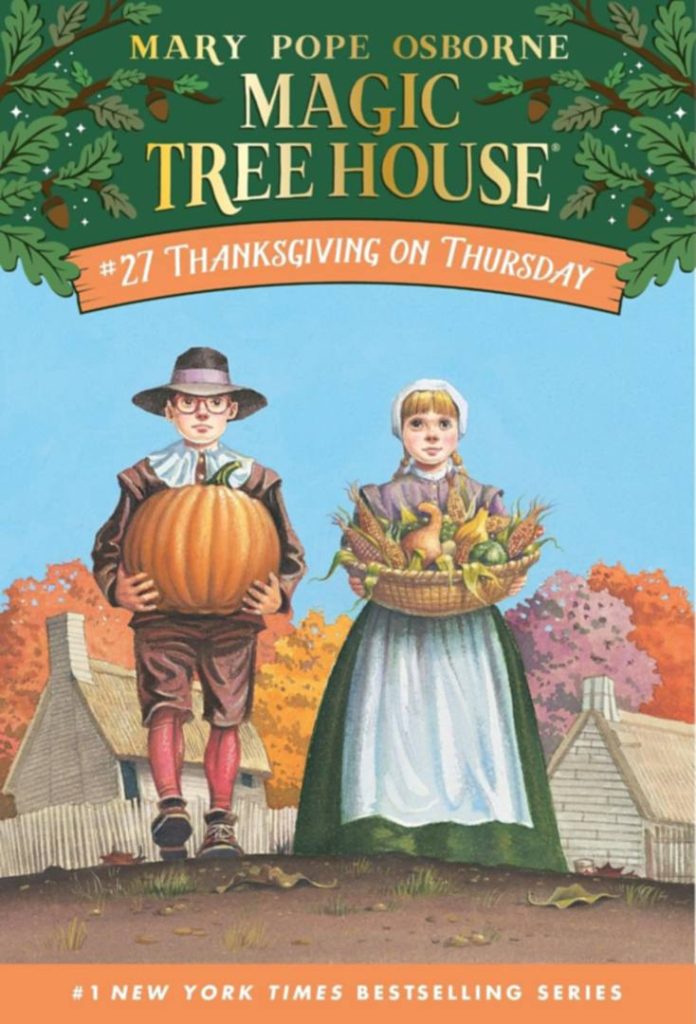
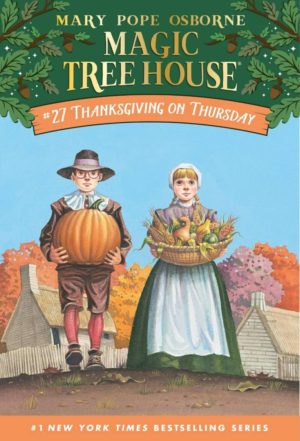
It is Thursday morning in Frog Creek, Pennsylvania, and the family car leaves for Grandmother’s at nine. Annie has a feeling the tree house is back, so she drags her brother into the woods with a promise to be home in ten minutes. A note from Morgan le Fay is waiting, along with a book whose cover shows a basket of corn on a wooden table. One wish later, the children are standing in Pilgrim clothes above a thatched village by the sea. Thanksgiving on Thursday by Mary Pope Osborne frames the oldest school-play story in America with a modern family’s holiday morning, and that frame is the cleverest thing about it.
Where It Sits in Mary Pope Osborne’s Series
This is the twenty-seventh book in the series that began in 1992 with Dinosaurs Before Dark, and the third of a four-book arc in which Morgan sends Jack and Annie to learn a special kind of magic. Each trip ends with a small keepsake left on the tree house floor. In order, the arc runs:
- Stage Fright on a Summer Night (#25), where a London playhouse supplies the magic of theater and a pair of scrolls.
- Good Morning, Gorillas (#26), whose cloud forest teaches the magic of animals and leaves behind a twig.
- Thanksgiving on Thursday (#27), this one.
- High Tide in Hawaii (#28), which closes the arc and the first great stretch of the series.
After Thanksgiving on Thursday by Mary Pope Osborne and its Hawaiian sequel, Christmas in Camelot opens the longer Merlin Missions books. We have not yet reviewed any of the other titles, so they appear here in plain text. A companion nonfiction guide, the Pilgrims volume of the Fact Tracker line, pairs with this book for children who want the history straight.
What Thursday in Plymouth Adds to Mary Pope Osborne’s Quartet
The earlier quartet entries were about watching and imitating. This one is about work. Morgan’s rhyme asks the children to gather together once the toil is done, and Thanksgiving on Thursday by Mary Pope Osborne spends most of its ten short chapters showing how badly two modern kids handle that toil. Sent to the shore for seafood, they wade into freezing water, Jack grabs an eel with both hands, and both children end up soaked and empty-handed. Asked to bring the bird to the table, Jack touches a scalding spit handle and drops the roast into the fire.
What works
- The research book does the teaching. Every few pages Jack checks the index of the book Morgan left, and a short passage set in bold type explains roots, herbs, fowling or the Mayflower crossing. It is a gentle way to build vocabulary without stopping the story.
- The comedy is pitched perfectly for seven-year-olds. The best joke turns on the word arms: told the men will exercise their arms, Jack starts flapping his own, seconds before a volley of muskets goes off.
- Grief is allowed in. A young Pilgrim woman tells the children how sickness took half the colony the winter before. Osborne keeps it to a few lines, but it lands, and it sets up the closing conversation about why the settlers felt thankful at all.
- The back matter is genuinely useful. It explains that Roosevelt moved the holiday to the fourth Thursday in 1939, gives the meaning of Wampanoag as people of the first light, and reveals that the little girl Mary is based on Mary Allerton, the last surviving Mayflower passenger.
- Sal Murdocca’s grayscale wash vignettes add warmth, and the full-page plate of Jack dangling upside down from a hunting trap will be the most-studied picture in the book.
Where It Gives Ground
- Massasoit never speaks. In Thanksgiving on Thursday by Mary Pope Osborne the Wampanoag leader arrives with ninety men, his face painted, and the plot moves on. The Wampanoag hunt, sit at the tables and drum in the distance, but only one Native character gets lines, Tisquantum, better known as Squanto, and his role is to help.
- The language is of its time. The text uses Indian where a book written today would use the nation’s name throughout, and the feast reads as pure harmony, with the governor’s toast to three worlds made one. Parents may want to add context about what followed for the Wampanoag.
- The slapstick repeats. Misunderstood modern slang, a lie about sailing with John Smith and a string of accidents carry most chapters. By the burned roast, older readers will see the pattern coming.
Do You Need the Earlier Books?
No. Thanksgiving on Thursday by Mary Pope Osborne explains the tree house in a one-page prologue, and the quartet’s keepsakes are a light thread rather than a plot. Reading #25 and #26 first adds a small pleasure when the scrolls and the twig appear, but a child can start here in November and lose nothing.
Read These Next
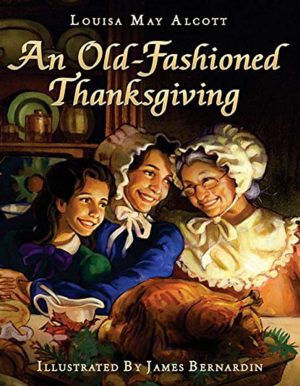
- An Old-Fashioned Thanksgiving by Louisa May Alcott, a nineteenth-century holiday story about children cooking the feast themselves, ideal for reading aloud to the same age group.
- Keepunumuk: Weeâchumun’s Thanksgiving Story by Danielle Greendeer, Anthony Perry and Alexis Bunten, a Wampanoag-authored picture book that fills the gap this one leaves.
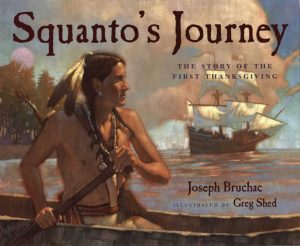
- Squanto’s Journey by Joseph Bruchac, for the same man’s life told in his own imagined voice.
- More titles for this age, from early readers to classics, are in our guide to the best children’s books.
- When the tree house runs out, the Percy Jackson and the Olympians series is the natural next adventure for older readers.
About Mary Pope Osborne and Sal Murdocca
Osborne, born in 1949, grew up in a military family that moved constantly, including a spell in Salzburg, Austria. She studied drama and then religion at the University of North Carolina, and she wrote picture books, novels and myth retellings for a decade before the tree house arrived. Thanksgiving on Thursday by Mary Pope Osborne came out in 2002, ten years into the series.
- The idea for the tree house came to her on a walk in the Pennsylvania woods with her husband, Will, when they spotted one in a tree.
- The series had sold more than 134 million copies worldwide by 2017.
- Sal Murdocca illustrated the American editions from the first book until 2016, when AG Ford took over.
- She has said she models her sentences on Hemingway, aiming to keep them simple and direct.
The Last Word
This is not the definitive children’s book about 1621, and it does not try to be. It is a funny, fast and kind adventure that gets a young reader thinking about where the holiday came from and what gratitude costs. On the walk home Annie and Jack decide that if the settlers could be thankful after that winter, they ought to manage it too. Thanksgiving on Thursday by Mary Pope Osborne sends them off to Grandmother’s on time, with a pouch of seed corn left behind on the tree house floor, and that is a fine way to start the holiday.