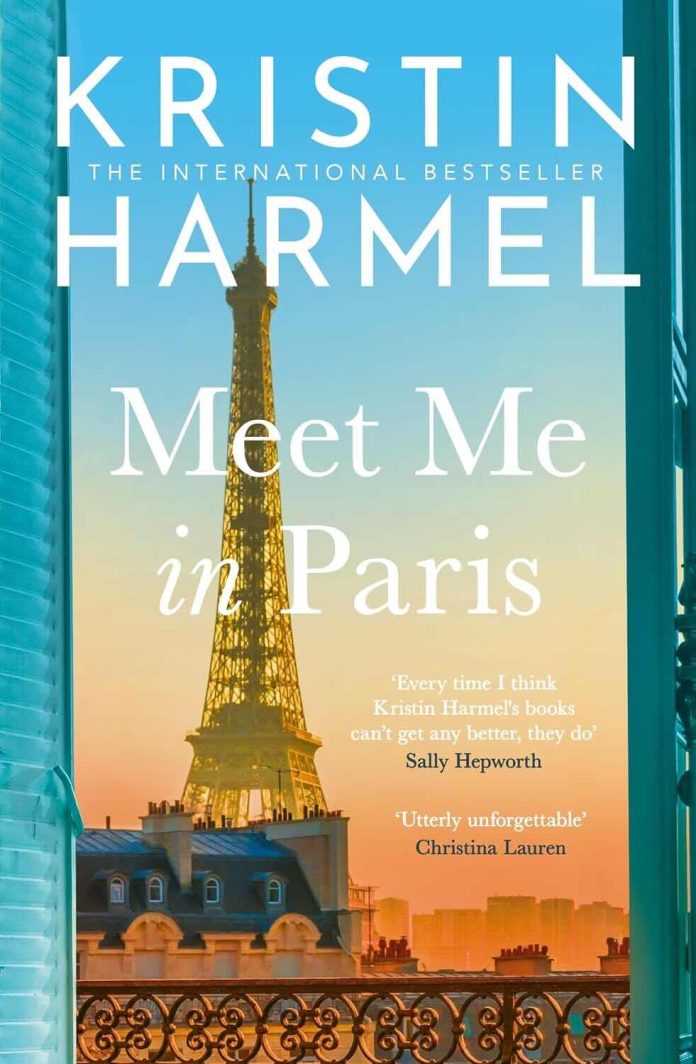
Some novels want you to think. This one wants you to feel, and it makes no apology for that. Meet Me in Paris by Kristin Harmel gathers a cluster of Americans in the French capital across a single spring week and lets their lives graze against one another the way strangers do at a crowded café, close enough to change everything without quite noticing. If you have ever walked a foreign city and wondered about the private histories carried by the people passing you on a bridge, this book hands you several of them at once.
A Familiar Recipe, Baked Fresh
Harmel has said she wanted to write something in the spirit of Love Actually, and the shape is right there on the page: separate stories that overlap, cross, and quietly feed one another until the city itself starts to feel like the matchmaker. What lifts the book above simple homage is the second flavor folded into the batter. Beneath the present-day romance runs a wartime thread that reaches back to 1943, and this is where the author’s long career in historical fiction shows its hand. The effect is like a bright spring afternoon that turns, without warning, into something that catches in your throat.
Meet Me in Paris by Kristin Harmel also marks a genre shift for her. Readers who know her for wartime novels will recognize the Paris streets and the ache of a lost love, but the setting here lives mostly in the present, phones and reunion tours and all.
The People You Will Sit Beside
The pleasure of an ensemble is meeting the cast, so here is who you come to know, with nothing important given away:
- Julia and Piper, a mother and daughter on a trip that means far more than either says aloud.
- Henry McGee, a songwriter who has spent a lifetime writing music for one love he lost long ago.
- Melanie, an American in Paris staring down a marriage that no longer fits the woman she has become.
- Jackson Quick, a fading rock star chasing a comeback and, in secret, something gentler.
- A widowed veteran, a woman fleeing a bad decision, and a pair of young dreamers by the Seine, each carrying a private story of their own.
What Kristin Harmel Gets Right
The strongest thing about this novel is how fully it sets you down in the city. You can smell the bread, hear the scrape of café chairs, feel the cool of a stone wall by the river. Harmel spent time in Paris as a young woman, and that first-hand affection gives the descriptions a warmth no guidebook could fake.
A few strengths stand out clearly:
- Paris as a full character. The streets, cafés, and light are drawn with obvious love rather than postcard shorthand.
- The wartime storyline. Henry’s decades-old love story is the emotional spine of the book, and it lands with real force.
- An honest look at mortality. One thread deals with terminal illness, and Harmel, who has written openly about her own cancer diagnosis, treats it with tenderness instead of melodrama.
- True ease of reading. Short chapters and unfussy prose keep the pages turning.
- A wide idea of love. Romance is only part of it. Friendship, parenthood, and learning to choose yourself all get room to breathe.
Where the Book Wobbles
An ensemble is a high-wire act, and this one does not clear every step. Spreading attention across so many couples means a few of them feel thin. One or two romances kindle and settle so fast that you may wish the author had lingered instead of hurrying on to the next thread.
Honest readers will likely bump against these points:
- Some stories get shortchanged. With this many arcs in play, a couple of them read more like sketches than finished portraits.
- Coincidence does heavy lifting. A mistaken-identity setup and a few tidy overlaps ask you to accept a great deal of luck in one small city.
- The sweetness runs high. Certain endings tie off so neatly that the bittersweet notes elsewhere start to feel safer than they should.
- The opening juggles a lot. Rapid shifts between so many viewpoints can feel crowded before you settle in.
- A thin antagonist or two. At least one character exists mainly to be wrong, and never grows past it.
None of this sinks the book. These knocks simply keep a lovely, generous novel from being a flawless one, which is why it sits so comfortably in four-star company for most readers rather than at the very top.
Harmel’s Voice on the Page
Harmel writes the way a kind friend tells a long story over a second glass of wine. Her sentences are plain in the best sense, direct and unshowy, and she trusts feeling over cleverness. That choice is both the charm and the ceiling of the book. When it works, you forget you are reading. When it leans too hard on sentiment, you can sense the author reaching for your tear ducts. Most of the time, she earns the emotion fairly.
Who Will Love It, and Who Might Not
This one is easy to match to the right reader.
Reach for it if you enjoy:
- Sweeping, emotional romance in the vein of Nicholas Sparks.
- Braided, many-character stories like the film Love Actually.
- Books that treat Paris as a place worth falling for.
Think twice if you prefer:
- Tight, single-focus plots with no loose ends left dangling.
- Grit and moral gray areas over hope and warmth.
- Romances that steer clear of a neat bow.
Before and After: What to Read Around It
If Meet Me in Paris by Kristin Harmel is your first taste of the author, her back catalog runs deep. Her historical novels include The Book of Lost Names, The Winemaker’s Wife, The Paris Daughter, The Stolen Life of Colette Marceau, The Sweetness of Forgetting, and The Room on Rue Amélie, while The Life Intended offers an earlier contemporary read, and her career began years ago with the rom-com How to Sleep with a Movie Star.
For books that share this one’s mood, try:
- The Notebook by Nicholas Sparks, for the same devotion that outlasts memory itself.
- One Day in December by Josie Silver, for warm, fate-nudged romance.
- The Paris Library by Janet Skeslien Charles, for love and wartime history in the same streets.
- Beautiful Ruins by Jess Walter, for interwoven lives that stretch across decades.
- The Little Paris Bookshop by Nina George, for a tender French wander with a bruised heart at its center.
The Last Word
Meet Me in Paris by Kristin Harmel is a soft place to land. It is a book about second chances, about telling the truth before the clock runs out, and about how a single week in the right city can quietly rearrange a life. It asks little of you beyond an open heart and a willingness to be moved. Give it that, and it gives back generously. Come for the romance, stay for the ache underneath it, and do not be surprised if, by the final page, Meet Me in Paris by Kristin Harmel has you glancing at flights of your own.







