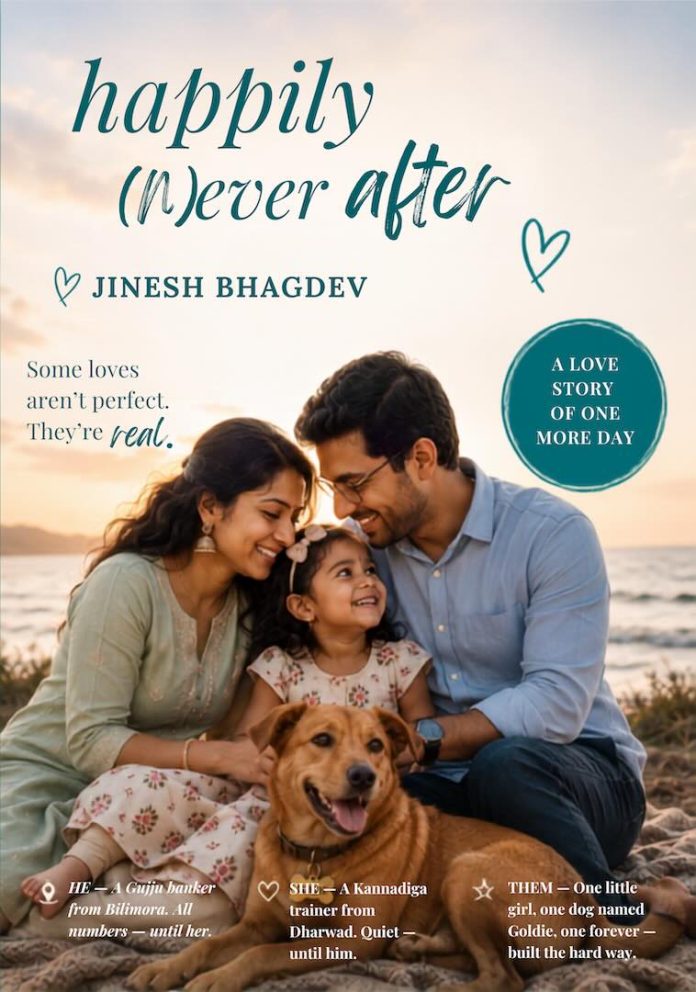
Most love stories count in years. This one counts in kilometres, in minutes, in cups of chai. happily (n)ever after by Jinesh Bhagdev opens with a man who times his dawn runs to the second and a scruffy indie dog who is already waiting at the door before the alarm rings. By the time the last page arrives, you have learned to count the way these characters do: one more walk, one more morning, ek aur.
I read a lot of contemporary Indian romance, and a lot of it runs on familiar fuel: meet-cutes, family opposition, a dramatic airport chase. Bhagdev’s debut has some of that texture, but it is doing something quieter and braver. It asks what love looks like when there is no grand gesture left to make, only the next ordinary day to show up for.
At a Glance
- Genre: Contemporary romance, emotional literary fiction
- Setting: Mumbai, Pune, Rishikesh, Dubai, Ladakh and small-town Gujarat
- Published: June 2026 (independently, Kindle)
- Best for: Readers who like slow-burn love, found family and a book that stays with them
- Keep nearby: Tissues, and possibly a dog to hug
The Story, Without the Spoilers
Viyaan Kotecha is a home loan banker from Bilimora who leaves office at 5:30 sharp, hits his targets by the twentieth of every month, and has never once in his life picked “truth” over “dare.” His rescue dog Goldie, adopted as a frightened, chain-scarred puppy, is the one soft spot in a life built on systems.
Meera is a soft-skills trainer from Dharwad, calm where he is loud, and first seen through Goldie’s eyes: the dog remembers her before Viyaan does. A WhatsApp group of near-strangers throws them together on an adventure trip to Rishikesh, and from bungee platforms to campfire chai, something begins that neither of them is quite ready to name. Every time he pushes for one more, she answers the same way: maybe next time.
Then life changes the plan. I will stop there, because the book deserves to be discovered the way it was written, one chapter at a time.
The People You Will Carry Home
Viyaan: The Man Who Counts
Viyaan could easily have been an unlikeable hero. He is cocky, allergic to overtime and happy to tease colleagues about it. Bhagdev slowly peels back why he needs everything measured, and the reason is tied to a childhood refusal that he still carries. His arc is less about becoming a better boyfriend and more about learning to say what he actually wants.
Meera: Quiet Until It Matters
Meera is the book’s real revelation. She reads rooms for a living, recites the Vishnu Sahasranama before her morning coffee, and eats raw onion like an apple because her mother did. She takes the first step, every time. Her restraint is never weakness; it is a different kind of courage, and the novel treats it with deep respect.
Goldie: The One Who Knew First
Goldie is not a cute accessory. Bhagdev writes this dog with an observer’s precision: the tail that drops half an inch, the nose pressed to crate wire, the shake that “always started at the head.” Anyone who has loved a rescue animal will recognise every gesture. Some of the book’s most moving pages have no human dialogue at all.
The Chosen Family
Around the couple sits a cast that feels lived in. Khushi, Viyaan’s sharp, practical younger sister, steps up in ways that quietly break your heart. There is the “loud one,” the “quiet one” and the Rajmachi girl from the WhatsApp group, a sulking Labrador at the daycare, and parents on both sides who love in their own stubborn dialects.
How Bhagdev Writes: Craft and Style
The prose is short, rhythmic and clipped, often sentence fragments stacked like beats. It suits a hero who thinks in numbers, and it gives the emotional scenes room to breathe. Nothing is over-explained. A heart rate, a stopwatch time or a missed antacid does the work that a paragraph of feeling would do in a lesser book.
A few choices stood out to me:
- Recurring motifs that earn their payoff. Ek aur, maybe next time and the 5:30 exit begin as habits and slowly become the book’s emotional spine.
- An outside narrator. Short first-person interludes from Raghu, Viyaan’s gruff boss, frame the story. They add perspective, guilt and a surprising amount of grace.
- Language as texture. Gujarati, Kannada, Hindi and Mumbai Hinglish sit side by side. A running joke about a Tamil film line at a dinner table does more for the cross-cultural theme than any lecture could.
- Place with purpose. The Ganga aarti at Haridwar, a reef off Dubai, a star-soaked night in Leh and the lanes around a Malad temple are written with sensory care, and each location marks a shift in the relationship.
This is where happily (n)ever after by Jinesh Bhagdev separates itself from standard romance. The tension is rarely about whether these two like each other. It is about whether a man who has built his identity on dares can learn to tell the truth.
Themes Worth Sitting With
- Devotion over drama. Love here is packed tiffins, pill organisers and pre-dawn walks, not declarations in the rain.
- Faith, doubt and bargaining. Temples, prayer and a dog-versus-God childhood wound are handled with nuance rather than sermon.
- Family expectations. Arranged-match pressure, parental fear and a sister’s quiet loyalty feel authentically Indian.
- The dignity of the body. Fitness, pride and physical limits are explored with real honesty.
- Chosen family. Friends, colleagues and one determined indie dog become as important as blood.
A Note on Authenticity
The copyright page describes “happily (n)ever after” as fiction drawn from lived experience and real events, and the dedication thanks two doctors by name. The author’s closing note makes clear how personal this story is. You can feel it in the details: the hospital forms, the family waiting room, the small logistics that only someone who has lived them would think to include. That lived knowledge is the book’s quiet authority.
Why It Works
- The romance builds slowly and believably, through small acts rather than speeches.
- The humour (banter over whiskey, a dog branded an “opportunist” over paratha) keeps heavy chapters from sinking.
- The dog’s point of view is emotionally precise without ever becoming sentimental.
- Supporting characters get genuine arcs, not just walk-on roles.
- The title is honest. It promises a different kind of ending, and it delivers on that promise with care.
About the Author
Jinesh Bhagdev is an Indian novelist who, in his own words, writes about people who are easy to overlook. happily (n)ever after by Jinesh Bhagdev is his first novel, so there is no earlier backlist to compare it with, but it reads like the work of someone who has been storing up these observations for a long time.
If You Loved This, Read These Next
- I Too Had a Love Story by Ravinder Singh: another Indian love story told with raw, personal honesty.
- The Fault in Our Stars by John Green: humour and heartbreak sharing the same page.
- Me Before You by Jojo Moyes: love tested by the limits of the body and hard choices.
- 2 States by Chetan Bhagat: a lighter take on a cross-cultural Indian couple and two very different families.
- A Walk to Remember by Nicholas Sparks: a quiet, faith-touched romance about showing up.
- Marley & Me by John Grogan: for anyone who knows a dog can hold a family together.
Final Verdict: Should You Read It?
If you want a breezy weekend romance, this is not it. If you want a love story that respects your intelligence, makes you laugh at a campfire and then sits with you through the hard hours, happily (n)ever after by Jinesh Bhagdev is one of the most sincere Indian debuts I have read this year. It will not give you a fairytale. It will give you something better: the reminder that the ordinary days were the story all along.
Read it slowly. Then go hug someone. Ek aur.







ever after by Jinesh Bhagdev review: a funny, aching contemporary romance about choosing each other on ordinary days. Spoiler-free)