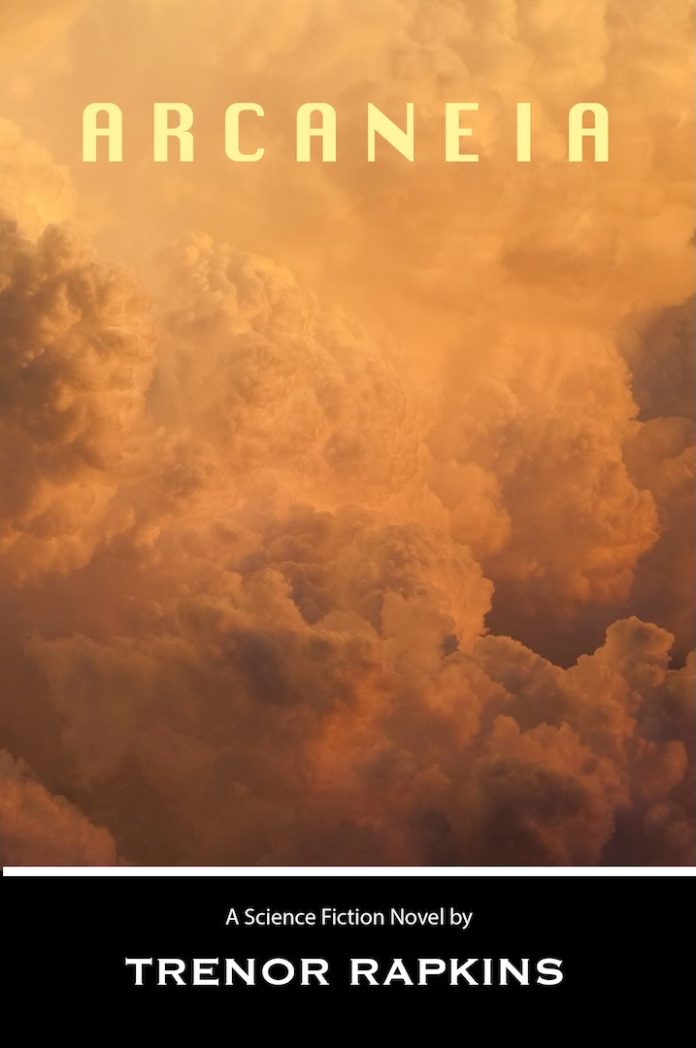
Sergeant Joseph Lang stands on a loading dock in the southern Utah desert, watching hazmat-suited workers move barrels he is not allowed to ask about. Behind him, autonobots hum. Ahead of him, a poisoned landscape waits with militias, drones, and a sky that never quite clears. He is good at his job. He believes in his employer. And he takes his Felipax and tells himself everything is going to be okay. That opening image sets the tone for Arcaneia by Trenor Rapkins, a novel that is less interested in blowing things up than in asking why we ever agreed they should be blown up in the first place. It is a dystopia and a utopia placed side by side, and the space between them is where the real story lives.
What the Story Is About
The premise is simple and sturdy. Joe serves in the private army of the Liberty Conglomerate, a corporation that has swallowed what remained of American government after nuclear war. Its president, the age-defying John Fredersen the Third, rules Liberty City from behind domes, slogans, and a news anchor who never seems to blink.
When a desert patrol goes badly wrong, Joe is left injured and alone. He is found by a band of scavengers who blindfold him and carry him somewhere they would rather he not remember. That somewhere is Arcaneia, a hidden settlement in the Colorado mountains with clean water, a public library, a nine-member council, and no interest whatsoever in Fredersen’s version of history.
What follows is a story of slow unlearning. The book does not hand Joe the truth on a plate. He resists it, resents it, and finally sits alone by a fire to examine his own past honestly. Where that examination leads him, and what it costs, is best discovered on the page.
The Two Worlds of the Novel
Rapkins builds his settings as moral arguments, and the contrast between them is the engine of the book.
Liberty City: The Comfortable Cage
- Middle-class domes with looped sky screens and scheduled artificial rain every Monday afternoon
- A slum outside the walls, ruled by gangs, vigilantes, and rumors of men in balaclavas who make people disappear
- A private prison where everyone is presumed guilty and justice is reserved for those who can afford it
- A slogan chanted in a megadome: “Liberty! Loyalty! Strength!”
Arcaneia: The Protopia
- Elected leaders who must pass courses in “truth and virtue” before running for office
- A Truth Court that sorts claims into confirmed, speculative, and false
- Rehabilitation instead of pure punishment, and a citizenship oath taken in a stone chamber called the Tholos
- Honey cake instead of sugar, echinacea tea instead of pills
The Arcaneians refuse to call their home a utopia. They prefer “protopia,” a society that improves gradually and admits it is unfinished. That small distinction tells you a great deal about the author’s outlook. He is not selling perfection. He is arguing for humility.
Character Analysis: Joe Lang’s Long Walk Inward
Joe is the heart of the novel, and he works because he is not an easy convert. He is a decorated soldier, a jiu-jitsu purple belt, a man grieving a fiancée he lost to illness, and someone who has quietly medicated his trauma for years. When a council member named Thea tells him the war he fought was manufactured, his first instinct is to defend his employer.
The campfire chapter where Joe interrogates his own memories is the strongest passage in Arcaneia by Trenor Rapkins. It reads like a man auditing his life line by line: the newsman’s warnings about the “intellectual elite,” the rally in the megadome, the friends lost in combat, the suspicious deaths of critics. Rapkins lets the realization arrive slowly, and when it lands, it carries real weight.
The supporting cast gives the book its warmth. Maria, the doctor who treats Joe, is grounded, funny, and endlessly curious about black holes and goulash recipes. A parallel thread follows Lamont, Rana, Kai, Critter, and Diego, factory workers in the slum who dream of escaping a life that is slowly poisoning them. Their banter about the meaning of life over cheap whiskey is some of the most human writing in the book, and their storyline gives readers a ground-level view of the system Joe once protected.
Themes That Stay With You
- Manipulation and consent. The novel borrows Aldous Huxley’s warning about people who come to love their servitude, and builds an entire society to illustrate it.
- Truth as a civic practice. Thea’s two questions, “Is it factual and is it ethical?”, become the moral compass of the book.
- Healing over numbing. Felipax is the quiet villain here, a pill that keeps grief and doubt at a manageable distance.
- Self-mastery. Joe’s growing refusal to answer provocation with violence is drawn from Spinoza, the Dhammapada, and Confucius, and it shapes how he behaves when the stakes rise.
Writing Style: Plain Present Tense, Big Ideas
Rapkins writes in a steady, present-tense, declarative voice. Sentences are clear and unhurried. Action scenes are precise rather than flashy, describing smart bullets, jet-bikes, and invisi-shields with the patience of a technical manual. Quiet scenes linger on small things: a cat named Georgy grooming himself, a pale evening primrose handed over without a word.
The book also wears its reading list proudly. Thoreau, Rousseau, Lao Tzu, Eckhart Tolle, Socrates, and the Gospels all pass through Joe’s hands. Readers who enjoy idea-driven fiction will find this one of the novel’s pleasures, because the philosophy is woven into Joe’s recovery rather than delivered as a lecture.
There is a rewarding layer for film lovers, too. The tyrant is named Fredersen, the wise councilwoman is Thea, and a kindly neighbor is Mrs. Harbou. Anyone who knows Fritz Lang’s Metropolis, written by Thea von Harbou and featuring the industrialist Joh Fredersen, will recognize a deliberate tribute, and even the hero’s surname, Lang, joins the joke. It is a clever signal that Arcaneia by Trenor Rapkins sees itself in conversation with the oldest stories about cities split between masters and workers.
About the Author and His Earlier Work
Trenor Rapkins is an artist as well as a writer. He studied art at The School of the Museum of Fine Arts in Boston, and writing at the Attic Institute in Portland, Oregon, where he lives and belongs to the Willamette Writers group. That painter’s eye shows in his landscapes of rust-colored mesas and glowing domes.
His previous books share a clear thread with this one:
- The Lords of Invention (2021): a digitally painted graphic novel about two inventors in New York just after the turn of the previous century.
- The Philosopher Kings (2026): a novella set in 404 BCE, when the Thirty Tyrants replace Athenian democracy and exiles under Thrasybulus rebel to restore it, drawing on the philosophy of Socrates.
Read together, these books show an author preoccupied with oligarchy, ambition, and the fragile work of keeping a free society honest. Arcaneia by Trenor Rapkins carries that preoccupation into the future.
Who Should Read It
- Readers who prefer reflective science fiction over nonstop action
- Fans of classic dystopias who want a story that also imagines an alternative
- Book clubs looking for a novel that sparks conversation about media, power, and responsibility
- Anyone drawn to redemption arcs built on honest self-examination
Similar Books You May Enjoy
- Brave New World by Aldous Huxley, for its study of pleasure as a tool of control
- Island by Aldous Huxley, Huxley’s own answer to his dystopia
- Nineteen Eighty-Four by George Orwell, for propaganda and rewritten history
- Metropolis by Thea von Harbou, the direct ancestor of Liberty City
- The Dispossessed by Ursula K. Le Guin, for its honest look at an imperfect better society
- Parable of the Sower by Octavia E. Butler, for survival and community-building after collapse
- Ecotopia by Ernest Callenbach, for a hidden, ecologically minded republic
Final Thoughts
Arcaneia by Trenor Rapkins is a sincere, thoughtful novel about a man who discovers that the walls around his city were also built around his mind. It trades spectacle for conscience and cynicism for cautious hope. If you have ever finished a dystopia wishing it had shown you a way out, this book is written for you.