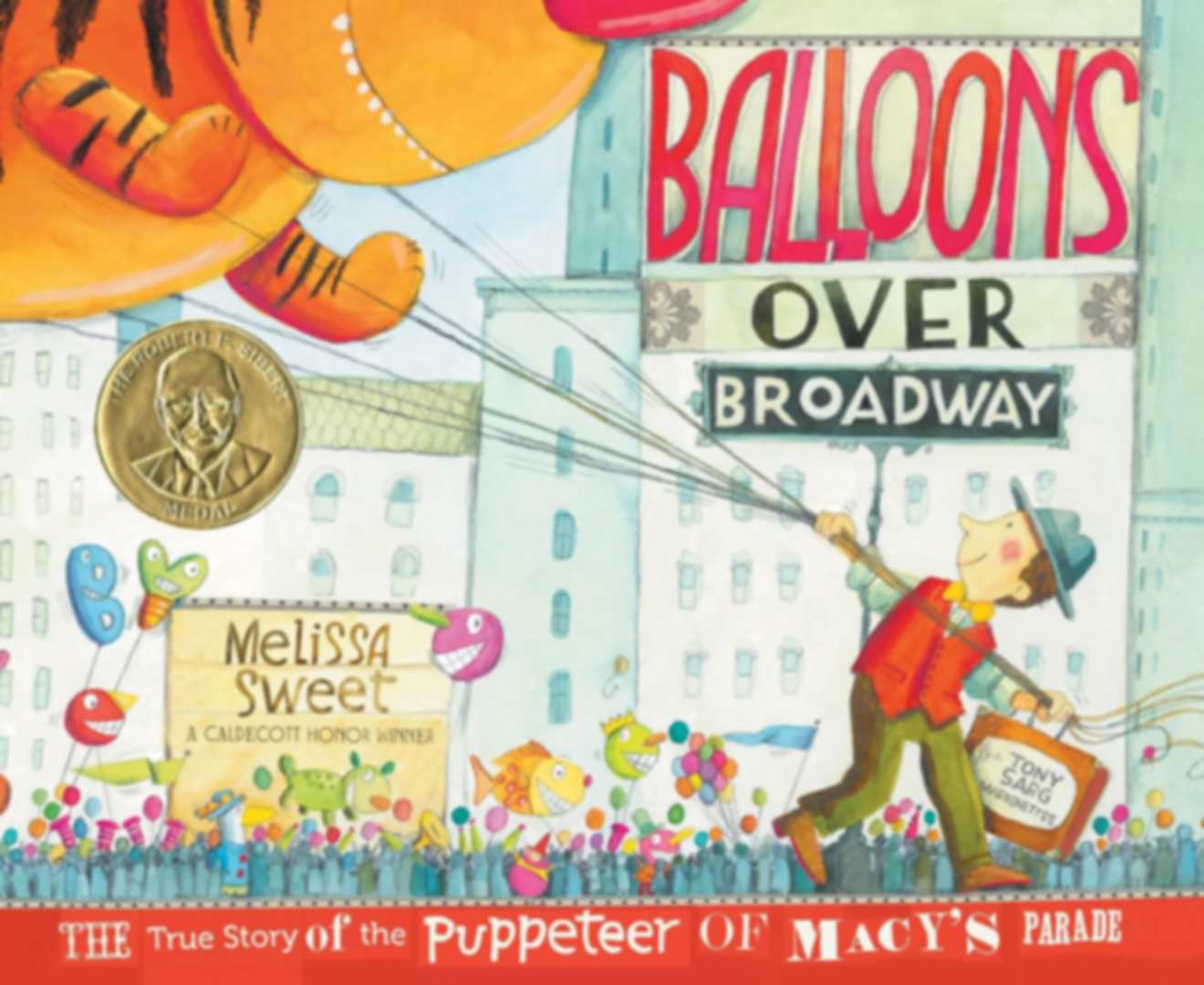



With a marionette, the strings run from a wooden control in the puppeteer’s hand down to the figure, which hangs and dances below. Turn that arrangement over, put the handlers on the street and fill the figure with helium, and the puppet floats above them instead. That single inversion is the engine of Balloons Over Broadway by Melissa Sweet, and the book builds toward it the way an inventor would: one problem, one fix, one new problem at a time.
The timing for a revisit is good. This November brings the 100th Macy’s Thanksgiving Day Parade, the count running a little behind the calendar because the parade stopped for three wartime years. Balloons Over Broadway by Melissa Sweet, first published in 2011, is still the best explanation a child can get of where those giant balloons came from.
How Balloons Over Broadway Works
The text is a chain of puzzles, and each spread solves one. A boy who hates his six-thirty chicken chore rigs pulleys so the coop door opens from his bed. The grown man makes lifelike marionettes in London, then moves to New York, where Macy’s hires him to animate its holiday windows. When the store stages a Thanksgiving parade in 1924, live zoo animals march in it; when lions and tigers join later, they frighten the children. Sarg needs puppets big enough to replace them, light enough to carry and tough enough for November weather.
So he tries rubber bags on sticks, finds the crowds are now too deep to see them, and finally flips the marionette principle. In Balloons Over Broadway by Melissa Sweet the logic stays transparent enough that a seven-year-old can predict the next step, which is exactly what good informational writing for this age should do.
Balloons Over Broadway Shows Its Working
The real argument of Balloons Over Broadway by Melissa Sweet is visual. Sweet’s art note explains that she began by making toys and puppets herself, then photographed them alongside watercolour drawings, scraps of old books, fabric and found objects. The result reads like Sarg’s workbench, and it teaches engineering without a single lecture.
What works
- The diagrams do the explaining. The chicken-coop rig appears as a numbered pencil plan with arrows, a format children can copy at the kitchen table. Later a blimp sketch carries the instruction to build from simple shapes glued together.
- The Humpty Dumpty work order. Sarg’s commission for the Macy’s windows is drawn as a dated studio ticket, with cut, sew and build lists, colour swatches and a shirt pattern. It turns an abstract job into a visible process.
- Collage lettering carries the big ideas. The page that asks what would happen if the controls sat below the puppet is built from mismatched cut-out letters, so the breakthrough looks like a thought being assembled.
- The sideways spread. When the balloons finally go up, readers must turn the book on its side, and the page becomes a street seen from below. It is the moment every read-aloud audience remembers.
- The back matter is generous. An author’s note, a note on the art, a bibliography, a list of quote sources, a photograph of Sarg in the Goodyear hangar and a 1933 newspaper advertisement for the parade on the endpapers.
Where It Gives Ground
- The timeline is squeezed. The main text dates the first parade but not the stick-propped balloons of 1927 or the helium debut of 1928; children need the note to place them.
- The credit falls on one man. Goodyear workers appear in the pictures, yet the apprentice who built the 1928 balloons, Bil Baird, enters only in the note, and for a different achievement.
- A small slip in the note. It says balloons were absent for two war years; the parade was in fact suspended from 1942 to 1944.
None of this dents the pleasure, but a teacher using Balloons Over Broadway by Melissa Sweet for a history unit should add the dates on the board.
Read These Next
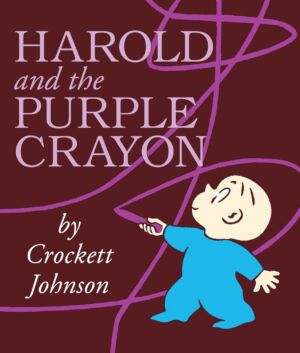
- Harold and the Purple Crayon by Crockett Johnson, for another child who makes the world move by inventing it.
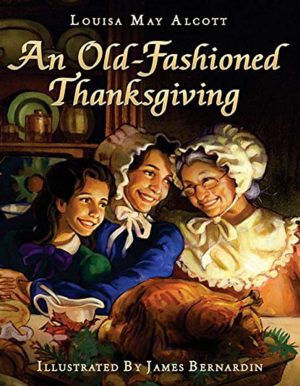
- An Old-Fashioned Thanksgiving by Louisa May Alcott, for an older, gentler holiday story to read aloud the same week.
- Milly and the Macy’s Day Parade by Shana Corey, a fictional immigrant-family take on the same parade, listed in Sweet’s own sources.
- Thank You, Sarah by Laurie Halse Anderson, for the woman who campaigned to make Thanksgiving a national holiday.
- The Right Word by Jen Bryant, illustrated by Sweet, for her collage method applied to Peter Mark Roget.
About Melissa Sweet, Writer and Illustrator
Sweet both wrote and illustrated Balloons Over Broadway by Melissa Sweet, and its research shows: the thank-yous name puppetry curators, a balloon designer and Macy’s own counsel. The book won the 2012 Sibert Medal, the American Library Association’s award for the year’s most distinguished informational book for children.
- Born in 1956 in Wyckoff, New Jersey, and trained at the Kansas City Art Institute.
- Her first illustration work was for James Howe’s Pinky and Rex early readers.
- She has two Caldecott Honors, for A River of Words and The Right Word, both written by Jen Bryant.
- This book also took the 2012 Orbis Pictus Award and the 2012 Golden Kite Award for picture book illustration.
- The Eric Carle Museum gave her a Carle Honor in 2019.
A little parade trivia from outside the book: Sarg’s 1928 helium balloons were simply let go at the end of the route, and Macy’s offered a $100 reward to whoever found them once they drifted down. The balloons themselves came from Goodyear in Akron, Ohio, which kept making them for decades.
What Stays With You
The image that lingers is the last one: Sarg as a black silhouette behind a toy theatre, his balloon creatures packed into the frame while little puppets dangle on strings underneath. Sweet’s point, made on every page, is that invention starts as play and stays playful when it grows up. Few picture books explain a machine this clearly, and fewer make the explanation as joyful as Balloons Over Broadway by Melissa Sweet does.