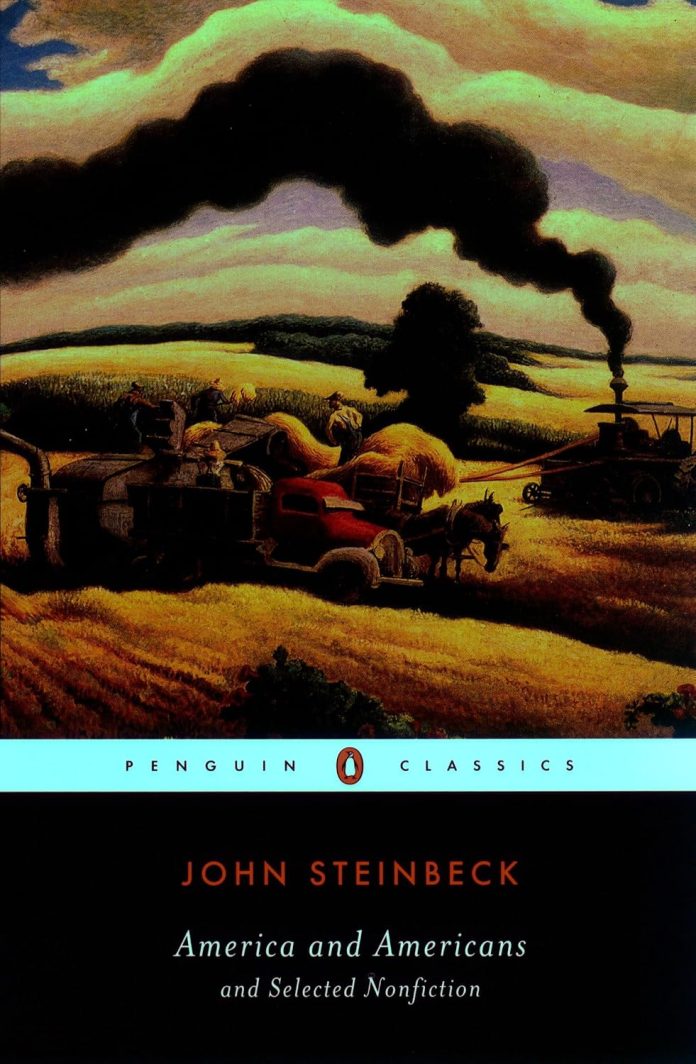
The strongest passage in America and Americans by John Steinbeck is about a woman on East 51st Street in New York. Every summer morning she carried the outdoors down to the pavement: a deck chair, a beach umbrella, two pots of geraniums, an artificial palm, a rolled-out lawn made of green raffia, and a small icebox of soft drinks. She sat in it and nodded at passers-by and she was in the country. Steinbeck, walking past, was so taken with the project that he left a potted fern and a bowl with two goldfish on her table, and was pleased to see both become permanent fixtures.
That is what he means by the American dream. Not the ladder. The raffia.
First, Which America and Americans This Is
A warning before anything else about America and Americans by John Steinbeck, because the title is doing double duty.
The original America and Americans was published in 1966, his last book, nine short chapters written to accompany a book of photographs. The edition now in print is the 2002 centennial omnibus edited by Susan Shillinglaw and Jackson J. Benson, which prints that book complete as its final section and surrounds it with seven more sections of uncollected journalism from 1936 to 1966.
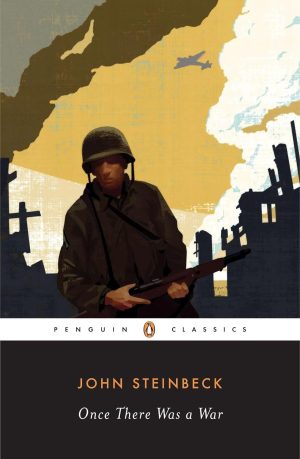
So the title work is roughly a quarter of what you are buying. The rest is essays on Salinas and New York, the 1930s migrant reporting, the Arthur Miller trial, the Nobel speech, obituaries of friends, travel pieces, the last unpublished chapter of Travels with Charley, and the Vietnam letters. It also reprints five dispatches already collected in Once There Was a War, which will annoy anyone who owns that.
What works
- “Paradox and Dream” is the best essay in America and Americans by John Steinbeck. The thesis is that Americans function by contradiction: a people who believe themselves self-reliant mechanics and cannot find a fuse box, who treasure living close to nature and eat out of cans, who are proudly a nation of laws and break every one they can.
- The environmental chapter of America and Americans by John Steinbeck is furious and holds up. Written in 1966, it is about poisoned rivers, a destroyed grove of redwoods he used to walk in, and a market hunter’s three-gauge gun loaded with shingle nails and fired into a lake by a string.
- The first chapter is sharper than its reputation. His account of how immigrant groups were hazed in sequence, each one joining the majority in order to turn on the next arrival, is bleak and convincing.
- The 1930s journalism justifies the surrounding omnibus. The Harvest Gypsies reporting, written before The Grapes of Wrath, shows exactly where the novel came from.
Where America and Americans Gives Ground
- The “Created Equal” chapter has not survived. It contains clear-eyed analysis of white Southern fear and, on the same pages, the claim that emancipation was forced on the South, that freed slaves emerged “blinking and helpless” and constituted a vengeful and untrained enemy, and that the white Southerner then had only self-defence to consider. These are not period infelicities. They are the argument.
- The Vietnam letters are worse than the politics. He went in 1966 at sixty-four, called it the finest army the country had ever had, flew a night mission in an AC-47 gunship nicknamed Puff the Magic Dragon, and reported its three Gatling guns admiringly as a waterfall of fire. His standing on the left never recovered and the dispatches explain why.
- The nine chapters do not hold together. This is a sequence of magazine essays, and the attempt at a unified thesis about comfort destroying nations arrives only in the final one.
- The omnibus is uneven by design. Thirty years of commissioned pieces include duds, and the editors have printed them.
The Argument He Actually Makes
Stripped down, the thesis of America and Americans by John Steinbeck is that the country was never given to anyone.
He is explicit that the high-school-graduation version, in which a golden land was inherited by grateful arrivals, is false. The continent resisted settlement. The people who took it stole and cheated and double-crossed for it, ripped the land, set each family against all other families, and treated every subsequent wave of arrivals abominably. And out of four centuries of that, in defiance of every probability, one people emerged.
The second half of the argument is the one that has dated oddly well. He names the things that destroy nations as comfort, plenty and security, and says that what frightens him is not American anger but the possibility of American satisfaction. A dying people, he writes, tolerates the present and rejects the future and locates its pleasures in half-remembered glory.
Read it if
- You want America and Americans by John Steinbeck for the late nonfiction voice, which is looser, funnier and more combative than the novels.
- You want to trace the route by which a man of the 1930s political left ended up where he was in 1967.
- You would read thirty years of a major novelist’s working journalism and accept that some of it was filler.
Skip it if
- You want the 1966 book on its own, because this edition buries it behind three hundred pages.
- Racial argument that reads as apologia will spoil the rest for you, and it reasonably might.
- You already own Once There Was a War and resent paying twice for five dispatches.
Where America and Americans Sits in the Backlist
America and Americans by John Steinbeck is the end of the shelf. It came out in 1966, two years before his death and four years after the Nobel and the Charley trip.
What is interesting is how much of the late Steinbeck is here that the novels never show. The man who wrote the 1930s labour trilogy is on these pages worrying about young people who distrust all authority. The man who wrote about migrant families is defending the corporation as more efficient than any government. And he is still, in the same volume, the writer who notices the raffia lawn, the geraniums, and a chief of the Piute tribe who climbed Mount Tallac in the snow to give a trout to something he could only describe as a person and an un-person at once.
The omnibus is therefore the most complete portrait available of what he was actually like, which is not the same thing as the best book he wrote.
Content notes
Extended discussion of slavery and segregation using the vocabulary of 1966, including a list of ethnic slurs quoted in full, and passages on emancipation and on Black Americans that read today as apologia for the white South. War reporting from Vietnam written in sympathy with the American campaign, including an admiring account of a gunship mission.
Read these next
- A Literary Analysis of The Grapes of Wrath by John Steinbeck. The novel the migrant journalism in this volume turned into.
- A Literary Analysis of East of Eden by John Steinbeck. The late masterwork, and the same interest in whether character is inherited.
- A Literary Analysis of Of Mice and Men by John Steinbeck. The writer at his most compressed, for contrast with the essayist.
- The Timshel Debate. On moral choice, which is the subject the last chapter here is circling.
Worth Your Shelf
Yes, with two chapters read as evidence rather than argument.
America and Americans by John Steinbeck is the work of a man of sixty-four who had stopped being able to write novels and had not stopped being able to see. When he is looking at a thing, he is still the best observer of his generation: the geranium pots on the pavement, the grove of redwoods that was there one week and slaughtered the next, the trailer parks that developed their own slums within a year.
When he reasons from what he has seen to what it means, he is no longer reliable, and on race he is considerably worse than unreliable. The honest way to read the book is the way he asked readers to read his war dispatches: everything here happened, and the trouble is in the thinking that got laid over it.
He ends by saying his people have taken wrong paths, paused for renewal, filled their bellies and licked their wounds, but never slipped back. Two of his own chapters are the argument against that sentence, and he could not see it.