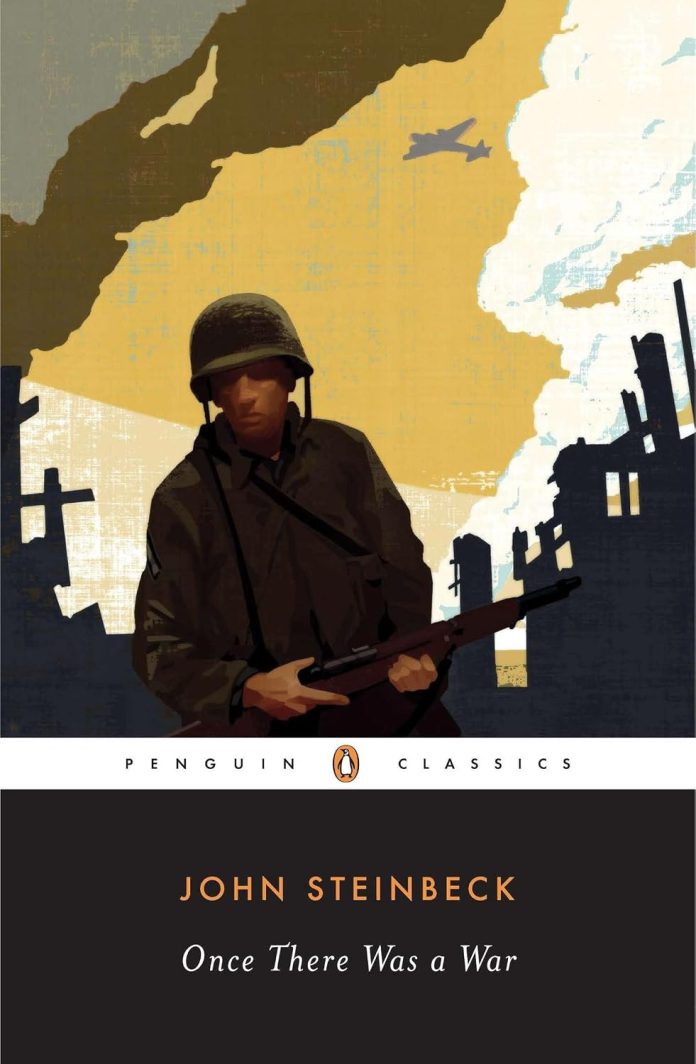
No other book in the bibliography comes with a warning from its own author. Once There Was a War by John Steinbeck opens with a 1958 introduction in which he calls the contents period pieces, says the attitudes are archaic and the impulses romantic, and allows that in the light of everything since, the whole body of work may be untrue and warped and one-sided.
Then he explains why. Everything in the dispatches happened, he says. It is in the things not mentioned that the untruth lies.
What Once There Was a War Actually Contains
Once There Was a War by John Steinbeck gathers fifty-odd dispatches filed between June and December 1943, syndicated by the New York Herald Tribune and collected by Viking in September 1958. Three sections: England, then North Africa, then Italy.
He was forty-one, famous, and by his own description a Johnny-come-lately among professionals who had covered Spain, Ethiopia and the Pacific. Ernie Pyle, he notes, outranked most general officers in the eyes of readers at home. Robert Capa gave him the only combat advice he ever found useful, which was to stay where he was, on the grounds that if they had not hit him they had not seen him. Both men were dead by the time the collection appeared.
What works
- The troopship sequence is the best opening in his non-fiction. Thousands of men in helmets on a dock, indistinguishable, like long rows of mushrooms. A ship that can hear but not speak. Seven rumours that he says circulate on every troopship without exception, which he lists so that a reader will recognise them as folklore.
- The bomber station pieces in Once There Was a War by John Steinbeck are extraordinary. The crew of the Mary Ruth sleeping in bunks emptied three weeks earlier by men shot down, inheriting their pin-up girls and leaving them up because yours would be the same girls. The unmade bed you must leave unmade so you can slip into it when you get back.
- One detail is unimprovable. The ground crews wait on a mound by the hangar for the squadron to come home, and a small dog of ambiguous breed waits with them. Long before any man can see anything, the dog begins to shudder, and then a high whine comes out of him.
- The blitz dispatch understands how memory works. Everybody he asks begins with fire and explosion and ends on one small thing: the flat vicious tinkle of glass being swept up, a pale blue evening slipper thrown clear at a man’s feet, a pair of stockings still pinned in front of a fireplace five storeys up a wall with no building behind it.
Where Once There Was a War Gives Ground
- He states the problem himself and it is a real one. The governing conventions of 1943 held that the American Army contained no cowards, no cruel or incompetent commanders, and no young men with any interest in sex. He observed all three.
- He names two stories he agreed not to file. Patton striking a sick soldier in a hospital, and the US Navy at Gela shooting down fifty-nine of its own troop carriers. Eisenhower asked the correspondents directly, and they complied.
- The censor is visible on the page. One briefing scene simply stops and says that the next three sentences were cut. He writes in 1958 that he has no idea what was in them.
- A dozen pieces are padding. Celebrity visits, a lucky regimental goat with a decoration, a long affectionate profile of a sergeant who can procure anything. Charming, and filler.
- The segregation goes entirely unremarked. Black troops appear repeatedly in Once There Was a War by John Steinbeck, sprawled on a deck singing in the dark, boarding a ship as a separate regiment, and the arrangement is never once treated as worth a sentence.
The Trick He Confesses To
The most interesting admission in the introduction to Once There Was a War by John Steinbeck is a stylistic one, and once you know it you see it everywhere.
He never says he saw anything himself. Every scene in the book is put in somebody else’s mouth: a crew describing a Fortress falling, a man recounting what the blitz was like, soldiers telling a story over flat beer. He says he cannot now remember why he did it. He wonders whether he thought it would be more believable at second hand, or whether he felt like an eavesdropper on the war and was faintly ashamed of being there when the men could not go home and he could.
Whatever the reason, it is why the dispatches outlived the occasion. A reporter saying what he witnessed dates immediately. A reporter transcribing how men talk about what happened to them does not.
Read it if
- You want Once There Was a War by John Steinbeck for the prose, which at its best matches anything outside the four or five novels everybody has read.
- You are interested in how wartime journalism was actually produced, from a man who did it and then explained the rules.
- You like short pieces that each do one thing and stop.
Skip it if
- You want an account of the fighting, because he is almost never near it.
- Admitted self-censorship is a dealbreaker rather than a subject.
- The lighter dispatches about entertainers and lucky mascots will irritate you, and they are a real part of the book.
Where Once There Was a War Sits in the Backlist
Once There Was a War by John Steinbeck is the strangest entry in the list, because it was published in 1958 and written in 1943, and the fifteen years in between are the point.
By 1958 he had done East of Eden and Sweet Thursday and was a Nobel laureate in waiting. He had been to the Soviet Union and come back convinced that the only creative thing a species has is the single lonely mind. He was in a position to look at his own wartime work and see a man who had subordinated his judgement to something he calls the War Effort, with a capital W and a capital E, and who had enjoyed doing it.
So he did not revise. He left the ragged sentences in, because the raggedness is part of the immediacy, and he wrote twenty pages explaining what the ragged sentences were permitted to say. That editorial decision is more honest than anything in A Russian Journal, where the same problem arises and goes unnamed.
Content notes
Aircrew deaths described in detail, including a bomber falling with its crew visible, civilian deaths in the London blitz, a refugee’s suicide during a raid, and racially segregated units and period racial terminology reported without comment.
Read these next
- A Literary Analysis of The Grapes of Wrath by John Steinbeck. The documentary method five years earlier, with the argument he was not allowed to make in 1943.
- A Literary Analysis of East of Eden by John Steinbeck. What he was writing by the time he agreed to publish these.
- A Literary Analysis of Of Mice and Men by John Steinbeck. The same compression, applied to invention instead of reporting.
- The Timshel Debate. On individual moral choice, which is what the 1958 introduction is quietly about.
The Verdict
One of his best books, and almost nobody reads it.
What makes Once There Was a War by John Steinbeck work is the collision between the two voices. The 1943 man is writing propaganda he believes in, beautifully, within rules he has partly invented for himself. The 1958 man knows exactly what that cost and says so before letting you read a word of it.
Neither voice is enough on its own. The dispatches without the preface would be a charming, slightly false artefact. The preface without the dispatches would be an essay. Together they make something rare: an honest book about war reporting written by the reporter rather than about him, and the last fifty pages, in which five men in a whaleboat accidentally capture an Italian island, are the most purely enjoyable thing he ever filed.
He was right that we do not learn from our accidents. He was wrong that the reports should have stayed on the yellowing pages.