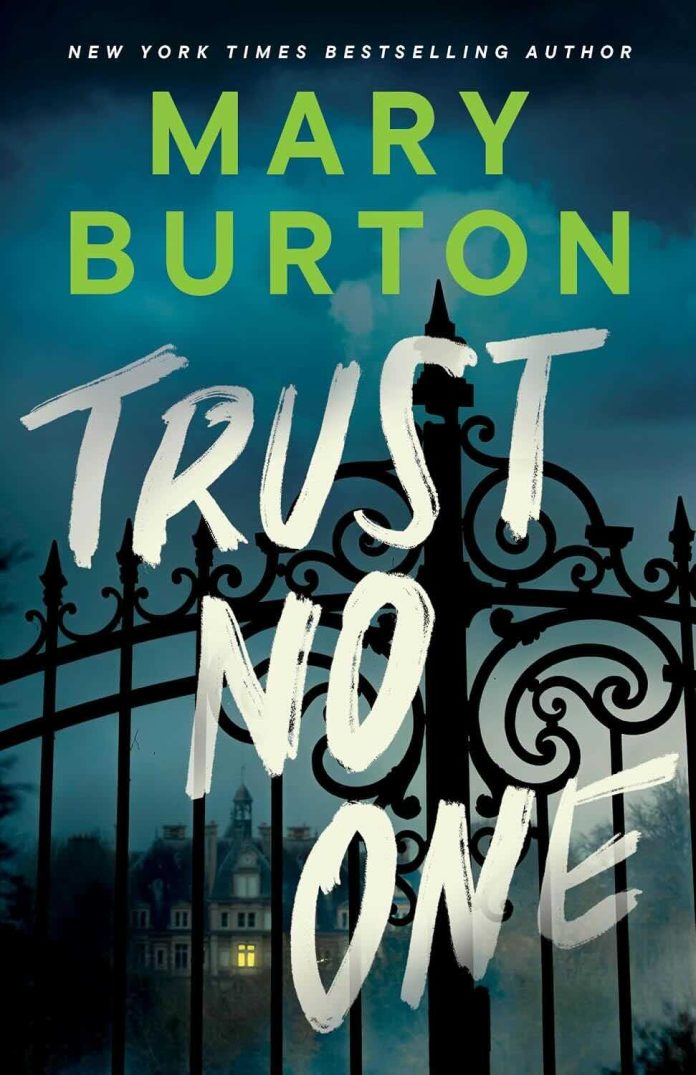
A woman collapses at her kitchen sink after one glass of wine her husband bought as a peace offering. She is thirty-four, a nurse, a distance runner, and she has just finished telling him she knows about the affair. The toxicology screen comes back as hydrogen cyanide. Within five days there are three bodies, all poisoned, and every single person with a claim on one Virginia estate is dead. Trust No One by Mary Burton is built like a clock, and the first thing worth saying about it is how the clock is assembled.
How Trust No One Is Built
Seventy-three chapters in three hundred and fifty-seven pages. Every chapter opens with a hard date and time stamp, sometimes a place as well, and the run begins at midnight on a Wednesday in October and closes in January. You always know exactly where you stand in the week, which matters enormously in a case where cause of death turns on an order of events.
Each chapter also names its point of view in the contents, so the architecture is visible before you read a word. A lawyer narrates about fifty of them in first person. A state police agent narrates roughly fifteen, also first person. A violent former client gets six short third-person interludes. The dying woman gets exactly one, the opening. And one more character gets a single chapter, right at the end. Trust No One by Mary Burton withholds that last allocation until it lands, and the allocation itself is the reveal.
What Trust No One Does With Fourteen Fragments
Spliced between the chapters are fourteen untitled pieces, six to ten lines each, unsigned and in the present tense. Each follows the same shape: a thing the speaker used to believe, then the words “But here’s the truth,” then the correction. Cheaters don’t win, except they do, all the time. Bad people are easy to spot, except they are not, and the speaker notes that monsters look like everyone else. Like me.
That is the whole device, and it works for three reasons. The fragments are short enough never to outstay their welcome. They are flat and unliterary, which keeps them from reading as authorial throat-clearing. And because the speaker is never named, they function as a running unreliable narrator layered over a book that otherwise plays straight. When the voice resolves, all fourteen reverse at once, and the honest test of Trust No One by Mary Burton is that you will want to go back and read them in sequence.
The Child Who Remembers Everything
The best character in Trust No One by Mary Burton is five years old.
Molly’s parents are gone by the midpoint, and the novel does something difficult with her: it treats her as a witness without making her precocious or cute. The information arrives sideways, in the way children actually give it. She draws the same picture twice, a house with two chimneys, three stick figures outside it and one woman alone inside, and will not explain why the family is on the outside. She mentions that her mother never cut the crusts off, but somebody else always did. And she remembers a red bear from the zoo that smelled funny. She remembers a candle, a game of ring around the rosie, and who put the fire out.
Each of those is evidence, and none of it is delivered as a set piece. An interview with her is just a woman making peanut butter sandwiches and asking what shape she wants them cut.
The House Is the Best Character in Trust No One
The estate in Trust No One by Mary Burton is a working antagonist rather than a backdrop. Five hundred acres of Piedmont, a lodge from the mid-1700s extended across two centuries, a walled family graveyard with room already allocated for the narrator, and an avocado-green kitchen a grandmother installed in the 1970s and swore would never go out of style.
It also actively resists being lived in. The hot water runs out after four minutes. A fuse scorches and the furnace dies. The third step from the top creaks, so the narrator has spent her life stepping over it. A light keeps coming on in her dead mother’s bedroom. The renovation quotes arrive in bronze, silver and gold, which is a joke that stops being funny at the second set of figures. And at some point the reader works out, several pages before the narrator does, that the reason there is fresh coffee in the cabinet of a house nobody has lived in for seventeen years is that somebody has been living in it.
Where Trust No One Loses Momentum
- The stalker’s chapters add nothing. Six interludes inside the head of the man who assaulted the narrator, and they mostly restate the same fixation in the same register. One exists solely to demonstrate that he strangles women during sex, and the plot would survive its deletion intact. He is already frightening as a reported threat. Interiority makes him smaller.
- Everyone speaks and thinks the same way. Clipped sentences. Verbless fragments. Nouns doing the work of clauses. It is propulsive for the first fifty pages of Trust No One by Mary Burton and flattening across the whole, because a public defender, a state trooper and a convicted felon all narrate in a voice you could not tell apart in a blind test.
- Two investigators, one investigation. The lawyer and the agent interview overlapping witnesses, and several scenes deliver the same information twice from different chairs. The mother-in-law alone is questioned three times about the same locked bedroom door.
- The solution arrives as a monologue. Late on, a character sits down with a bottle of wine and explains the mechanism from premise to conclusion. It is a good scene for tension. It is still ten pages of someone narrating the plot aloud.
Content Notes
Trust No One by Mary Burton makes poisoning its method throughout, rendered through symptoms: cramps, vomiting, a throat closing to the width of a straw, cardiac arrest. One death is narrated from inside as it happens. A strangulation assault is recalled in physical detail more than once, and two further strangulations occur on the page, one during sex, with the woman left for dead. A child is sedated with over-the-counter antihistamine and found unresponsive. A child is present when an attic catches fire. A past suicide attempt by pills and blade is described, including the hospital aftermath. An exhumation is shown step by step. A dog was poisoned years earlier and its bones kept. Coercive control and love-bombing by a spouse, financial abuse, stalking, and a man who arranges violence against his own wife. A bereaved five-year-old throughout, and a narrator who felt relief rather than grief when a parent died.
Read These Next
Five of ours for readers finishing Trust No One by Mary Burton.
- What She Saw by Mary Burton is the obvious next stop in her own backlist.
- The Queen of Poisons by Robert Thorogood for the same method handled with a lighter hand.
- Not a Happy Family by Shari Lapena if inheritance as a motive is the thread you want pulled.
- Forget Me Not by Stacy Willingham for a narrator who cannot trust her own account of a house.
- It’s Not Her by Mary Kubica if the woman who becomes somebody else’s double is the hook.
What Stays With You
Not the poison and not the reveal. What stays is a crayon drawing of a house with four people in it, one of them inside and three of them outside, and a five-year-old who will not say why she keeps drawing it that way.
Trust No One by Mary Burton is too long in its middle, too uniform in its voice, and carrying six chapters it does not need. It is also assembled with real care, and it understands the thing most inheritance thrillers miss. The estate is not the prize in this book. The estate is the weapon, it has been in use for seventeen years, and the person holding it has been waiting patiently for somebody to come home.







