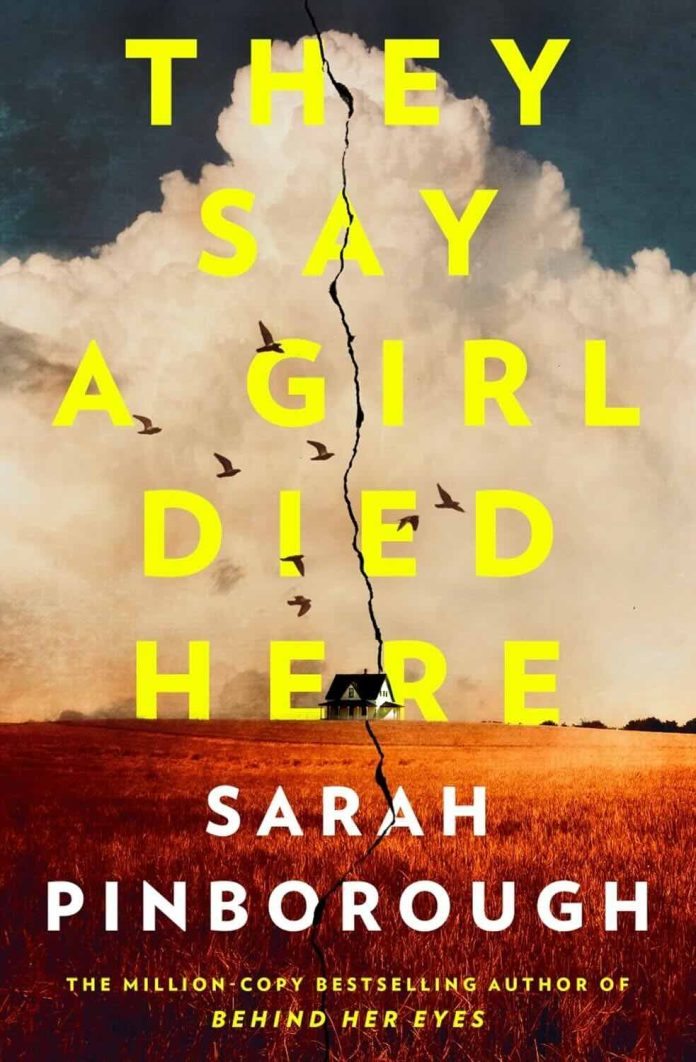
The girl is face up in a field that should be wheat, washed clean, six inches of skin cut from her lower back. That is the first page, and it is not the murder this book is about. It happened six years ago, or three, depending on which girl you mean, and the town of Harper’s Creek has agreed to consider the matter closed since a drifter with dirty photographs on his phone was conveniently shot dead during a robbery. They Say a Girl Died Here by Sarah Pinborough opens with a killing already filed away, and spends four hundred pages proving how much work a town will do to keep a file shut.
The drought helps. Nothing has grown here for years, half of Main Street is boarded up, and the reopened amusement park needs a good season. Nobody wants the subject raised again.
How They Say a Girl Died Here Works
Anna Maybourne is twenty-two, and she has been moved here from Boston along with her exhausted mother, her twelve-year-old sister, and the grandmother whose money bought the house. She dropped out of a journalism degree after something happened to her at a party that she cannot remember and that a number of strangers have watched. She waits tables, sleeps in the wrong half of the day, and refuses to be alone in a car with a man unless she can see his hands.
The town has a boogeyman to explain its dead girls. Say Farmhand into a mirror three times and he comes for you. Anna does it in front of her little sister to prove it is nonsense, and this is the closest the book comes to a conventional horror set-up, because the actual engine is much better.
Her grandmother’s dementia is accelerating. In the gaps, Evelyn produces things she should not know: fragments of dreams Anna has not described, a half-pack of cigarettes that turns up days before Anna acquires it, and one sentence, over and over, in a voice that is not entirely her own. They say a girl died here. Anna assumes she is hearing the murdered girls. She is wrong, and the correction is the finest thing They Say a Girl Died Here by Sarah Pinborough does.
What They Say a Girl Died Here Is Actually About
Underneath the mechanism, this is a novel about who gets counted.
Lila Clarke was going to be homecoming queen and got the newspapers. Bonnie Buchanan was nineteen, worked reception at the dental practice, and her mother is still furious that her daughter was treated as the lesser loss. The professionals here are not incompetent so much as invested: a sheriff who cannot afford another unsolved case, a doctor who has delivered half the town and would rather remember it kindly. And Anna, who is not believed about anything, by anyone, including herself.
That is the real argument They Say a Girl Died Here by Sarah Pinborough makes, and it makes it without a speech: a place decides how much truth it can carry, then rounds down, and the people it rounds down are always the same people.
What Works
- Evelyn. The best character Pinborough has written in a while. The scene where she asks her granddaughter for a cigarette on the dark porch, and gets as close to an apology as her generation permits, is worth the entry price.
- The clues are planted in plain sight. Cigarette butts that multiply in a tin can, leftovers that change species between meals, a bloodstain that moves. All of it is there long before it means anything.
- Anna’s damage is structural, not decorative. Her refusal to sit in the front seat, her habit of filming a lift from a policeman. It also blinds her: she suspects every man in town and cannot see past that.
- The drought as pressure gauge. Nothing in this book breaks until it finally rains, and the rain lands exactly where it should.
- Four short unnumbered chapters written from the land’s own point of view, which ought to be twee and are instead the coldest voice in They Say a Girl Died Here by Sarah Pinborough.
Where They Say a Girl Died Here Gives Ground
- The middle is a repetition engine. Anna interviews someone, fights with her mother, smokes on the porch, fails to sleep, repeat. It is thematically apt and about eighty pages longer than it needs to be.
- The rules are never firm. How much control Evelyn has, what carries over, why Anna gets flashes sometimes and not others: it runs on feel and does not survive much prodding.
- Two books in one coat. The supernatural horror and the whodunnit resolve separately, and the stranger half has almost no bearing on catching the killer.
- One suspect is kept in play far too long, and the last quarter loses momentum propping him up.
- The coda ties off very fast. A criminal case, a new career, a romance and a town’s recovery are all settled in about six pages.
Read It If
- You want small-town crime fiction with a genuinely strange idea underneath it, rather than atmosphere standing in for one.
- You like a heroine who is angry, unlikeable in places, and never asked to apologise for it.
- A grandmother with dementia as the most powerful person in the book sounds like something you want to see attempted.
Skip It If
- You need your supernatural rules nailed down and consistent.
- Drugged sexual assault, recalled rather than shown, is not something you can read at the moment.
- You want a tight procedural. They Say a Girl Died Here by Sarah Pinborough is a slow, hot, wandering book.
Read These Next
- We Live Here Now by Sarah Pinborough, her previous novel and the closest sibling to this one in register.
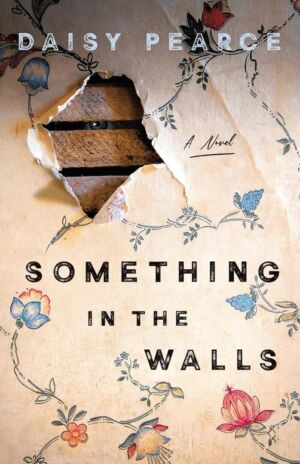
- Something in the Walls by Daisy Pearce, for a rural community that has agreed on a story about its dead and does not want it disturbed.
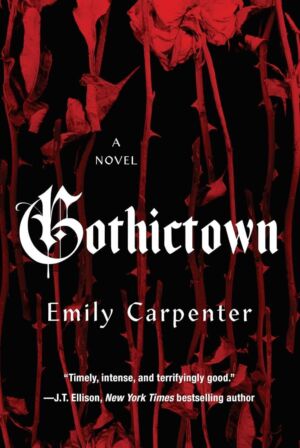
- Gothictown by Emily Carpenter, if a town with an economic reason to keep its secrets is the thread you want pulled.
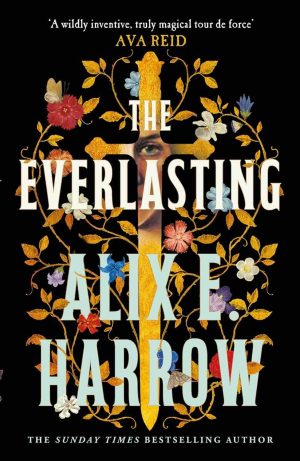
- The Everlasting by Alix E. Harrow, for a differently shaped novel about lives that keep being run again.
- Behind Her Eyes and 13 Minutes by Sarah Pinborough, the two of hers that best predict what this one does with a reveal.
Content Notes
They Say a Girl Died Here by Sarah Pinborough carries a fair amount. Drugged sexual assault, filmed and circulated, remembered rather than depicted. Strangulation and mutilation of bodies after death. A child drugged and placed in danger. Heroin addiction and a fatal overdose. A middle-aged man’s relationship with a teenage girl. Pregnancy and termination. A family murder-suicide recalled in detail. Dementia, written unsparingly. The novel also names a helpline in its own back matter; readers who want the equivalent here can find plain information at Rape Crisis.
The Verdict
Worth knowing: this began life in 2016 as a limited-edition novella called They Say a Girl Died Here Once, and has been rebuilt at novel length ten years later. There is something apt about a book that was itself rewritten from an earlier version, given what it turns out to be about.
The image that lasts is not the field or the fight or the fire. It is a woman standing in a locked bathroom with the light off, gripping the countertop, deliberately not turning round, because in the near dark she is almost featureless and can almost pretend she is not dying by inches.
They Say a Girl Died Here by Sarah Pinborough is uneven. The middle wanders, the mechanism will not bear close inspection, and the last chapter tidies too much. But the central idea is a genuinely good one, the grandmother is superb, and the book understands the thing most small-town crime novels miss: the horror is not that nobody knows. It is that enough people do, and have quietly decided what the truth is worth this year.