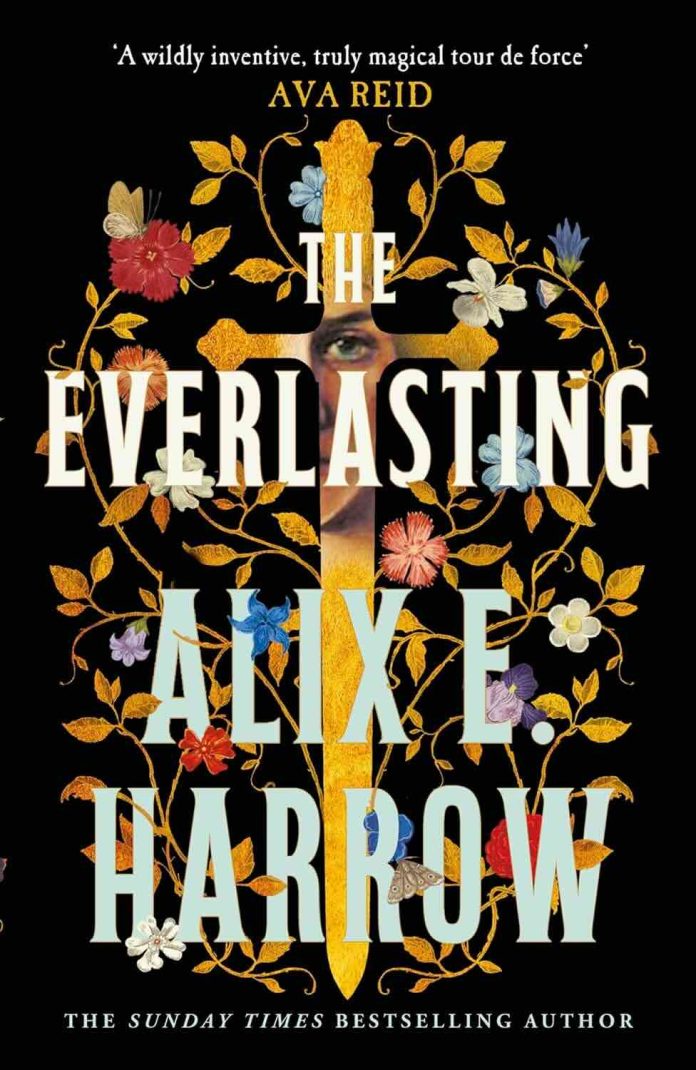
Alix E. Harrow has built her literary reputation on stories that tear down the walls between myth and reality, and her latest novel continues this tradition with breathtaking audacity. The Everlasting is neither a simple fantasy nor a straightforward historical romance, but rather a genre-defying meditation on how stories shape us, trap us, and occasionally, if we’re fierce enough, set us free.
The novel’s central premise is deceptively simple: Sir Una Everlasting, the legendary knight whose heroic death built an empire, never truly died. Instead, she’s been caught in a temporal loop, dying and resurrecting across centuries while Owen Mallory, a failed soldier turned obsessive historian, serves as her chronicler and inadvertent executioner. Their relationship transcends the typical bounds of romance, becoming something far more complex—a love story written across lifetimes, where remembering might be both salvation and curse.
The Architecture of Repetition
Harrow’s structural choices are bold to the point of recklessness. The novel unfolds through alternating second-person perspectives, with Una and Owen addressing each other directly across the chasm of time. This could have been a gimmick, a stylistic flourish that draws attention to itself rather than serving the story. Instead, it becomes the novel’s greatest strength. The second-person narration creates an unsettling intimacy, as if we’re reading love letters written in blood and memory, each addressed to someone who may or may not remember receiving them.
The book is divided into sections marking Una’s deaths—First, Second, Third, Fourth, and Last—but these aren’t simple chronological markers. Time in this novel moves like a needle through cloth, stitching forward and backward, creating patterns that only become visible when you step back to see the whole tapestry. Harrow trusts her readers to follow these temporal leaps without excessive hand-holding, and that trust pays dividends in the book’s increasingly complex middle sections.
However, this structural ambition occasionally stumbles under its own weight. The time-loop mechanics, while thematically resonant, can become murky during pivotal moments. Readers may find themselves flipping back through pages, trying to determine which iteration of events they’re witnessing. This confusion seems intentional—mirroring Owen and Una’s own disorientation—but it occasionally crosses the line from atmospheric to frustrating.
Character as Mythology, Mythology as Character
Una Everlasting is not the shining hero of legend. She’s bitter, violent, haunted by the countless versions of herself she can’t quite remember. Harrow refuses to soften her protagonist’s edges, presenting us with a woman who has committed atrocities in the name of a queen who manipulated her into existence. Una’s journey isn’t about becoming a better person—it’s about becoming a person at all, rather than merely a symbol.
Owen, the self-professed coward, provides a necessary counterbalance. He’s neurotic, scholarly, prone to panic attacks and existential spirals. In another author’s hands, he might be insufferable. Here, he’s achingly human. His obsession with Una’s legend begins as academic fascination, curdles into complicity with her oppressor, and ultimately transforms into something redemptive. The evolution feels earned rather than imposed.
The true villain of the piece is Vivian Rolfe, known throughout most of the story as Queen Yvanne, and she represents Harrow’s most incisive commentary on power and narrative. Vivian doesn’t just rewrite history—she authors it, literally, using a magical book to loop time until she achieves the story she wants. She’s propaganda personified, a reminder that every national myth is written by someone with an agenda. Her chilling pragmatism makes her more terrifying than any dragon: she loves Una, in her way, but only as a craftsperson loves their most useful tool.
The Weight of Words
Harrow’s prose shifts registers with remarkable fluidity. When writing from Una’s perspective, sentences become shorter, more percussive, weighted with the exhaustion of someone who has fought too many battles. Owen’s sections bloom with scholarly tangents and neurotic parentheticals, reflecting his tendency to overthink everything. The author’s control over voice is masterful, making each narrator’s sections immediately identifiable even without headers.
The novel’s exploration of storytelling itself is where Harrow’s ambitions shine brightest. The Everlasting asks urgent questions: What does it mean when a story becomes propaganda? Who gets to tell the legend, and who must live it? Can love exist outside the narratives that contain it? These aren’t abstract philosophical musings—they’re woven into every choice the characters make, every iteration of the loop they endure.
Yet there are moments when Harrow’s thematic ambitions overwhelm the emotional core. The novel’s middle section, where Owen researches the various historical versions of Una’s tale, occasionally reads more like a treatise on narrative theory than a fantasy novel. These passages are intellectually stimulating, but they can interrupt the story’s momentum just as it builds toward its most crucial revelations.
Where Romance Meets Resistance
The love story between Una and Owen unfolds with aching slowness across hundreds of pages and hundreds of years. Their romance isn’t built on grand gestures but on accumulation—stolen glances that might be remembered in the next iteration, touches that leave invisible marks on bodies that remember what minds forget. When they finally escape the loop and steal nine years together, Harrow wisely compresses this happiness into summary rather than detail, understanding that earned joy sometimes speaks loudest when whispered rather than shouted.
The novel’s queer sensibility extends beyond Una’s casual references to past lovers of various genders. It’s embedded in the story’s DNA—the refusal of neat categories, the insistence that love can exist outside prescribed narratives, the recognition that the most radical act might be choosing to disappear from history rather than being immortalized within it.
Technical Triumphs and Stumbles
Harrow demonstrates impressive control over multiple fantasy subgenres, blending Arthurian legend, time-loop science fiction, historical fantasy, and romance without letting any single element dominate. The world-building of Dominion—clearly modeled on various European empires—provides just enough detail to feel real without overwhelming the character-focused narrative.
The novel’s weaknesses are primarily pacing-related. The first act takes perhaps too long establishing Owen’s academic obsession before plunging into the time-travel mechanics. The final act, conversely, rushes through its resolution in ways that may leave readers wanting more closure. Some plot threads—particularly involving Owen’s colleague Professor Sawbridge—feel underdeveloped despite their apparent importance.
The magic system, centered on the mysterious book that allows time travel through blood sacrifice, operates more on thematic logic than rigorous rules. Readers seeking hard-magic explanations may find this frustrating, though it aligns with the novel’s interest in stories as living, mutable things rather than fixed laws.
A Place Among Peers
The Everlasting sits comfortably alongside Harrow’s previous works—The Ten Thousand Doors of January, The Once and Future Witches, and Starling House—all of which explore how marginalized people claim agency through storytelling and magic. However, this novel feels darker, more interested in the costs of legend-making than in its possibilities.
Readers who enjoyed Madeline Miller’s The Song of Achilles or Naomi Novik’s Spinning Silver will find familiar pleasures here: myths retold with modern sensibilities, complex interrogations of heroic narratives, love stories that refuse easy categorization. Fans of N.K. Jemisin’s Broken Earth trilogy will appreciate how Harrow embeds political critique within fantasy structure, while those who loved Emily Tesh’s Silver in the Wood will recognize the quiet power of love stories that unfold in secret places, apart from empires and their demands.
Final Considerations
The Everlasting is an ambitious, frequently brilliant novel that occasionally trips over its own complexity. It demands active reading and rewards careful attention to detail. This isn’t a book to skim through on a beach vacation—it’s a novel that wants to be wrestled with, argued over, reread to catch the patterns hidden in plain sight.
Harrow has written a love story that doubles as a ghost story, a fantasy that functions as historical critique, a tragedy that insists on hope. It won’t work for every reader. Those seeking straightforward adventure or uncomplicated romance should look elsewhere. But for readers willing to follow Harrow into the tangled wood of narrative itself, the journey offers profound rewards.
The ending—which I won’t spoil—manages something genuinely difficult: it honors both the weight of all that came before and the possibility of genuine transformation. Whether you find it satisfying or frustrating may depend on your own beliefs about whether love can truly rewrite destiny, or if the best we can hope for is to choose which stories we’re willing to die for—and which ones we’re brave enough to abandon.
Similar Reads Worth Exploring
For readers captivated by The Everlasting, consider these companion reads:
- The Ten Thousand Doors of January by Alix E. Harrow – Harrow’s debut explores similar themes of storytelling and escape through more accessible prose
- The Song of Achilles by Madeline Miller – Another romance that unfolds across an epic timespan, interrogating classical mythology
- This Is How You Lose the Time War by Amax Gladstone and Max Gladstone – For readers drawn to the time-travel romance elements and experimental structure
- Spinning Silver by Naomi Novik – Fantasy that transforms fairy tales into complex narratives about power and choice
- The Once and Future Witches by Alix E. Harrow – Harrow’s exploration of how women’s stories get erased from history
- Piranesi by Susanna Clarke – For those who appreciated the novel’s meditations on memory, identity, and repetition
The Everlasting is a novel that believes in the revolutionary potential of choosing your own story, even—especially—when that story is quieter, smaller, and more human than the legend history demands of you.







