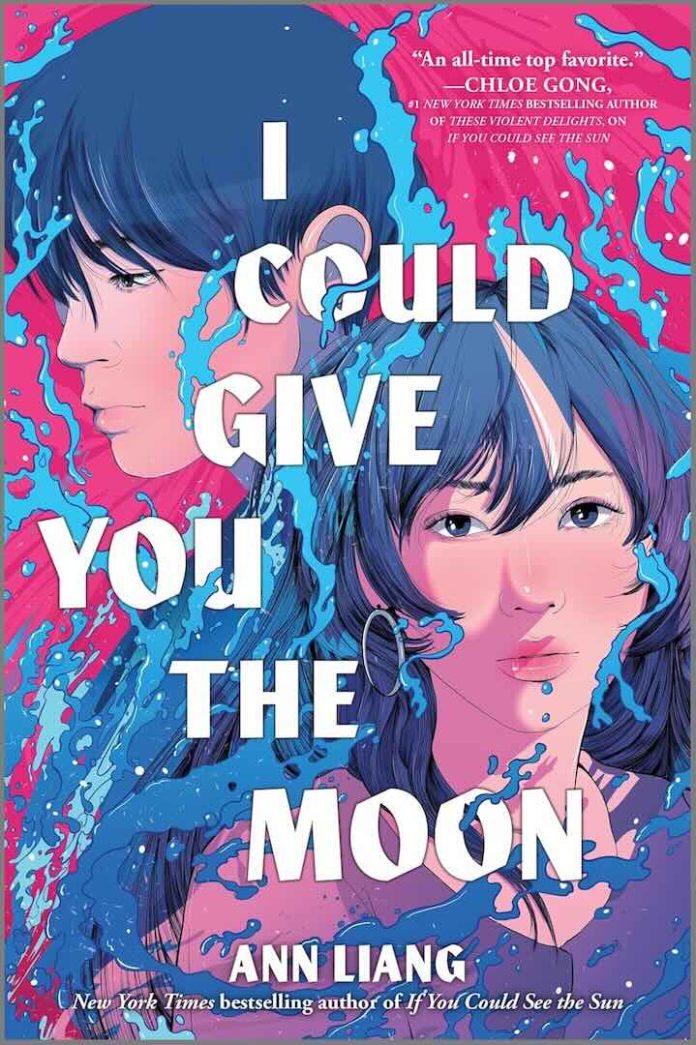
Some books announce their intentions in the first paragraph. Ann Liang’s latest, I Could Give You the Moon, opens with its narrator delivering a wry mini-essay on the predictable stages of heartbreak, and you understand immediately what kind of voice you’ve signed up for: knowing, glossy, slightly mean, and secretly hoping someone proves it wrong.
The Premise: A Vision That Won’t Let Go
Chanel Cao is the kind of girl whose existence has been algorithmically optimized since middle school. Her face sells magazines in Beijing, her selfies trend on Weibo, and her smile arrives twelve frames before the camera does. Ares Yin, the new transfer at Airington International Boarding School, has spent his life doing the opposite: shrinking, deflecting, and quietly searching for the little brother who vanished three years ago.
When the two of them stand by a strange lake and witness the same impossible vision, the rules of their lives flip. Chanel’s house is burning down in the water. Ares’s missing brother is standing across the street from the flames. Each wants something only the other can give, so they make the kind of bargain teenagers make: bad faith dressed up as cooperation, with a private promise to use each other and walk away clean.
Whether anyone walks away clean is the whole question of I Could Give You the Moon by Ann Liang.
What Works: Voice, Vibe, and a Heroine Who Refuses Likability Coaching
Chanel’s voice and the pleasure of an unapologetic narrator
The clearest strength here is Chanel as a first-person narrator. Liang writes her in present tense, and the voice carries a sting that feels lived-in. Chanel observes other people the way a fashion editor reads a contact sheet: every gesture clocked, every motive priced, every flaw catalogued for later. She is performative and self-aware about being performative, which is harder to pull off than readers tend to realize. A lesser version of this character would tip into cartoon villain or secret cinnamon roll. Chanel sits in between, prickling at the edges, daring you to roll your eyes before she rolls them at herself.
Ares’s quiet, and why the POV switch earns its keep
Ares gets the third-person treatment, and the contrast is deliberate. Where Chanel is all surface, monitoring her angles in real time, Ares moves through the book carrying weight he cannot name. His chapters slow the heart rate down and let the prose breathe. The structural choice gives the book a rhythm that mirrors its central tension: the curated public self, the unguarded private one, and what happens when they collide in a hotel elevator.
Beijing as a co-star, not a postcard
Liang’s Beijing is the other true love interest. She knows the city in her bones. The skewer stalls and rainbow LED signs, courtyard dancers swaying slightly off-rhythm to nineties ballads, the Sky Restaurant pretending to be a sky, the auntie on her electric bike with a polka-dot blanket fused to the handlebar. None of it reads like tourism. It reads like a writer who lives somewhere and pays attention.
The Romance: Slow, Wary, Earned
Chanel and Ares aren’t falling in love so much as they’re slowly losing their excuses for not having fallen already. The book understands that the most affecting YA romance is the kind where each person has to relearn their own face in the other person’s reflection. There is plenty of cherry lip gloss and clenched jaws, late-night phone calls at five a.m., and one or two scenes that will make readers who came for the longing very glad they did.
What I appreciated most is that Liang refuses to let Chanel be redeemed by Ares’s love. Chanel is the one who has to dismantle her own scaffolding. Her arc is internal long before it is romantic, and the romance only deepens once she stops performing for it.
Where the Book Stumbles
I Could Give You the Moon by Ann Liang is technically YA contemporary, but it borrows speculative machinery (the lake visions, the prophetic burning house), and the gear shifting between magical realism and grounded teen drama does not always click cleanly. Some readers will find the visions atmospheric and dread-soaked. Others will feel they thin out under examination, especially as the third act asks the device to carry increasingly heavy plotting work.
The antagonist, a Beijing nightclub owner with a crescent scar, has presence in early scenes and softens as the story demands more of him. His motives, once spelled out, lose some of their mythic edge. The book is also long, and a stretch around the midpoint, when Chanel’s plan to engineer Ares’s affection tilts into broadcast manipulation, runs longer than the emotional progress justifies. You feel the chess pieces moving more than you feel the players sweating.
A brief note for series readers
I Could Give You the Moon is the second book set in the Airington universe, after If You Could See the Sun. Henry Li and Alice Sun reappear as Chanel’s brain trust, and they are a delight. Newcomers won’t be lost, but a few beats land harder if you’ve read the earlier book first.
A Few Things I Loved Without Reservation
- The friendship dynamics between Chanel, Henry, and Alice. Henry’s whiteboard scene is one of the funniest set pieces in any YA romance this year.
- The way Chanel’s mother is written as imperfect and achingly real, applying pressure that reads like multigenerational weather rather than villainy.
- The titular line, which lands earlier than expected and twice as hard.
- A late chapter at a tattoo parlor that does more emotional work in five pages than most romances do in fifty.
Who This Book Is For
I Could Give You the Moon by Ann Liang will resonate most for readers who come for:
- Voice-driven YA romance with sharp first-person narration.
- Slow-burn dynamics where the leads hurt each other before they help each other.
- Beijing and fuerdai culture rendered with insider specificity.
- The gap between social media identity and inner life.
- A speculative thread that tilts a familiar romance shape sideways without going full fantasy.
If you came for tightly plotted suspense or a strictly grounded contemporary, the lake-vision element may feel like the book is wearing a coat from a different season.
Comparable Reads and Ann Liang’s Other Work
Liang has been one of the more consistent voices in YA over the last few years. Readers who enjoy this one should explore her earlier titles, including If You Could See the Sun, This Time It’s Real, A Song to Drown Rivers, I Am Not Jessica Chen, and her adult historical fantasy debut A Song to Drown Rivers. Fans of her dry humor and Beijing settings will find familiar pleasures here, with a darker undertow.
Quick pairing notes
- If You Could See the Sun by Ann Liang for the Airington connection and a sister-text to this one.
- Counting Down with You by Tashie Bhuiyan for tender YA romance with high emotional intelligence.
- XOXO by Axie Oh if the East Asian setting and complicated family expectations spoke to you.
- Loveboat, Taipei by Abigail Hing Wen for the dazzling, suffocating wealth and identity friction.
- Tokyo Ever After by Emiko Jean for the public-persona-versus-private-self thread.
- These Violent Delights by Chloe Gong if you want the romance pushed further into atmospheric speculation.
Final Thoughts
There is a moment late in I Could Give You the Moon by Ann Liang where Chanel realizes that her favorite version of herself is one she cannot post. That alone justifies the book’s existence. The romance is tender, the prose is funny and observant, and the world is gorgeously specific to a Beijing that rewards readers willing to look up from the love story long enough to admire the lanterns. The seams show in places, particularly where the speculative element meets third-act mechanics, and the manipulation arc tests patience before it pays off. Even so, Liang remains one of the few YA writers whose narrators feel genuinely interior, and Chanel Cao might be her most ambitious, most flawed, most quietly furious heroine yet.
A glamorous, smart-mouthed, surprisingly bruised love story about who you are when the camera stops recording.







