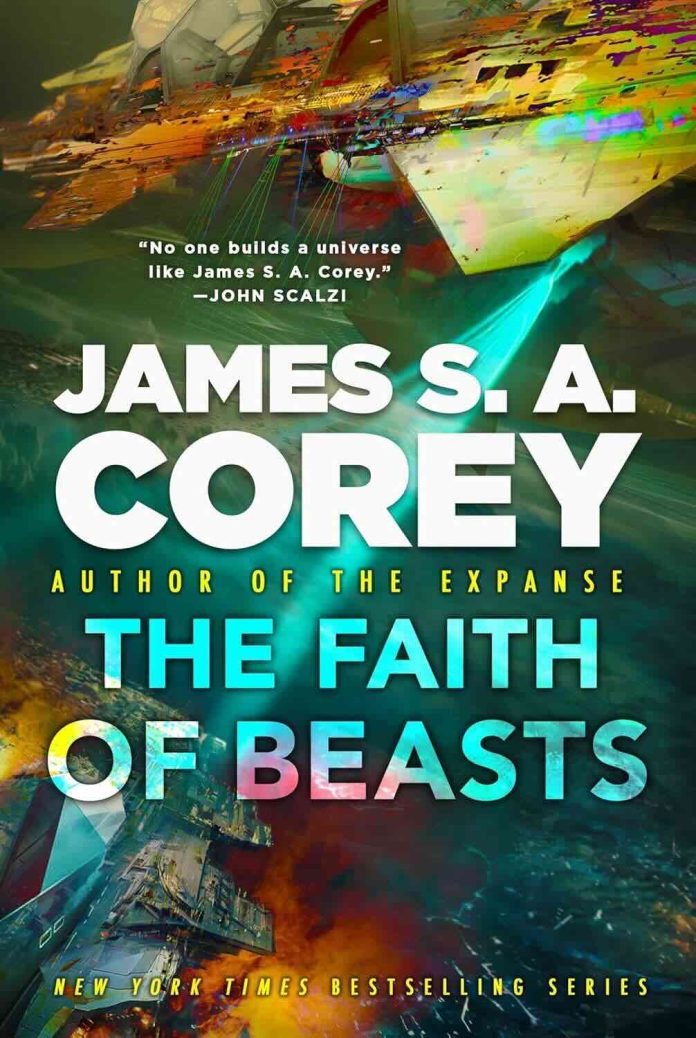
Some sequels widen the world. Some sink deeper into a single beating heart. The Faith of Beasts by James S.A. Corey tries to do both, and the strain shows in places, but it stands as one of the most morally serious space operas in recent memory. This second entry in The Captive’s War picks up the human survivors of the Carryx invasion exactly where readers left them at the end of The Mercy of Gods: alive, useful, and starting to suspect that usefulness might be the worst thing of all.
Where the Trilogy Stands So Far
If you are coming in cold, here is the shape of things. The Mercy of Gods dropped about four thousand humans into the Carryx world-palace as captive labor. Livesuit, the connected novella, follows soldiers on a different front of the same eternal war. The Faith of Beasts by James S.A. Corey is the second full novel, and it widens the canvas without letting go of any earlier thread. Together, the three works form a triptych about life under an empire that does not negotiate, does not tire, and does not mourn its dead.
A Spoiler-Free Look at the Story
The novel splits its attention across several fronts and lets each carry its own weight. Daniel Abraham and Ty Franck have always been generous with point-of-view characters, and here the structure works because each thread answers a single question in a different voice: how do you fight a thing that does not care if it loses today, because it will be the same thing tomorrow?
The Threads That Carry the Book
- Dafyd Alkhor, the human “factor” appointed by the Carryx, must engineer his people’s survival across generations while their masters demand children for future use.
- The swarm wearing Jellit Kaul’s body still walks among the humans, gathering intelligence for an enemy on the far side of the stars and weighing whether to tell Dafyd what it really is.
- Jessyn Kaul is dropped onto a contested world thick with feral life and silent ruins, where she meets a man who knows things he should not know.
- Campar crawls through the wrecks of enemy starships beside a sentient lump of nacreous mucus called Vaudai, the strangest comic relief in a serious book this year.
- Rickar tries to keep his mind from coming apart on a Carryx warship that does not want him there.
What Stays With You
At its bone, this is a book about strategy under impossible odds. Dafyd’s plan to kill the Sovran, glimpsed in book one, finally meets the wall of reality. Plans tend to lose against walls. Watching an intelligent man understand the limits of his cleverness without giving up has rarely been done this well in modern science fiction.
Three Things That Linger
- The swarm chapters. Written in present tense and sliding between three buried voices, they carry a grief I do not often see handled this honestly outside literary fiction. The arguments between an alien weapon and the ghosts of the people it has consumed are the strangest, most affecting passages in the trilogy so far.
- Uuya Tomos. A small old woman with a writer’s history and a politician’s nose. She quietly rewires the second half of the book by suggesting that resistance might be a story handed to grandchildren rather than a battle won in a single lifetime.
- The interludes. Each part opens with a fragment of Myths of Origin, the parable of Ke and the bird that ate the sky. In other hands this would feel decorative. Here it becomes the lens through which everything else makes sense.
Where the Pace Falters
The mixed reader response to this novel makes sense to me, and this is where it lives. The middle of the book is patient to a fault. Jessyn’s arc on the contested world has long stretches that read like a slow-cooked stew when the reader wants flame. Rickar’s chapters, while psychologically rich, deliver less plot per page than any other thread, and some readers will resent the time he takes. The philosophical conversations between Dafyd and an interspecies historian called the Soft Lothark are the moral spine of the book for some readers and a speed bump for others.
The novel also asks a great deal of your memory. If you have not recently revisited The Mercy of Gods, names like Tonner Freis, Ostencour, or Synnia will land softer than they should. Livesuit is not strictly required, but it adds context the main novels assume.
A smaller quibble: the climax of The Faith of Beasts by James S.A. Corey refuses the catharsis a more conventional space opera would deliver. That is by design, and I respect the choice. Some readers will close the book wishing for the satisfaction the authors’ Expanse novels delivered with such reliability.
On Style and Voice
Daniel Abraham and Ty Franck, the two writers behind the Corey name, have always written prose that feels lived in. Their sentences wear working clothes. Dialogue still does most of the heavy lifting, but the descriptive passages carry a darker texture than their Expanse work ever did. The Carryx world is sketched in smells, in the canted angles of corridors, in the wet coughs of translation devices. You walk through it without getting lectured.
If you arrived at The Captive’s War expecting Leviathan Wakes with aliens, the tonal shift will surprise you. The Faith of Beasts by James S.A. Corey reads closer in spirit to late Le Guin or Adrian Tchaikovsky than to a Jim Holden adventure. The action is real and brutal when it arrives, but it is not the point. Survival is.
Books in the Same Key
If you finished The Faith of Beasts by James S.A. Corey wanting more in this register, six honest recommendations to keep close:
- Children of Time by Adrian Tchaikovsky, for civilizations built on alien biology and a deep patience with time.
- A Memory Called Empire by Arkady Martine, for empire as a problem of language and identity.
- Embassytown by China Miéville, for the slow dread of being unable to truly communicate with aliens who have decided you matter.
- The Locked Tomb series by Tamsyn Muir, for grief written into the architecture of a body.
- Blindsight by Peter Watts, for the cold terror of minds that do not share our priors.
- Leviathan Wakes by James S.A. Corey, the authors’ own first novel, if somehow you have not read where they started.
Verdict
The Faith of Beasts by James S.A. Corey is not a comfortable book. It does not promise victory and it does not always reward patience in the moment. What it offers is rarer: a sustained, intelligent argument with itself about what resistance means when your enemy is evolved to win. Read alongside The Mercy of Gods and Livesuit, this trilogy is shaping up to be one of the most demanding and rewarding works of space opera in years. I want book three now, and I want the authors to take their time with it.







