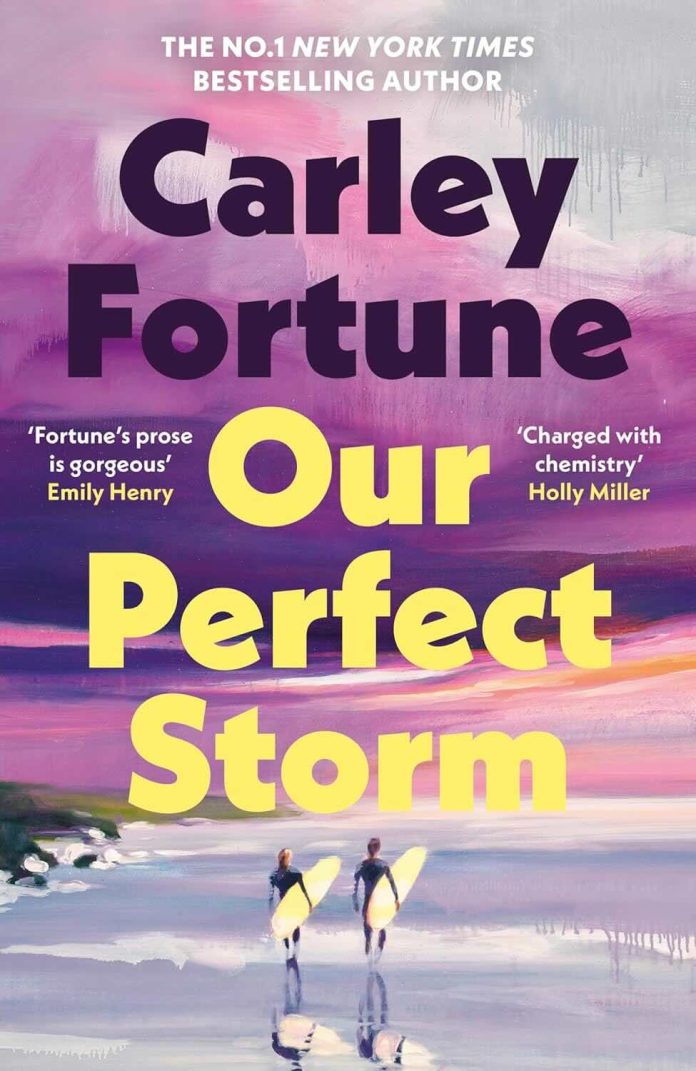
The premise of Our Perfect Storm by Carley Fortune dares you to roll your eyes before turning a single page. Bride gets jilted. Bride goes on the honeymoon anyway. With her childhood best friend. To the Pacific Northwest. To a villa with a hot tub, a candle path, and one bedroom heaped in rose petals.
It sounds like a setup that should collapse under its own contrivance. And yet.
Frankie Gardiner is hours from her wedding when she finds the note. Not a hard conversation. Not a phone call. A note. Her fiancé Nate has decided he can’t marry her, and he leaves her to read the news at the manor where the ceremony was supposed to happen. Enter George Saint James, her best friend since they were eight years old, who has shown up late to play best man and now refuses to let her wallow alone in her childhood bedroom for the rest of the summer. He has a plan. Seven days in Tofino. A printout of psychology research. The goal, supposedly, is to mend Frankie’s heart and possibly their fraying friendship along the way.
Anyone who has read Fortune before will already know how this generally plays out. The pleasure is in watching her work the territory.
What Carley Fortune Does Best
Fortune writes weather like a chef writes a sauce, patiently and with a generous hand. Her descriptions of the temperate rainforest along Vancouver Island are some of her most assured work to date. Sitka spruce dripping onto bare shoulders. The salty mizzle that fogs George’s glasses every five minutes. A hot tub on a private deck wrapped in fern. Tofino isn’t a postcard backdrop here. It’s a living organism the characters move through, and Fortune lets it imprint on Frankie until the woods feel like another character in the friendship.
The food writing is just as alive. Frankie used to be a chef, now develops slow-cooker recipes for a brand called Brie, and her senses tune to gooseneck barnacles, Dungeness crab, spot prawns, house-made baguettes, and the gewürztraminer the resort’s head of guest experiences keeps pushing on them. Readers who loved the lake-and-sandwich sensuality of Every Summer After and Meet Me at the Lake will find that same texture here, deepened by salt and cedar and a Pacific that won’t sit still.
A few craft choices pay off in particular:
- The dual timeline. Chapters titled We Were Eight, We Were Sixteen, We Were Twenty-One drop in across the present-day week, releasing the friendship’s history at exactly the rate the present needs it.
- The letters. Frankie and George have left each other notes since childhood in a birdhouse-mailbox between their properties, and those scraps carry emotional weight that dialogue alone could not.
- The mother. Frankie’s relationship with her mom, a former marine biology student who once loved whales more than anything, runs underneath the romance like a current and gives the book its quietest, hardest moments.
A Friendship That Earns Its Heat
The leap from best friends to something else is the friends-to-lovers writer’s hardest jump, and it’s the one Fortune handles with more nuance than the synopsis lets on. Frankie and George are not saints. They yell. They keep secrets. And they get sloppy with each other’s feelings the way only people who have known each other since age eight can. When the book leans into that, the bickering over glasses, the house rules they once pinned to a fridge, the shared shorthand they have to relearn at thirty, Our Perfect Storm by Carley Fortune hums with the kind of intimacy that’s almost embarrassing to read.
The chemistry, when it arrives, has been earned across decades on the page. The kissing scenes are unhurried and exact. A morning dream sequence in the shared villa becomes a small comic set piece that also says something true about wanting someone you’ve been told you cannot have. Fortune trusts her reader to feel the difference between attraction and history, and the back half of the book leans on that trust.
Where the Book Wobbles
A four-star average tells you something honest, and the criticisms are worth naming. Our Perfect Storm by Carley Fortune is not a flawless book.
- The Plan is sometimes too cute. George’s seven-step healing program, complete with day labels (Wallow, Move, Expand, Memorialize), can read more like a magazine listicle than something a grieving best friend would actually devise.
- Nate is thin. He functions as a plot mechanism more than a real partner. The reasons for the breakup, when they emerge, are credible, but Nate himself never quite feels like a man Frankie would have chosen for a year of her life.
- Frankie can be exhausting. Her temper is a feature, not a bug, and Fortune is honest about it. There are stretches where her self-pity sits a little long on the page before George or her mother or the ocean shake her out of it.
- The third-act reveal lands a beat late. Without spoiling, the moment that explains the breakup is well-engineered, but it sits buried under enough foreplay that some readers will see it coming early.
None of these are dealbreakers. They are the trade-offs of a book that wants to be both a beach read and an emotional reckoning, and that mostly succeeds at being both.
Who This Book Is For
Readers will likely fall hard for Our Perfect Storm by Carley Fortune if they:
- Already loved Every Summer After, Meet Me at the Lake, This Summer Will Be Different, or One Golden Summer
- Want a friends-to-lovers romance with real history and real friction
- Like setting-as-character writing, especially Pacific Northwest atmospheres
- Don’t mind a heroine who would happily fight you in a parking lot
- Care about climate stakes folded quietly into love stories: wildfires, endangered whales, the ocean as more than scenery
It might land softer for readers who prefer fast-burn romance, neat plotting, or heroes and heroines who behave well under pressure.
Comparable Reads
If Our Perfect Storm by Carley Fortune is on your nightstand, these will likely sit comfortably beside it:
- People We Meet on Vacation by Emily Henry, for the friends-to-lovers travel architecture
- The Friend Zone by Abby Jimenez, for the long-history ache
- Things We Never Got Over by Lucy Score, for the messy, headstrong heroine energy
- Beach Read by Emily Henry, for two writers, one cottage, and a slow combustion
- The Seven Year Slip by Ashley Poston, for grief, food, and a heroine relearning her own life
- Funny Story by Emily Henry, for breakup-into-better-fit timing
The Final Word
Fortune has built a small empire on summer, water, and women figuring themselves out. Our Perfect Storm by Carley Fortune is not her tightest novel, but it might be her bravest. She is asking what happens when the friendship was always the love story, and everyone in the room knew it except the two people standing in the cupboard. The answer she lands on is generous, sea-soaked, and quietly insistent that you cannot outrun the people who know your real name.
Pack it for a long flight, a porch, or any week you suspect you might cry once and laugh four times. Most readers will close the book a little salt-stung and a little better for it.