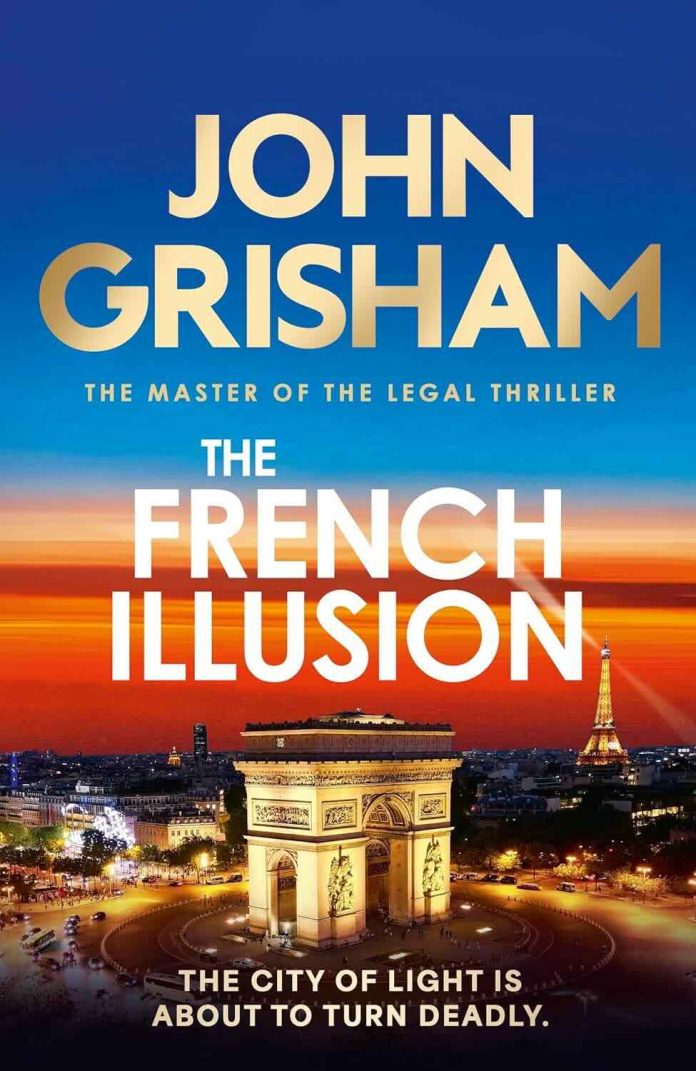
The surveillance starts on the third day, and the couple never notice it because they are busy telling the internet where they will be. That is the first sentence of the argument The French Illusion by John Grisham is making, and it arrives before anybody has been touched. Paul and Chelsea Tanner have been married nine days. Their itinerary is public. On the fifth morning they hire a car to the Normandy beaches, their driver is drugged over lunch in Bayeux, a replacement in a surgical mask collects them from the restaurant, and by four o’clock a black Peugeot is sitting under a tarpaulin in a tractor shed with an empty rear seat.
Two Ransoms, One Groom
The mechanics of the opening ninety pages are the best Grisham has written in years, and they are almost entirely domestic. A text arrives at 8:04 on a Thursday evening. A video runs for nine seconds and deletes itself. A twenty-four-year-old bartender named Sam buys burner phones at an all-night pharmacy because his father, an orthopaedic surgeon worth five million dollars, would never have thought of it. The demand is two million per family, wired, no police, no press.
The Clayburns can find the money by lunchtime. The Tanners cannot. Watching Fritz and Linzy Tanner assemble two million dollars in five days is where the novel is at its most quietly devastating: an off-market cash sale of the Old Town Alexandria house they bought for ninety thousand in 1988, their retirement accounts torn open with penalties, a hundred thousand borrowed from a brother, a quarter of a million from the other family with a promissory note attached because they are too proud to accept it otherwise. Both wires go out on time. One groom walks free in a church in Chantilly. The other does not, and his wife sits in Saint-Sulpice until the bells ring at five.
What The French Illusion by John Grisham Is Actually About
This is the fortieth Grisham and it contains no trial, no jury, no closing argument, and no lawyer who saves anybody by being clever in a room. Nearly every principal has a law degree and it is worth nothing to them. That is deliberate.
When the motive finally surfaces, roughly halfway through, it points back at a decade of American detention policy: bounties paid for men in Afghanistan, prisons where nobody was charged, and a list of interrogation methods the reader will recognise. Grisham has written non-fiction about wrongful conviction before, and the anger here is of the same order, only pointed outward. Readers who want the documented version of what the novel dramatises can find it in the casework of organisations like Reprieve, which has spent twenty years on exactly these files. The book’s position, stated once and never laboured, is that a country which processes innocent men for years creates creditors, and creditors eventually collect.
What Works
Four things make The French Illusion by John Grisham worth the hardback.
- The abduction itself. A bicycle crash, two capsules in a glass of water, a canister of nitrous oxide under a passenger seat, a set of swapped licence plates. Twenty pages, no wasted motion, entirely plausible.
- The financial ruin. Grisham has always been the best popular novelist alive on what money does to ordinary households. Selling the family home to a faceless investor, then renting it back at two thousand a month, is the cruellest thing in the book and nobody fires a shot to do it.
- The captivity chapters. Sparse, unsentimental, and built around the small victories of a man teaching a teenage guard the days of the week in order to find out what month it is.
- The refusal of a hero. No character solves this. Institutions grind, politicians stall, and the outcome turns on a decision taken by somebody who never appears on the page.
Where It Stumbles
Four things keep The French Illusion by John Grisham off the top of his backlist.
- The middle sags into procedure. Long stretches of briefings, inter-agency turf jokes and men in rooms agreeing they have nothing. Realistic, and slow.
- The third act belongs to the machinery. Once the counter-operation begins, the families essentially leave the book. Chelsea, the most alive character in the first hundred pages, is reduced to a phone call and a beach in Bermuda.
- The gadgetry strains. A key device involves molars, and the novel spends more time being pleased with it than the payoff justifies.
- The antagonist arrives late and leaves early. His grievance is genuine and well argued, but he gets perhaps fifteen pages of interiority in a four-hundred-page novel, which is not enough to carry the weight the ending puts on him.
Content, and Who This Is For
A Word on Content Warnings
Heavy. Prolonged torture depicted in detail: repeated waterboarding, floggings with rubber hose, starvation, sleep deprivation by noise and light, electric shocks, and confinement in a wire cage. Drugging and abduction. One death by explosion. Non-graphic sexual content. The captivity sequences are the most sustained physical cruelty Grisham has put on the page.
Who Should Read The French Illusion by John Grisham
Reach for it if you want a thriller that is genuinely furious about something, if you like watching a middle-class American family taken apart by arithmetic rather than violence, or if the phrase enemy combatant has ever made you uneasy. Skip it if you come to this author for courtrooms and verdicts, because there are none, or if graphic torture is a hard line for you.
What to Read After The French Illusion by John Grisham
- The Widow by John Grisham. His previous novel, and the nearest recent comparison for how coldly he handles money and grief together.
- Framed by John Grisham and Jim McCloskey. The non-fiction that explains where this anger comes from, ten true stories of people the system was certain about.
- The Oligarch’s Daughter by Joseph Finder. For readers who liked the ordinary-person-inside-the-machine half best.
- Camino Ghosts by John Grisham. A far gentler book, useful mainly to see how wide his range now runs.
- The Prisoner by Hwang Sok-yong. If the detention material is what stays with you, this is the memoir that sits behind that whole tradition.
The Last Word on The French Illusion by John Grisham
The title works three ways. There is the illusion sold to four million American tourists a year, that Paris is a set rather than a country with a history and a diaspora and a grievance. There is the illusion the families are made to maintain for six months, a cover story about food poisoning that costs them their friendships. And there is the operation at the centre of the last third, which is an illusion in the stage-magic sense and is treated as such. Grisham is not usually thought of as a political novelist, and he has spent forty books proving he can build a machine that runs. This one runs a little roughly in the middle, and it is the only one of his I have read that seems genuinely unsure whether the country it is written for deserves a happy ending.







