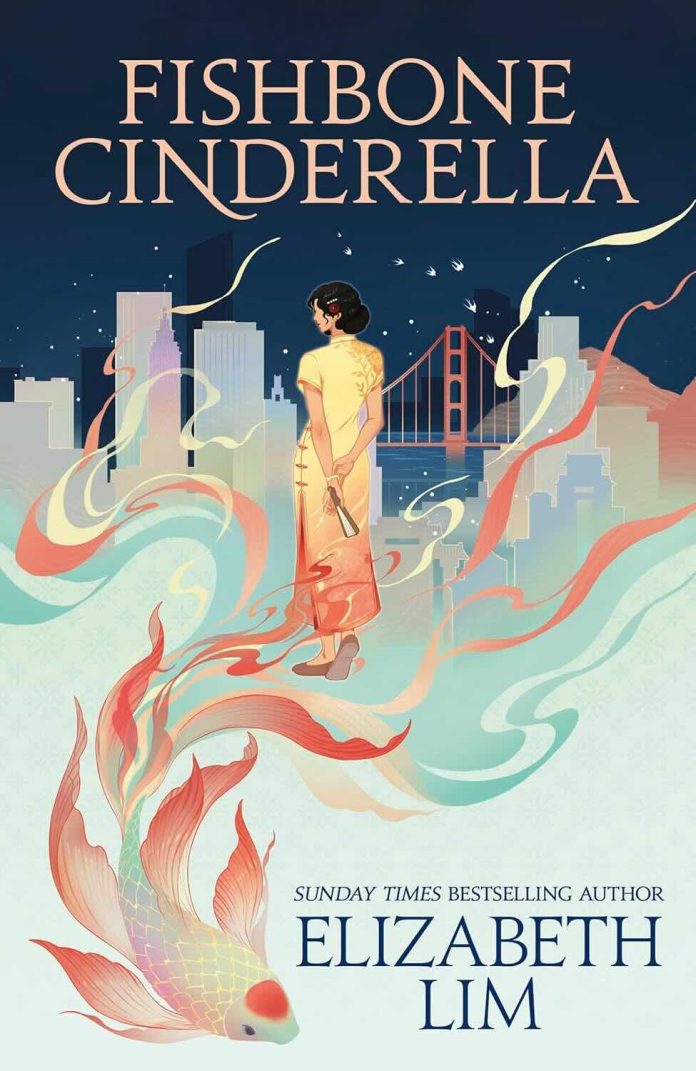
Some retellings simply dress an old fairy tale in new clothes. Fishbone Cinderella by Elizabeth Lim attempts something braver. It takes Yeh Shen, the Chinese Cinderella who prayed to the bones of a golden fish, and buries her quietly inside a sweeping family saga that stretches from wartime Guangdong to 1980s California. The glass slipper is gone. In its place you get a gold bracelet with fishbone links, a missing shadow, and a promise broken generations before the story begins.
This is Lim’s first novel written for adults, and it reads like the book she has been circling her entire career. Part historical fiction, part magical realism, part slow-burning romance, it is above all a story about mothers and daughters who love each other fiercely in languages neither can speak aloud.
The Story, Kept Spoiler Free
The novel braids two timelines together. In 1940, seven-year-old Yut Ying hides from Japanese soldiers in her mother’s cupboard and discovers she can turn invisible. Sent to Hong Kong after the war to live with her father’s glamorous second wife, she becomes an unpaid cook and factory seamstress inside her own family’s home, a Cinderella hiding in plain sight while the city rebuilds itself around her.
Decades later in Berkeley, her American-born daughter Marigold never takes off her gloves. One touch shows her other people’s memories, and the sharpest ones always cut. When the two women fly to Hong Kong together in 1980, ostensibly for a friend’s wedding, both are carrying secrets that have been eroding them for years. What follows is a reckoning with an inherited curse, an abandoned first love, and a house on Harbourage Road that neither of them can forget.
The Women Who Carry the Book
Yut Ying, later called Helen, narrates her chapters in first person, and her voice is the novel’s great achievement. She is petty, proud, funny, and heartbreakingly observant, the kind of narrator who notices that a soldier’s eyes move “in the motion of a knife being sharpened.” Marigold’s third-person chapters are cooler and more analytical, fitting for a future doctor who treats her own strangeness like a diagnosis to be managed. Around them orbit a memorable supporting cast:
- Lily, the bespectacled stepsister who steals small objects from people she dislikes and steals the reader’s heart entirely
- Sai Ma, a stepmother whose cruelty arrives wrapped in lavender perfume and honeyed advice
- Yuk Fong, the grandmother whose prophetic dreams give the family curse its terrible spine
- Tommy and Kenji, two boys from two eras, both proof that love in this family always demands a toll
Magic That Behaves Like Memory
How the Fantasy Works
The supernatural elements are restrained and deeply metaphorical. Each generation of women inherits the curse in a different form: one dreams the future, one vanishes from the world, one reads pain through her fingertips. Lim never over-explains the rules, and the book is stronger for it. Invisibility here is not a superpower. It is what happens to a woman who has been overlooked, underestimated, and silenced for so long that disappearing starts to feel like relief.
A Note on the Fairy-Tale Interludes
Short italicized fragments of the golden carp’s tale appear between the novel’s four parts. They are lovely, precise, and frankly too few. I wanted more of them.
The Romance, Written in Loquats and Soymilk
Both love stories are tender without being saccharine. Tommy courts teenage Yut Ying with bicycle rides, egg tarts, and a loquat tree they plant together on a Hong Kong hillside, while Marigold and Kenji fall for each other over comic books, driving lessons, and terrible turtle puns. Lim writes first love through food and small kindnesses rather than grand declarations, and those scenes are some of the warmest in the book. Readers should know the romance is a strand, not the engine; anyone expecting a full romantasy in the vein of her Lor’yan novels will find something quieter and sadder here.
What Works Brilliantly
- The historical texture. Wartime Tunglam, post-occupation Hong Kong, Kansas City winters, and a Berkeley bakery all feel lived-in, built from cha chaan tengs, Peaksoy billboards, mahjong tables, and tins of luncheon meat.
- The mother-daughter mirroring. Helen and Marigold wound each other in exactly the ways they were wounded, and watching them slowly recognize this is the novel’s emotional payoff.
- Food as a love language. Egg tarts, cabbage buns, ngau lam, and dried persimmons do more emotional work than most dialogue in other novels manages.
- The Cinderella inversion. Lim interrogates the tale rather than replaying it, asking what actually happens to girls who marry kings, and who pays for the magic.
Where the Novel Stumbles
For all its beauty, Fishbone Cinderella by Elizabeth Lim is not a flawless book, and readers deserve honesty about its rough edges.
- The middle sags. The 1950s Kansas City stretch, while thematically necessary, slows the momentum badly, and some readers will feel the pull to skim until the timelines converge.
- Predictable reveals. Several twists, including the identity of the girl on the soymilk bottle and the source of a certain character’s chronic stomach troubles, are telegraphed chapters before they land.
- Uneven villains. Sai Ma is genuinely chilling in her small cruelties, but late in the book she tips into melodrama, and Gu Ma’s arc resolves offstage in a way that feels convenient rather than earned.
- A hurried ending. After four hundred pages of patient build, the curse resolves with surprising speed. The final chapters are moving, yet the solution feels almost too easy for the weight the book has asked it to carry.
- POV imbalance. Helen’s first-person voice is so vivid that Marigold’s sections, especially the school-years chapters, occasionally read like connective tissue.
None of these flaws sink the novel. They do keep it just shy of greatness.
How It Compares to Elizabeth Lim’s Earlier Books
Longtime fans know Lim from her Legends of Lor’yan universe, including Spin the Dawn, Unravel the Dusk, Six Crimson Cranes, The Dragon’s Promise, Her Radiant Curse, and A Forgery of Fate. Those were plot-forward young adult fantasies full of demons, dragons, and enchanted needlework. Fishbone Cinderella by Elizabeth Lim trades that velocity for depth. The prose is more patient, the stakes more intimate, the grief more adult. If Six Crimson Cranes was a fairy tale with teeth, this is a family history with a fairy tale buried in its bones, and it confirms Lim can write outside the genre that made her name.
Similar Books You Might Enjoy
If Fishbone Cinderella by Elizabeth Lim works for you, these belong on your list:
- The Ghost Bride by Yangsze Choo
- Peach Blossom Spring by Melissa Fu
- The Fox Wife by Yangsze Choo
- Lucky Bones by Michael Wong
- The Joy Luck Club by Amy Tan, for the mother-daughter architecture without the magic
Final Verdict
Fishbone Cinderella by Elizabeth Lim is a moving, richly detailed, occasionally uneven family saga that uses one of the world’s oldest fairy tales to ask a piercing question: what do we owe the people, and the promises, that made us? Come for the Cinderella hook. Stay for Helen and Marigold, two resistant hearts learning, at last, how to be seen. Readers of historical fiction with a thread of magic will find Fishbone Cinderella by Elizabeth Lim well worth the tears it will almost certainly cost them.







