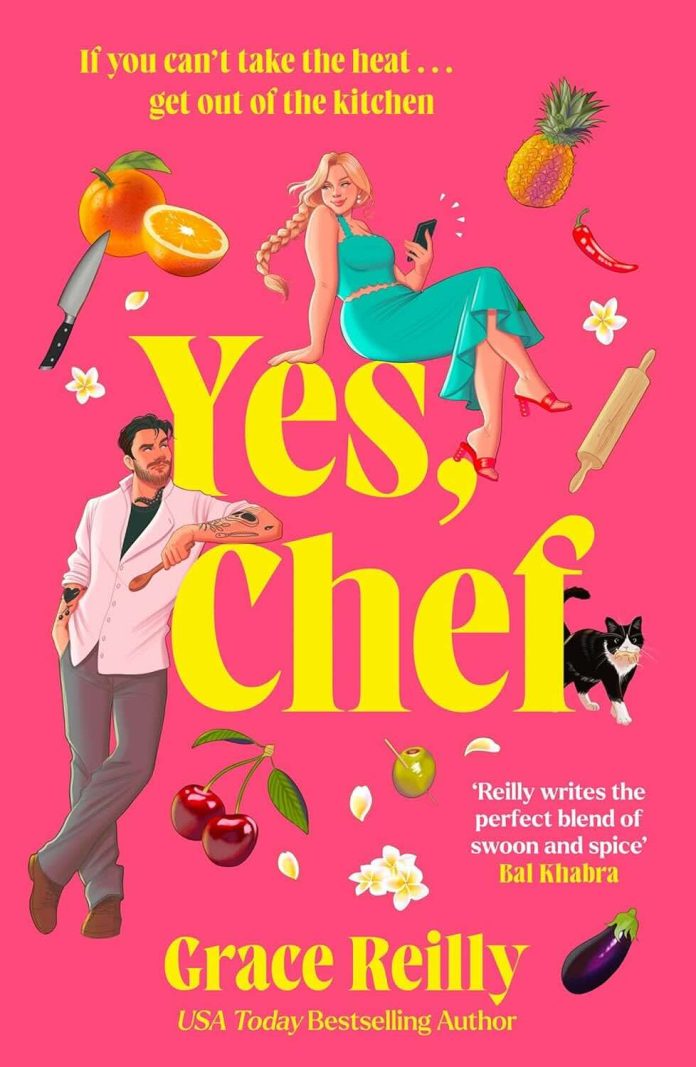
Most romances open with a meet-cute. This one opens with a cocktail shrimp to the face. That shrimp, lobbed across a Hamptons wedding tent by a tipsy bridesmaid at a chef who called her a disco ball, tells you almost everything about the tone of Yes, Chef by Grace Reilly. It is loud, food-obsessed, occasionally mean, and far more tender underneath than its first fifty pages suggest. Reilly built her name on the Beyond the Play college sports romances. This is her first adult standalone, and the change of uniform suits her.
The Setup: Two Public Disasters and One Neglected Restaurant
Jack Hartman is a James Beard winner with a drinking problem he refuses to name, a mentor he failed to bury, and a temper that finally detonates in front of the wrong critic. Poppy Winfield is a 2.3-million-follower influencer who gets dumped in the same dining room on the same night. He inherits a shuttered Florida restaurant he doesn’t want. She proposes a deal. He agrees on one condition: if she’s going to sell his food, she has to learn how to cook it.
What follows is a slow, dusty, sweaty rebuild in a town called Diamond Bay, told in fifty-three short alternating chapters, each named after an ingredient or a technique. Tarragon. Squid Ink. Maillard Reaction. It’s a small structural trick, and it’s the smartest thing in the book, because it quietly promises that every chapter will change the flavor of the thing.
Jack and Poppy: Character Work Worth the Calories
Reilly’s leads are the strongest ingredient here.
Jack is written with an unglamorous accuracy that fans of The Bear will recognize immediately: the water gulped from a quart container, the earbuds, the reflex to fire someone rather than be fired. His grief doesn’t announce itself. It leaks out sideways, through his refusal to rename a restaurant and his inability to say the word dad until very late.
Poppy is the bigger achievement. She could easily have been a punchline, and Reilly refuses to let her be one. Her competence arrives incrementally and believably: onions, then knives, then a butchered chicken, then a menu concept, then a dining room she runs like a conductor. The scene where she pivots a collapsed dessert into something better is the most satisfying beat in the book, and there isn’t a kiss anywhere near it.
Both leads have ADHD. Reilly, who writes about her own diagnosis in the acknowledgments, treats it as texture rather than plot fuel. Two pill organizers, two sets of alarms, one shared shorthand about hamster wheels and heads full of bees. It’s specific in a way that only lived experience produces.
The Writing: Sensory, Fast, Deliberately Unfussy
The prose is plain by design and rich where it counts. Reilly writes food the way a line cook talks about it, in verbs and temperatures rather than adjectives, then lets Poppy supply the poetry. Florida gets the same treatment. Lizards on the sidewalk, brackish water at the inlet, tropical rain arriving like coins out of a slot machine, a Publix sub treated as a religious experience. The setting has a pulse.
Chapters run four to eight pages, which keeps momentum high. The banter is genuinely funny rather than merely quippy, and Reilly has a gift for the small physical tell: a braid tugged, a hairnet handed over as punishment, a pop tart decorated with tweezers as an apology.
Where the Dish Is Underseasoned
An honest review of Yes, Chef by Grace Reilly has to admit the book is uneven, and reader reception reflects that.
- Jack’s cruelty outstays its usefulness. In the first third he isn’t grumpy so much as contemptuous, and the apologies arrive on a schedule. Readers with a low tolerance for a hero who insults the heroine’s livelihood will struggle.
- The middle sags. Roughly a dozen chapters follow the same shape: cooking lesson, banter, near-miss, retreat. The rhythm becomes predictable well before the story wants it to.
- The third-act conflict is telegraphed. A withheld arrangement sits in plain view for hundreds of pages waiting to detonate. When it does, the fallout is emotionally real, but the mechanism feels dutiful.
- The spice crowds the story. The heat level is high and the back half leans hard on it, sometimes at the expense of conversations the couple badly needs to have. One kink surfaces abruptly and will divide readers sharply.
- The supporting cast is thin at the edges. Kiara and Chester are lovely. Hazel, Owen, and Herman arrive with promise and then mostly hold pans.
- One parental turnaround is quick relative to the decades of damage the book carefully establishes.
What It Gets Right
- Kitchen procedure that reads as researched rather than decorative: mise en place, expediting, “heard, Chef,” mother sauces, timing as a moral position
- Grief written with restraint, especially in the birthday and beach sequences
- A heroine whose arc is about competence rather than makeover
- Neurodivergent representation that’s affectionate and unpitying
- A genuine argument underneath the romance about whether ambition and belonging have to be opposites
- Food as memory, threaded from the epigraph to the final page
Content Notes for New Readers
- Explicit and frequent sexual content, including a breeding kink and light impact play
- Alcohol misuse, grief, and terminal illness discussed on the page
- Foster care background, parental abandonment, and childhood neglect
- Online harassment directed at a public-facing woman
- A medical emergency involving a food allergy
Grace Reilly’s Other Books
Her Beyond the Play series, complete at four interconnected college sports romances, runs First Down, Breakaway, Stealing Home, and Wicked Serve. Readers coming from those books should know the voice carries over but the register is older, slower, and considerably more grief-forward. Yes, Chef by Grace Reilly stands entirely alone; no prior reading required.
If You Liked This, Order These Next
- It Happened One Summer by Tessa Bailey, for the fish-out-of-water heroine finding competence in a working town
- The Hating Game by Sally Thorne, for antagonism that curdles into want
- Part of Your World by Abby Jimenez, for small-town warmth with real emotional weight
- Nora Goes Off Script by Annabel Monaghan, for a quieter take on rebuilding after public humiliation
- Business Casual by B.K. Borison, for banter-forward contemporary romance with heat
- Kitchen Confidential by Anthony Bourdain, if the restaurant world itself is what hooked you
Should You Book a Table?
Yes, with a caveat. Yes, Chef by Grace Reilly is a warm, sensory, food-drunk romance with a heroine worth rooting for and a hero who tests your patience before he earns your sympathy. It doesn’t reinvent grumpy-sunshine, and the plotting is sturdier than it is surprising. What it does have is a specific, working understanding of why people give their whole lives to a kitchen, and why someone who has never been chosen might mistake a gift for a punishment.
Come for the shrimp. Stay for the pop tarts.