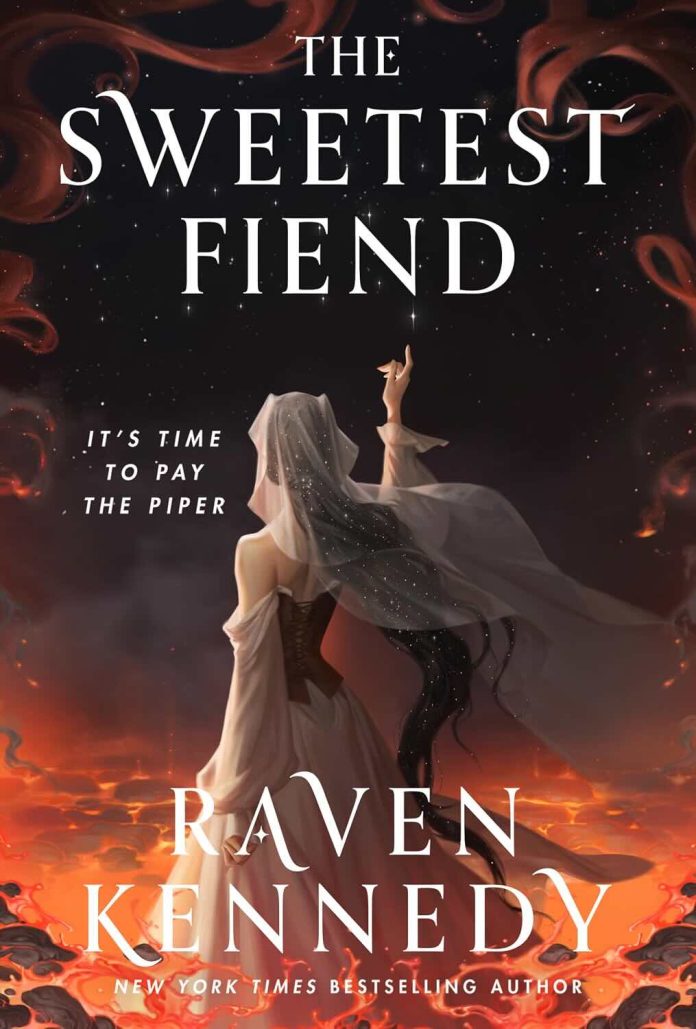
The Pied Piper of Hamelin is a very short story with a hole in the middle. A town has rats, a stranger clears them, the town refuses to pay, the stranger takes the children. No old version explains what he wanted them for. The Sweetest Fiend by Raven Kennedy is built inside that hole, and the architecture is the reason to read it.
What the Legend Gives Raven Kennedy
The bones are borrowed and load-bearing. A walled city called Hamelyn. A rat plague. A piper in a ragged colour cloak who arrives uninvited, solves the problem and presents a bill. A governor who will not pay.
What The Sweetest Fiend by Raven Kennedy adds is the invoice. Thirty thousand coins, refused, so the piper takes one hundred and thirty people instead, and that transaction is not the ending but roughly the first sixth. Everything afterward answers the question the legend leaves blank.
Around it sits a world worth the effort. Thirty years ago the earth cracked and the molten core came up through it. The fae who survived contact with that power became Core fae, ears stained red at the tips, carrying magic their bodies were never built to hold. Nine antlered creatures called Banes climbed out of the same cracks, each releasing one plague, and ravaged the continent for five years before the Core killed them. The children they fathered on fae women have pointed ears and horns. They are called fiends, and every hardship in the world gets laid at their feet.
How The Sweetest Fiend Is Built
Esti Calyx is one of them. Twenty-five, makes paper with her aunt on a river in Hamelyn, keeps her horns under a veil. She also has two small magics nobody knows about: a constellation flares on a stranger’s face at first meeting and hands her three true words about their character, and her fingernails change colour with her feelings, which she passes off as mill dye.
The opening movement is a siege. Flies for five months, then poison in the rain and the river, then rats, all inside a sealed city whose governor is selling the municipal water back to his own citizens. Esti is chained forty feet up a punishment post for breaking curfew by one minute, and that is where the rats find her. The chapter where she climbs a greased pole by her own collar chain while the city is eaten below her is the best thing in the first half of The Sweetest Fiend by Raven Kennedy, and it happens before the piper speaks a word.
From there it becomes a captivity narrative, then a court story, then a road story. The seams show, but every stage moves one woman from someone the world discards to someone the world will fight over.
The Idea at the Centre
The premise, when it lands, is strong enough to lift the book past its packaging.
Months before the novel opens, a mob killed a fiend during a hail plague, and the hail stopped falling over the spot where he died. A Core fae whose magic is blood-scenting built a theory on it: each fiend’s blood can halt the one plague released by the Bane who fathered them, and a small repeatable amount, applied often enough, might prevent plagues from arriving at all.
So the despised are the cure. The Sweetest Fiend by Raven Kennedy does not leave that as an irony and walk away. It follows the political consequence: the moment this becomes public knowledge, a few hundred people become a resource to be hoarded, sold, bled or hidden by whichever ruler reaches them first. The secrecy that makes the piper look like a monster in chapter nine is the secrecy keeping those people alive in chapter thirty, and the novel is honest about how uncomfortable a bargain that is.
The second good idea is the latch. Core magic slowly kills everyone who holds it unless it fastens onto another person’s life force. One Core fae here burned too much power on a single plague, never found his match, and is dying in a cabin in consequence. It writes dependence without making it pretty, and the rule that attraction must exist before the magic will latch keeps it clear of a fated-mates shortcut.
Where The Sweetest Fiend Buckles
- The first third loops. Escape attempt, capture, argument, wound care, repeat. Three attempts in a hundred pages, and the middle one mostly exists to strand her somewhere with a monster in it.
- The retrofit on the hero does not fully hold. Early on he calls her damaged goods and tells her she smells, repeatedly. We are later asked to read that as a man at war with his own instincts. Some of it lands; some reads as cruelty the plot has decided to forgive on our behalf.
- The premise arrives as a speech. The theory is delivered in a field by one character while a crowd asks the questions a reader would ask. Efficient, and a briefing.
- The register changes hard at the midpoint. The back half of The Sweetest Fiend by Raven Kennedy is explicit in a way the front half does not advertise. Anyone who came for a plague fantasy should know a different book is waiting after the halfway mark.
- The antagonists are thinner than the ideas. The ex-boyfriend is a device, the hostile fiend has one note, and the governor is drawn in crayon next to a world this carefully made.
- It ends mid-fall. The last chapter detonates something enormous and then stops. The final page is a door closing rather than a chapter break.
What Holds It Up
Two scenes justify The Sweetest Fiend by Raven Kennedy on their own. One is an ash plague in an outlying settlement, where the piper stands at a gate and plays people up out of the heaps that have buried them, gets a fraction of the town out, loses more on the walk home, and ends the day on his knees in a forest counting the ones he missed. The other is a campfire where four Core fae describe the day the world broke: boiled alive in a lake, pinned under a burning pine, melting on a sickbed. Best worldbuilding in the book, and it arrives as conversation.
Esti is a properly built narrator too. Her courage is the stubborn domestic kind rather than the chosen-one kind, and her love for a chronically ill mother drives every decision she makes, including the bad ones. When she carries a man across a desert because fifteen years of hauling vats at a paper mill made her strong enough, the moment is paid for in advance.
Content Notes
The Sweetest Fiend by Raven Kennedy earns a long list. A thirteen-lash public whipping with a poisoned whip, and the resulting infection flushed without pain relief. People eaten alive by vermin on the page. Mass death by plague, children included. Kidnapping and confinement. Sustained prejudice, slurs and ritual gestures of contempt. Off-page rape as the founding fact of an entire population. Chronic illness, seizures and a parent’s decline. Child abandonment. Several explicit sex scenes in the second half, including dominance play.
Read These Next
This is a first instalment, so the useful comparisons run sideways rather than backward. Four to try:
- Crowntide by Alex Aster. Closest match for the scale of the mythology and the appetite for a cliffhanger.
- A Forsaken Prophecy by Stacey McEwan. The same hate-to-want trajectory with a tighter first act.
- The House Saphir by Marissa Meyer. A gentler landing, and another writer reworking old story furniture.
- The Dark Is Descending by Chloe C. Peñaranda. For readers who liked the bargain-and-obligation machinery best.
Still working out whether this corner of the genre suits you? Start with our piece on romantasy and the emotional turn in modern fiction, or the guide to fantasy book tropes that this novel cheerfully reorganises.
What Stays With You
Strip out the romance and a good novel remains about what a society does on discovering it needs the people it has spent thirty years spitting on. Strip out the idea and the romance could not carry it. Together they mostly work, and the slack is the price.
What lingers from The Sweetest Fiend by Raven Kennedy is not the piper at all. It is a detail planted early and never underlined: a woman who reads three true words on every face she meets read his the first time she saw him, and trusted him anyway. The stars said defender, thief, liar. All three turn out to be doing work.







