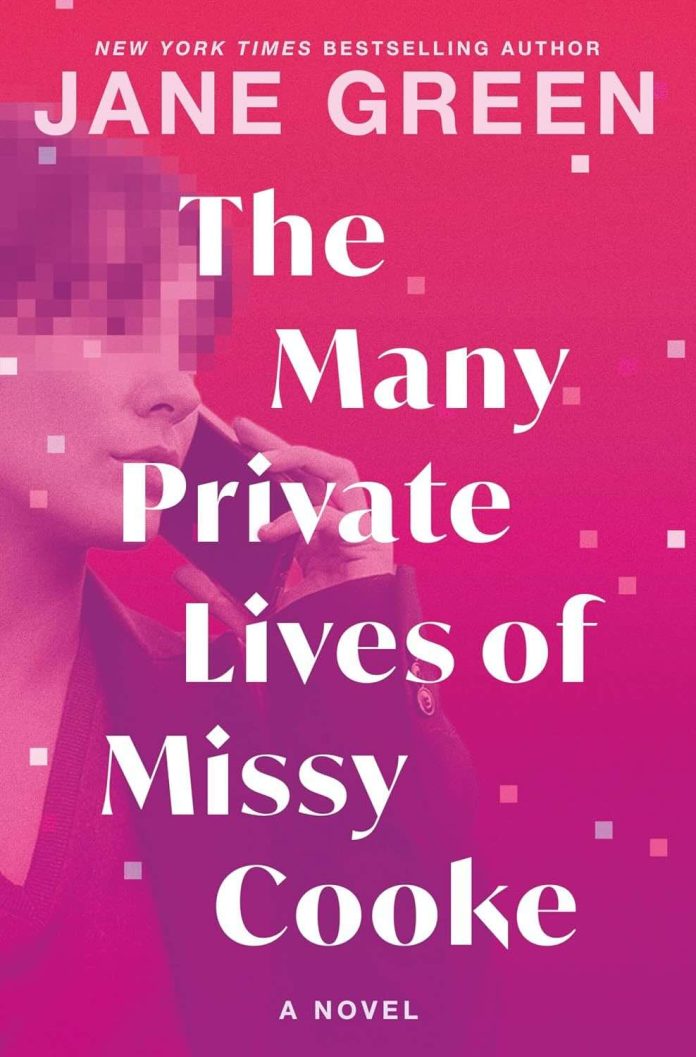
Missy Cooke is fourteen when her father agrees to furnish her bedroom. She has kept a catalogue in a drawer for months. She chooses the loft bed with the steps, the furry chair, the pink rug and the dressing table with the oval mirror, and a colleague takes her shopping because her father has a meeting. When he gets home he stands in the doorway and says the room looks like a giant cupcake. Within a second she is seeing it through his eyes, hating all of it, wishing she had chosen black. The Many Private Lives of Missy Cooke by Jane Green is full of small scenes like that, and they are the reason to read it.
How The Many Private Lives of Missy Cooke Is Built
The novel runs on two strands wired together. The present strand is first person, present tense: Missy at twenty-nine, four years into a job at her father’s company, drinking a bit too much at parties her best friend throws. The childhood strand is past tense, and never arrives as a flashback for its own sake. It arrives because something has just happened.
Her father orders sushi without asking, knowing she does not eat it, and the memory that follows is of him bagging up a pizza slice she had barely breathed on and driving her home because she had a sore throat. He calls her a fucking idiot in a burger restaurant, and the memory is of her mother screaming down a phone he calmly unplugs. The mechanism is simple and used with discipline: the slight would read as minor alone; the childhood scene makes it land as hard as it lands on her.
It is also why the book’s central lesson works. Her father tells her, on a bench outside an ice cream shop, that most people treat you as badly as you allow them to. Two hundred pages later her mother says the same thing at the worst moment of her life, and it does not feel like a bow being tied, because we have watched both of them live it from opposite ends.
The Portrait at the Centre
Marty Cooke is the reason this novel is better than its plot. He arrives in a Mustang when you are five, tells you scars are cool so you stop hiding yours, buys the convertible you have been saving for and pretends the keys were left in the ignition, then tosses you his own keys and tells you to drive faster past a parked police car. He also withholds child support to punish your mother, cannot be surprised by a gift, and puts out a family Christmas card with his wife, his baby and the cat on it, without noticing you are not.
The Many Private Lives of Missy Cooke by Jane Green refuses to reconcile those two men, which is the correct decision. His rages are short, and because they are short he refuses to believe anyone was frightened. His daughter cannot tell whether he knows what he does to people, and the book leaves it there.
The result is a narrator with a precise kind of damage. She is not weak: she wins the company’s biggest deal by throwing out the prepared figures and talking instead about educating girls. She simply cannot hold on to having done it. Two pages later a photographer makes her ashamed of eating a strawberry.
Missy Cooke, Jane Green, and the Boardroom Half
The diagnosis arrives at the end of Part I of The Many Private Lives of Missy Cooke by Jane Green. Stage 4 lung cancer, in the bones, terminal, an experimental clinic in Switzerland as the one option, and Missy installed as interim CEO because, her father says, she is the person he trusts most.
Part II changes genre, and gets weaker. Her father’s first employee sets about undermining her, and the campaign is competently built: an email address mistyped by one letter so she misses her own meetings, senior discussions held without her, a borrowed outfit pressed on her for a photoshoot that becomes the evidence against her in print. The hatchet job is well done, down to the invented manicure and the colleague quoted anonymously on her clothes.
But the antagonist is a device, not a person. Her motive is never stated, and her turn is signalled cosmetically: new highlights, new cheekbones, shorter hems, a darker perfume the narrator points out. Signalling corruption with a makeover is beneath a novelist this good at small humiliations.
Where The Many Private Lives of Missy Cooke Gives Ground
Four things hold The Many Private Lives of Missy Cooke by Jane Green back.
- The corporate machinery will not survive a reader who knows any. Thirty-three per cent is a blocking stake, and she is introduced from the stage as the majority shareholder. A vote called from the floor does not install a chief executive. The decisive evidence comes out of a rival’s inbox, and the narrator says outright that she does not know how.
- A number changes. The projected profit on the new product is $806 million for most of the book and $906 million in the final speech.
- The romance is deferred almost entirely. The childhood crush reappears, is written with real charge, gets one scene at the least defensible moment available, and leaves. The book closes on an unsent text message.
- The ending is one slideshow. Everything withheld for three hundred pages comes out in one meeting, and the room turns on cue.
Read It If, Skip It If
The Many Private Lives of Missy Cooke by Jane Green suits a particular reader.
Read it if:
- You want a father-daughter portrait with specific cruelty in it, not a monster and not a teddy bear.
- You like a narrator who is competent in public and demolished in private, and want the childhood that explains the gap.
- You have enjoyed this author before. The voice is warm, the pages turn, and the food and houses are described with pleasure.
Skip it if:
- Boardroom plotting that does not hold up will spoil a book for you.
- You want the romance the cover copy implies; it is barely there.
- You would rather not read a dying parent in intensive care.
Content Notes
A parent’s terminal cancer, sepsis and death, with sustained scenes in intensive care. A mother’s bipolar illness, long depressive episodes, and medication she abandons. Child labour in mining, and a seven-year-old’s death in a shaft collapse. A sedative used heavily for grief, and a sexual encounter the narrator cannot clearly recall. Infidelity. Recreational drug use. A controlling partner. Press intrusion. Frequent profanity, including a misogynistic slur used repeatedly between friends.
Read These Next
Five of ours for readers who finish The Many Private Lives of Missy Cooke by Jane Green.
- When We Were Friends by Jane Green is the closest sibling in her own catalogue, and better on how friendship curdles.
- Character Limit by Kate Conger and Ryan Mac is the non-fiction counterpart on what a founder’s temperament does to everyone downstairs.
- Favorite Daughter by Morgan Dick takes half-siblings and a father’s estate somewhere sharper and funnier.
- What My Father and I Don’t Talk About by Michele Filgate collects the essays this novel is in conversation with.
- Emotional Journaling for Fiction Writers on the technique the memory strand is built from.
What Stays With You
The bequest tells you what The Many Private Lives of Missy Cooke by Jane Green is really doing. Of an estate that includes houses and a yacht, the daughter gets a motorcycle, a third of the stock and an old steel watch. It is a Rolex Daytona of the kind Paul Newman made famous, given to her father by Newman after a donation to his camp for seriously ill children, and it is the watch he used to throw into the deep end so she could dive for it. She is left the thing she once swam to the bottom for, because retrieving it was how she got him to keep looking at her.
And then the photograph. The image everyone associates with her father shows him throwing a ball, his gaze slightly off camera. The Many Private Lives of Missy Cooke by Jane Green has that picture enlarged in front of two thousand people, and standing at the edge of the uncropped frame, in the same jeans and striped T-shirt, arms out for the ball, is his toddler daughter. He was looking at her the whole time. It is the best thing in the novel, and it very nearly carries the plot around it.







