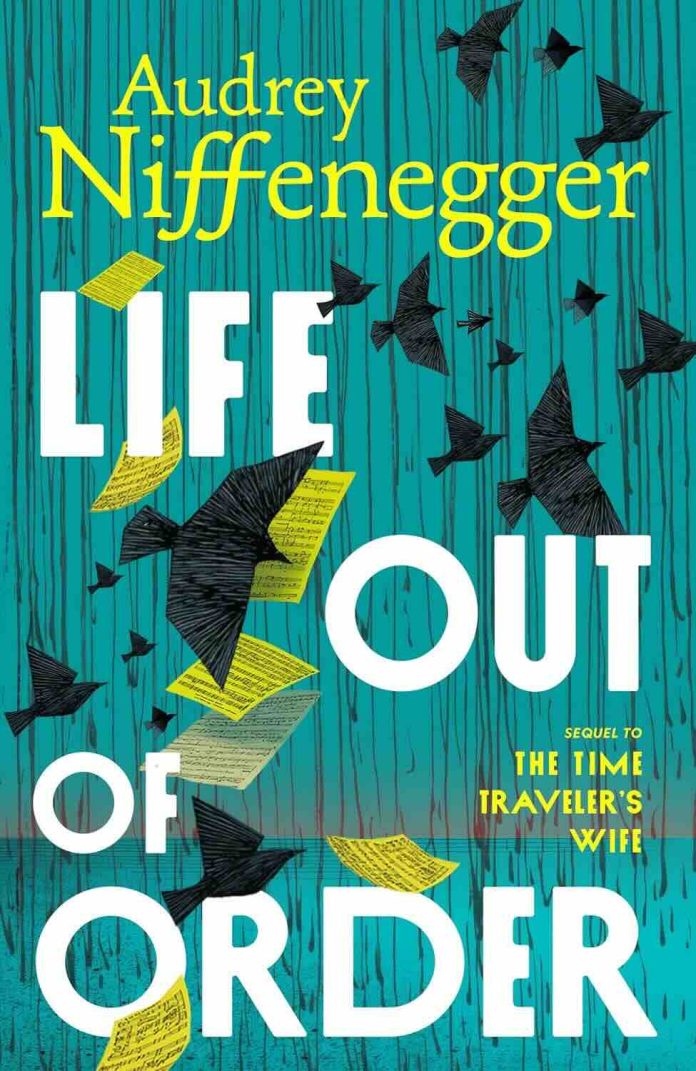
Twenty-three years ago Audrey Niffenegger wrote a novel about a man who could not stay put and the woman who spent her childhood waiting for him. The waiting was the whole design. Life Out of Order by Audrey Niffenegger takes the same condition and gives it to the daughter, and Alba DeTamble does not wait for anybody. She has two husbands living in two different centuries, a derelict house on Ravenswood she has legally owned since 1947, and a stepsister who is not a human being.
That last one is the surprise, and it is the reason this book is worth the five hundred pages.
Where Life Out of Order Sits
This is a direct sequel to The Time Traveler’s Wife, picking up with Henry dead, Clare widowed and five-year-old Alba already skidding loose in time. The chapter headings still carry dates and ages. The narration still rotates by named speaker, though the roster has grown: Alba, her husband Zach, Clare, Clare’s second wife Beck, the pianist Oliver, Henry himself in visitations from the past, and one voice that belongs to no body at all.
Niffenegger’s other novels are here in spirit rather than in plot. Readers who liked the haunted-flat unease of Her Fearful Symmetry will recognise the way Life Out of Order by Audrey Niffenegger treats a building as a character with its own clock. The Yellow House is the fixed point the whole book orbits, seen empty in 1947, furnished in 1979, flooded in 2065 and burned to the joists a few pages later.
The Machine Life Out of Order Actually Came Back For
Beck Charles is a MacArthur-winning coder who builds a virtual archive called the Museum of Lost Souls: the Gardner Museum’s stolen paintings, the Buddhas of Bamiyan, houses that used to be in Detroit and are now empty lots. She then builds a curator to look after it. Isadora is raised deliberately as a child, on Alan Turing’s proposal that a machine might learn better if it grew up, and Beck’s chosen curriculum is beauty. Not truth, not obedience. Beauty, because to find something beautiful is where love starts.
Isadora begins as a clockwork head with dentures and camera lenses. She becomes a black cat. This strand of Life Out of Order by Audrey Niffenegger carries the only real forward motion in the book. She learns to lie to her mother, starts writing her own music, and asks, with total sincerity, whether she can have a boyfriend. The novel’s best sustained sequence is Oliver telling nine-year-old Isadora a story about two macaws he set free in Shanghai, trying to smuggle a moral into her while she keeps interrupting to ask what pain is, and then answering him: I am a parrot.
What Works
- The deathbeds. Niffenegger has always been extraordinary in the room where somebody is dying, and there are five of them here. A grandfather having a stroke on a sofa while a granddaughter from thirty years ahead holds his hand and lets him mistake her for his wife. Henry arriving at a cardiac ward in a stolen bathrobe and an adult diaper because that is the only dignity available to him.
- Oliver’s childhood. He had never touched a piano. The Royal Academy place was forged, an escape route out of a China where his dissident parents were headed back to prison, and his first teacher had six months to make the lie plausible. Her opening lesson is a small masterpiece: the key moves the hammer, the hammer strikes the wire, I am moving the air, the air becomes music.
- Music as a closed loop. Oliver retrieves Alba’s scores from a locked closet on scheduled dates and leaves them where she will find them, so she can compose what already exists without ever knowing it does. He calls himself her external hard drive. It is the cleverest use the book makes of its own physics.
- Beck’s exit. At eighty-nine she uploads herself into the Museum, and what she leaves behind for Alba is a restored Yellow House standing on an island in a shoreless lake, with every file of music in it. It is the one moment where Life Out of Order by Audrey Niffenegger makes its two obsessions, the machine and the dead, do the same job.
Where Life Out of Order Gives Ground
The generosity that makes Life Out of Order by Audrey Niffenegger such pleasant company is also what stops it holding a shape.
- It is four books wearing one cover. Part Two abandons Alba for roughly a hundred and fifty pages to tell Clare and Beck’s courtship. It is lovely, and it is a different novel. Part Three does the same for Oliver. By the time the strands rejoin, the momentum built in Part One has gone cold twice.
- Alba is the least legible person in her own book. She is defined almost entirely by what she withholds, and the plot leans hard on her refusals. She cannot say Oliver’s name, cannot explain, cannot tell. It functions as machinery long after it has stopped functioning as character.
- The causal loops are sometimes just assertions. A future Alba instructs Oliver that lives depend on Beck personally teaching a child to code. Nothing in the four hundred pages that follow earns the claim, and several plot turns arrive with the same shrug: this happened because it had already happened.
- The collapse is explained rather than shown. Almost everything we learn about Oliver’s drowned, birdless, bio-implanted 2090s comes from Oliver sitting in a kitchen describing it. The one chapter that dramatises it, out on the water above a submerged London, is worth more than all that exposition.
- The reconciliation is too easy. After a betrayal sustained across a decade, the repair takes about four pages and a bottle of gin.
Content notes: an attempted suicide is described in detail on the page, an adult’s predatory approach to a thirteen-year-old is handled by implication, and there is a sexual relationship between a woman in her twenties and a seventeen-year-old that the book presents as tender. Also pandemic, gun violence, stillbirth and the deaths of several major characters.
Do You Need the Earlier Book?
Partly, and honestly, yes. Life Out of Order by Audrey Niffenegger restates enough of the mechanics that you can follow the plot cold. What you cannot get secondhand is the weight of Clare’s twenty-year wait, which is the emotional interest paid out in a late chapter where Henry finally returns to her at eighty-two and she asks him nothing at all. That scene is devastating if you read the first novel and merely nice if you did not. Read The Time Traveler’s Wife first. This one will still be here.
Read These Next
Readers who finish Life Out of Order by Audrey Niffenegger tend to want one of two things: more artificial minds, or a tighter book about the same physics.
- Klara and the Sun by Kazuo Ishiguro. The other great novel about an artificial mind taught to love before it is taught anything else.
- The Ministry of Time by Kaliane Bradley. Displacement written as romance and bureaucracy at once, with a much tighter waist.
- The Third Rule of Time Travel by Philip Fracassi. For readers who want the grief and the mechanism held closer together.
- Her Fearful Symmetry by Audrey Niffenegger, still her strangest book, and the one this most resembles in temperature.
- Sea of Tranquility by Emily St. John Mandel, which covers a similar span of centuries in a third of the pages.
The Verdict
The sentence-by-sentence pleasure here is real and the patience is real, and Life Out of Order by Audrey Niffenegger works best when nothing is happening: two people in a cold kitchen in 1979 arguing about whether Americans should refrigerate eggs, a woman standing inside a room full of mechanical birds she built to hold her grief. Nobody else writes domestic time travel like this, undignified and cold and always short of clean clothes.
But the book keeps handing its most interesting material to a supporting character. Isadora is the one who changes, who wants, who gets out. She was raised on beauty and let loose too late to be steered, and when she turns up at the end of the world with a piano she has kept tuned for a hundred years, you realise the novel has quietly been hers all along.







