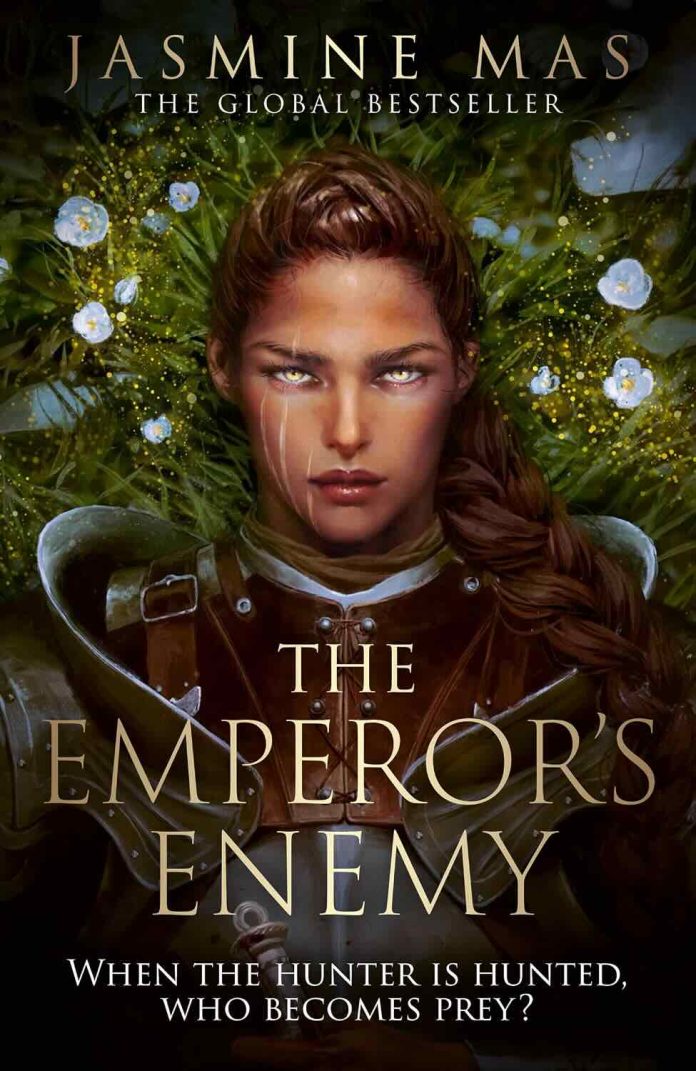
A twenty-three-year-old recruit is strapped upright to a gurney in a white room beneath a desert military base. A needle in her left arm drains her blood into a bucket. A needle in her right pumps something back in, dark red and threaded with silver, from a tank beside her. This is the Iron Ritual, which two people have survived in the past century, and she asked for it. She asked for it as a reward, for carrying an insufferable classmate out of a canyon on her shoulders. The Emperor’s Enemy by Jasmine Mas opens with a woman volunteering for a procedure with a rounding-error survival rate, and it never once implies she has made a mistake.
The Con at the Heart of The Emperor’s Enemy
Zora Ravenal is a hunter from the frozen North, two months into the Crimson Army and already famous. In a forest back home she put a bone dagger through the Empire’s most feared Royal Mage and dragged him back through the snow as a prisoner. There is a painting of it. Copies hang in taverns.
Now that man has been moved into her bedroom. Chained, collared with a device that shocks him on a dial she carries, and assigned as her magic trainer by a Marshal who has given Zora a second, secret set of orders she is forbidden to say aloud.
He has his own reasons for agreeing.
That is the engine of The Emperor’s Enemy by Jasmine Mas, and it is a good one. Two people sleep an arm’s length apart for months, each of them certain they are working the other, each of them privately keeping score. On the table between the beds a chess game runs the whole time, one move a day, and every match ends in a draw. Nobody ever discusses it. It is the tidiest joke in the novel and also its thesis.
What makes it land is Zora, and The Emperor’s Enemy by Jasmine Mas knows it. She narrates in short, wry, adrenaline-poisoned bursts, punctuating her own chapters with survival rules she learned from a dead mentor, and she plays chess against herself in her head to dissociate on long hunts. She is funny about her own doom in a way that reads as genuine coping rather than quip delivery. The novel is also honest that her instinct for violence frightens her, and that the thing she actually cannot do, repeatedly, is kill a man who is lying helpless in front of her.
What Jasmine Mas Does With a World That Broke Its Own Machines
The setting is the reason to read this even if the romance is not your register.
Centuries ago something called the Mist arrived and began killing working technology. It rises out of the ground in blue strands, finds an engine, and stops it. So this is a world with fighter jets parked on wooden pallets because they can only be used once, helicopters that stall on schedule during training so the recruits practise jumping out, and cavalry on mutated horses who drag the dead aircraft home on chains afterwards. Missiles exist. Aiming one requires a man with a metal bow to shoot a designator arrow into the target first, and the whole sequence is a race against a fog.
A character sings a filthy little ballad calling it modern-medieval times, and the phrase does real work. Mutually assured destruction has held two continents in stalemate for generations precisely because neither side can rely on its own weapons. The Emperor’s Enemy by Jasmine Mas keeps finding fresh, concrete consequences of that idea instead of stating it once and moving on.
The politics get the same treatment. The Commonwealth calls itself the first democracy on the continent, prints a newspaper full of heroic portraits of Zora, and elects its Marshals from a line of people who all, when you look at the official paintings in the right order, share a nose. Both continents open the book with a propaganda clipping about the same event, and the two accounts agree on nothing.
Then there is Squire, a two-ounce pygmy owl with the gift of speech and no filter whatsoever, whose interjections the narration annotates as helpful or not helpful. He should be unbearable. He is the best supporting character in the book.
Where The Emperor’s Enemy Gives Ground
- Information is withheld by authorial fiat. Characters say thou would not believe me, or that is above your clearance level, dozens of times. At one point a technical briefing the plot depends on is explicitly rendered as noise because the narrator does not follow it, which conveniently keeps the reader out too.
- The last quarter changes genre. A war novel about magical soldiers becomes something considerably older and stranger, at speed, in the final eighty pages. The groundwork is there in hindsight. It does not feel earned on a first read.
- One metaphor, running at full volume throughout. Everyone in The Emperor’s Enemy by Jasmine Mas smells like an abstract noun. People reek of righteous chaos, grandiose delusions, the complete absence of hope. It is a terrific device the first five times.
- The ending is a door, not a room. Nothing central is resolved. The final page is a hook for the next book, which is not currently listed anywhere.
Against that, the sex scene is properly written rather than gestured at, the fight choreography is legible, and there is a set piece involving a bathhouse, a poisoned drink and an enormous animal that is the most exciting forty pages of the year so far.
Content Notes and Heat Level
The warnings The Emperor’s Enemy by Jasmine Mas carries are earned and considerable. On the page: graphic death and dismemberment, repeated electrocution used as both torture and flirtation, a friend murdered in front of the protagonist, childhood starvation, chronic illness in a family member, animal killing described in full, and a great deal of blood. The heat level is explicit, with one long scene late in the book and months of extremely charged build-up before it. Readers who need consent negotiated cleanly should know that the central relationship is built on mutual deception, and the book is more interested in that than in untangling it.
Read These Next
Five for readers who finish The Emperor’s Enemy by Jasmine Mas and want the same voltage:
- Blood of Hercules by Jasmine Mas. Her breakout, and the clearest sample of this exact voice: brutal, horny, very funny, mythology-soaked.
- Bonds of Hercules by Jasmine Mas. The follow-up, for anyone who wants more of the same ensemble chaos.
- The Ashes & the Star-Cursed King by Carissa Broadbent. Two people on opposite sides of a war, each concealing the thing that would end it.
- Onyx Storm by Rebecca Yarros. For military-fantasy readers who want dragons, a war college and a heroine keeping secrets from her own side.
- The Lion and the Deathless Dark by Carissa Broadbent. For captor and captive played with more grief and considerably less comedy.
The Verdict
There is an object on a chair in Zora’s front room in the North, mentioned twice and never explained. It is a potato with wires pushed into it and a scrap of silver attached, a school project her mother made her build years ago. Touch the wires and it delivers a small shock. It is a model of artificial power, in a house lit by oil lamps, in a city that sends its news by trained falcon, on a continent where a jet engine dies the moment it starts.
That potato is the whole book in miniature. The Emperor’s Enemy by Jasmine Mas is set among people who remember that the world used to work and who have built an entire civilisation of horses, swords and hand-sewn clothes on top of the wreckage, and who are now fighting a war they cannot win with weapons they mostly cannot use. The romance is loud and the last act is a swerve. The world underneath it is sharper than the packaging suggests, and the woman at the centre of it is worth following into the next one.







