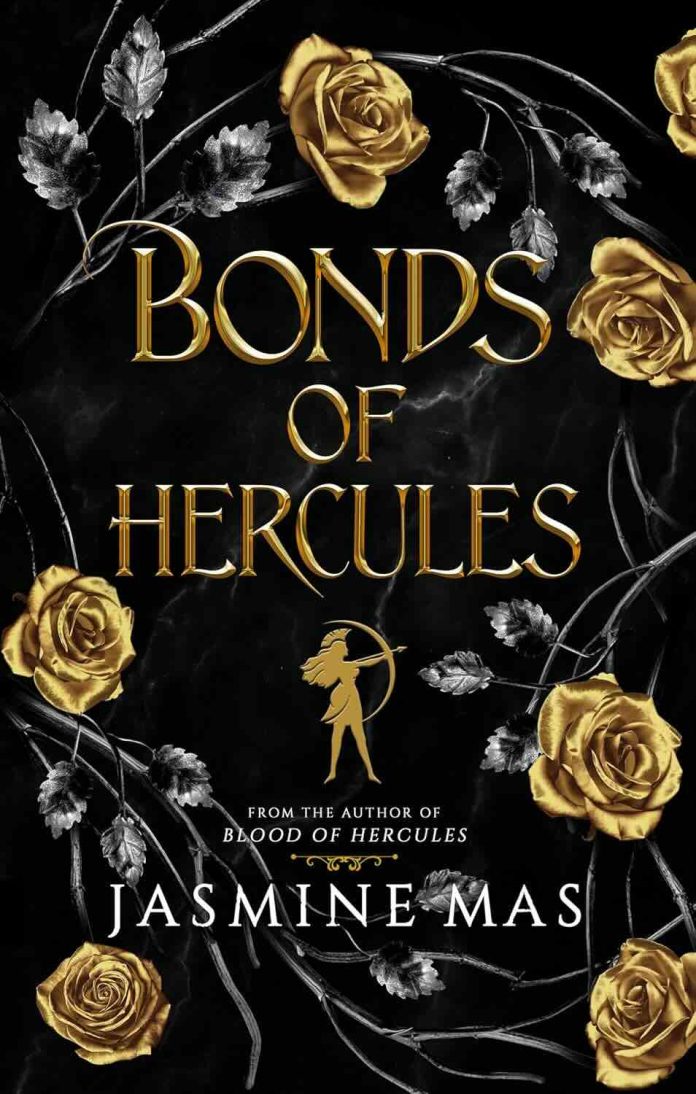
In the tumultuous world of contemporary dark romance, Jasmine Mas returns with “Bonds of Hercules,” the electrifying second installment in her Villains of Lore series. Following the explosive events of “Blood of Hercules,” this sequel plunges readers deeper into a world where mythology collides with modern brutality, and where love is as dangerous as any weapon forged in war. What emerges is a story that’s simultaneously intoxicating and infuriating, compelling yet occasionally confounding—a narrative that demands as much from its readers as it does from its battered protagonist.
The Chains That Bind
Alexis Hert awakens in this novel bound not just by marriage vows, but by the very fabric of fate itself. Eternally tethered to the Underworld’s dark heirs, Augustus and Kharon, through a marriage that has sent shockwaves through Olympus, she finds herself in a position that would break lesser heroines. The marriage bond that was forced upon her in the previous book has evolved from a simple constraint into something far more complex—a twisted enhancement of powers that makes her stronger even as it threatens to destroy her sense of self.
Mas excels at portraying the psychological torment of Alexis’s situation. This isn’t a protagonist who meekly accepts her fate or succumbs to Stockholm syndrome. Instead, she enlists in the Assembly of Death alongside her mentors, transforming her rage into purpose. The author captures the delicate balance between Alexis’s desire for vengeance and her unwilling attraction to her captors with remarkable nuance. Her internal monologue, peppered with dark humor and mathematical references, grounds the fantastical elements in genuine emotional reality.
The Assembly of Death serves as both literal training ground and metaphorical crucible where Alexis must forge her identity anew. Through brutal missions and deadly competitions, she begins to understand that her blood powers—once uncontrollable and terrifying—might be the key to her freedom. Yet Mas doesn’t make this journey easy or straightforward. Alexis’s powers remain volatile, bleeding from her eyes when emotions run high, turning her into both healer and destroyer.
The Villains We Love to Hate
Augustus and Kharon remain as morally complex as they were in the first book, if not more so. Augustus, the eldest heir with his mental compulsion abilities, walks the razor’s edge between protective and possessive. His bleeding eyes—a new development from the marriage bond—serve as a constant physical reminder of the cost of the power he’s gained. Mas writes his perspective with unflinching honesty, revealing a man who genuinely believes he’s doing right by Alexis even as he systematically destroys her autonomy.
Kharon, the sociopathic hunter with emotional manipulation powers, proves equally fascinating and frustrating. His attempts at apology—”I demand you forgive me, Alexis. Right now!”—would be comical if they weren’t so tragically sincere. The author’s ability to make readers simultaneously want to throw the book across the room and keep reading to see what he’ll do next is a testament to her character work.
However, the romance elements struggle under the weight of the trauma. While the chemistry between Alexis and her husbands crackles with dangerous energy, the power imbalance remains so extreme that moments meant to be swooning often feel uncomfortable. Mas doesn’t shy away from this discomfort—she leans into it—but readers expecting traditional romance beats may find themselves conflicted. The “just physical” declaration from Alexis and the violent response it provokes perfectly encapsulates the toxic dance at the heart of this relationship.
The Crimson Duo and Supporting Cast
The introduction of Achilles and Patro as the “Crimson Duo”—Alexis’s assigned mentors and bodyguards—adds layers of tension and intrigue. Achilles, with his mysterious muzzle and devastating power, and Patro, the lie detector with emerald eyes full of calculated menace, create a secondary relationship that mirrors and contrasts the central romance. Their own twisted devotion to each other provides a dark reflection of what Augustus and Kharon could become—or perhaps what they already are.
Mas deserves credit for her supporting characters, particularly Nyx the snake companion and the various protector animals that populate this world. These creatures aren’t mere window dressing; they serve as emotional anchors and comic relief in a story that desperately needs both. The hellhounds Hell and Hound, with their attempts at the “alliteration game” and limited vocabulary, provide genuinely humorous moments without undermining the story’s darker elements.
Persephone emerges as a more complex figure in this installment. Her power to feel every emotion on Crete, coupled with her genuine concern for Alexis, creates one of the more nuanced relationships in the book. She represents what Alexis could become if she accepts her fate—powerful, bound, but finding peace within constraints. Yet she also serves as a warning: even she couldn’t escape her chains, she merely learned to decorate them.
The Spartan Gladiator Competition
The heart of the novel beats strongest during the Spartan Gladiator Competition sequences. When Zeus moves the competition forward by two months and essentially imprisons all Chthonics under suspicion of helping Medusa escape, the stakes skyrocket. Mas’s action sequences shine with brutal clarity. The fight scenes where Alexis faces Titans with wings—a terrifying new development—are visceral and immediate.
The “Angel of Rome” sequence, where Alexis battles Titans to protect humans, represents the novel’s thematic and emotional peak. Here, Mas demonstrates her skill at weaving character development through action. As Augustus watches footage of his wife single-handedly taking down creatures that should be beyond her abilities, while protecting the very humans Spartans typically disdain, the full scope of who Alexis is becoming crystallizes. She’s not just learning to wield her power—she’s redefining what power means.
Yet these competition scenes also highlight one of the book’s persistent issues: pacing. The novel moves in fits and starts, rushing through some crucial moments while lingering perhaps too long on others. The extended sequences in the Dolomites Coliseum occasionally feel repetitive, and the constant near-death experiences, while intense, begin to lose their impact through sheer volume.
World-Building: Mythology Meets Dystopia
Mas continues to expand her unique fusion of Greek mythology with dystopian elements. The hierarchy of Olympians versus Chthonics, the political machinations of the federation, and the mysterious threat of the Titans create a rich tapestry. The revelation about Medusa’s escape and Zeus’s machinations adds political thriller elements to the romance and action.
However, the world-building sometimes overwhelms the narrative. New concepts, houses, and characters are introduced at a breakneck pace that can leave readers scrambling to remember who’s aligned with whom. The various houses—Ares, Hades, Artemis, Aphrodite, Apollo, Dionysus—each have their own politics, powers, and prejudices that aren’t always clearly delineated. A glossary or character guide would have been invaluable.
The integration of modern technology with ancient powers creates fascinating moments—graphing calculators as lucky talismans, body cameras capturing battles, the “Assembly of Death” functioning as a military organization with pagers and generators. Yet these contemporary elements sometimes clash awkwardly with the mythological framework, creating tonal inconsistencies.
The Cost of Power
Where “Bonds of Hercules” truly succeeds is in its unflinching examination of power and its corrupting influence. Alexis’s journey isn’t about becoming powerful enough to escape—it’s about deciding what kind of powerful person she’ll become. The recurring theme of penance versus revenge, separated by “a razor-sharp edge,” captures the moral complexity at the story’s heart.
Mas doesn’t offer easy answers. Hades tells Alexis there are only two paths: “Either we run from what we really are, or we hone it and become legends.” But legends, as this story makes clear, are built on blood and trauma as much as triumph. The question isn’t whether Alexis will become powerful—it’s whether she’ll recognize herself when she does.
The marriage bond itself serves as a brilliant metaphor for toxic relationships. It makes all parties stronger, but at what cost? Augustus and Kharon gain enhanced abilities, but their eyes bleed. Alexis’s powers surge, but they’re triggered by extreme emotion and injury. Everyone gets what they wanted, and it’s torture. This dynamic—getting everything you thought you wanted only to discover it’s destroying you—resonates beyond the fantasy elements.
Technical Craft and Style
Mas’s prose style remains distinctive, blending dark humor with brutal honesty. Alexis’s internal monologue, with its mathematical references and sardonic observations, creates a unique narrative voice. Lines like “Don’t panic, she said as I did just that” and the renaming of Artemis as “Arthritis” inject personality into even the darkest scenes.
However, the multiple POV structure sometimes works against the narrative. While glimpses into Augustus, Kharon, and even Achilles’s perspectives add depth, they also fragment the momentum. The shifting viewpoints can make it difficult to maintain emotional continuity, particularly during action sequences when rapid POV changes create confusion rather than tension.
The author’s tendency toward descriptive detail enriches some scenes while bogging down others. We don’t just learn that Augustus has a scar—we learn every “jagged edge” of it. Every tear of blood is tracked, every wound described in medical precision. While this creates visceral immersion, it occasionally edges into overwrought territory.
Critical Considerations
Despite its strengths, “Bonds of Hercules” stumbles in several areas. The relationship dynamics, while intentionally toxic, sometimes cross from compelling darkness into problematic territory. Augustus and Kharon’s treatment of Alexis—the stalking, kidnapping, and sending of body parts—is framed as romantic obsession rather than abuse. While Mas doesn’t excuse these behaviors, the line between critique and romanticization occasionally blurs.
The plot also suffers from predictability in places. The revelation about Zeus’s schemes, while dramatic, follows familiar patterns. The competition structure, with its increasingly dangerous trials, adheres closely to genre conventions. Readers familiar with dark romance will anticipate many of the major beats, though Mas’s execution generally elevates familiar territory.
Character development, while strong for the main trio, falters with secondary characters. Drex, despite being positioned as comic relief and Alexis’s ally, remains frustratingly two-dimensional. Helen and Charlie, crucial to Alexis’s motivation, appear so infrequently they feel more like plot devices than people. Even interesting characters like Hermos and Agatha from the Assembly of Death remain underdeveloped.
Comparing to Blood of Hercules
Readers of the first book will find “Bonds of Hercules” both familiar and evolutionary. Where “Blood of Hercules” established the world and central conflict, this sequel deepens character relationships and raises the external stakes through the Spartan Gladiator Competition. The mythology is richer, the action more intense, and Alexis more agentic despite her constraints.
However, some may find the sequel lacks the raw discovery that made the first book compelling. The shock value of the forced marriage has worn off, and while the complications it creates drive the plot, the basic dynamic remains unchanged. Alexis is still trapped, still fighting, still torn between hatred and attraction. The circular nature of this conflict may frustrate readers hoping for more forward momentum in the relationship dynamics.
Who Should Read This Book
“Bonds of Hercules” will appeal most strongly to readers who:
- Enjoy dark romance with genuinely morally compromised heroes
- Appreciate mythology-inspired fantasy with contemporary settings
- Can handle explicit content and potentially triggering themes
- Value complex, flawed protagonists over likable ones
- Don’t mind slow-burn romance with heavy emphasis on trauma
- Enjoy ensemble casts with multiple POVs
- Have patience for extensive world-building
This book is emphatically not for readers seeking:
- Traditional romance with healthy relationship dynamics
- Light, escapist fantasy
- Quick resolution to central conflicts
- Easily likable heroes
- Predictable happily-ever-afters
- Standalone stories (this requires reading Blood of Hercules first)
Similar Reads for Genre Enthusiasts
Readers who enjoy “Bonds of Hercules” might also appreciate:
- “From Blood and Ash” series by Jennifer L. Armentrout – For mythology-based fantasy with dark romance elements
- “A Court of Thorns and Roses” series by Sarah J. Maas – For fae romance with initially antagonistic male leads
- “Neon Gods” by Katee Robert – For modern Greek mythology retellings with dark romance
- “The Cruel Prince” by Holly Black – For enemies-to-lovers with genuinely cruel love interests
- “Kingdom of the Wicked” series by Kerri Maniscalco – For mythology-inspired dark romance with strong heroines
Final Verdict
“Bonds of Hercules” is a deeply flawed yet undeniably compelling addition to the Villains of Lore series. Jasmine Mas has crafted a sequel that doesn’t shy away from the darkness inherent in its premise, even when that darkness becomes uncomfortable. The book’s greatest strength lies in its refusal to offer easy answers or quick redemption arcs. Augustus and Kharon remain villains even as we understand them better. Alexis’s journey toward power comes at costs she’ll spend the rest of the series paying.
For readers willing to sit with moral ambiguity, who can appreciate technical craft even when questioning content choices, “Bonds of Hercules” delivers a dark, visceral experience. It’s a book that will provoke strong reactions—both positive and negative—and linger in readers’ minds long after the final page. Whether that’s a recommendation or a warning depends entirely on what you’re seeking in your fiction.
The novel ultimately asks readers to consider: When does a victim become a villain? When does survival become complicity? And perhaps most troublingly: Can love forged in captivity ever truly be free? Mas doesn’t answer these questions definitively, leaving readers to grapple with the same uncomfortable truths as her protagonist.
In the end, “Bonds of Hercules” succeeds more on ambition than execution, more on character than plot, more on atmosphere than resolution. It’s a messy, bloody, emotional journey that refuses to be easily categorized—and in a genre increasingly dominated by formulaic approaches, that refusal might be its greatest strength.
Rating Context: While the book averages four stars from readers, individual reactions will vary wildly based on tolerance for dark themes, appreciation for morally complex characters, and patience with deliberate pacing. Some will find it brilliant; others, deeply problematic. Most will find it somewhere uncomfortably in between—exactly where Jasmine Mas seems to want them.







