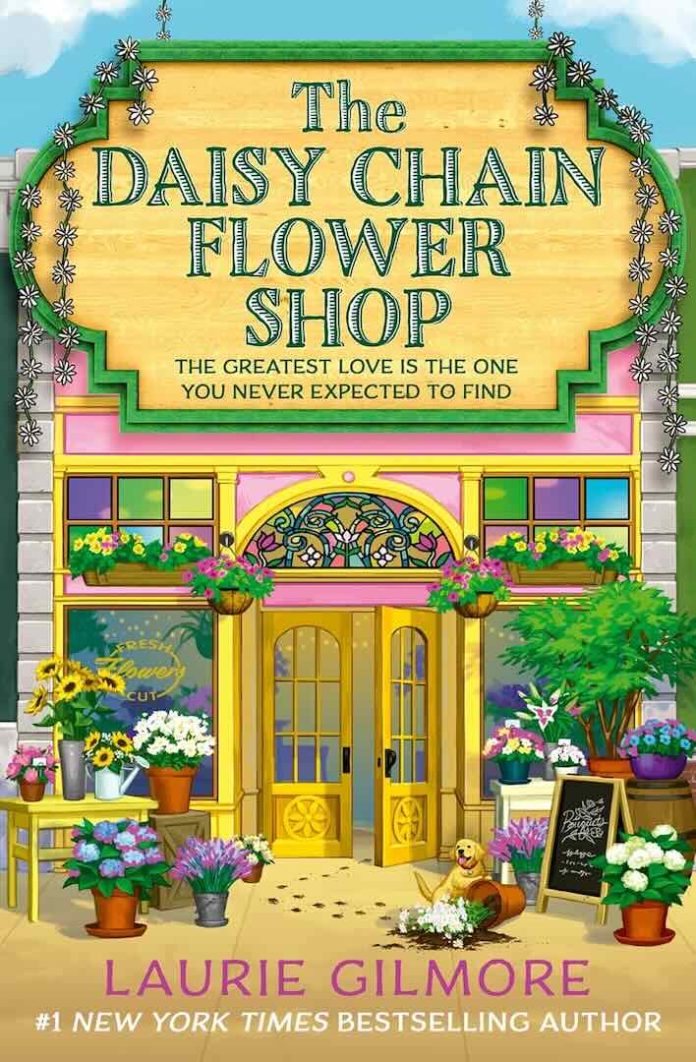
Daisy Scott is allegedly cursed. Three weddings she designed flowers for ended in divorce within a year. Mayor Kelly had a bad dream about a cloud over her shop. Word, as it tends to in small towns, has gotten around. By the time we meet her in The Daisy Chain Flower Shop by Laurie Gilmore, Daisy is booking funerals instead of weddings, and her ex-fiancé has just walked through her door with his new fiancée, looking for venues. It is, as you might imagine, a Tuesday afternoon she did not see coming.
This is the sixth visit to Gilmore’s fictional Dream Harbor, the New England town where a mayor forecasts the future via dreams, every small holiday warrants a festival, and the senior aerobics group chat functions as the central nervous system of local gossip. If you have already cried over Jeanie’s pumpkin spice latte or Iris’s scrambled eggs at the pancake house, you know the drill. Or if you haven’t, here’s the question: do you want to spend a few hundred pages in a town that celebrates Beltane in earnest? If yes, pull up a porch chair.
A Heroine Who Wears Black to a Flower Shop
Daisy is the latest in a long, on-the-nose line of Daisies running the family shop. She has been twice burned. There was Matthew, the eighteen-year-old high school sweetheart she eloped with and divorced a year later. Then David, the city boyfriend who let her move into his apartment, then dumped her by text a month before their wedding. She has come home to recover and ended up with a “cursed” reputation hung around her neck like a wreath.
Enter Elliot, an architect renovating the local inn, two years out from a divorce that flattened him. He has been crushing on Daisy from a polite distance and avoiding her shop on principle, since the last thing he needs is more bad luck. He also has a mother flying in from Tampa to check whether her grown son has remembered to eat. So when Daisy panics and announces him as her boyfriend in front of David, he plays along. They both badly need a fake relationship. The fact that they actually like each other is almost beside the point. Almost.
What Gilmore Gets Right in The Daisy Chain Flower Shop by Laurie Gilmore
Gilmore has been writing this series for a few years now, and her sense of small-town comedy has sharpened. The Beltane festival sequence alone is worth the cover price, complete with maypole chaos and an unlikely May Queen. Her dialogue runs warm and snappy, and she trusts readers to catch a joke without underlining it.
A few elements that work especially well:
- A shy hero done right. Elliot is not the broody growler so common in this genre. He is awkward, observant, kind, and very aware he is about to fall too hard, too fast. He owns ivory dishes with pale blue roses because they were the only thing he kept from his marriage. Reader, you will sigh.
- Heroine self-talk that lands. Daisy’s internal voice is funny in the way that only women who use humor as armor are funny. Her “are you mad at me” spirals feel lifted from a real friendship.
- A community that earns its page time. Couples from the previous books drop in. None of them hijack the story. It is a graceful cameo job.
- A historical companion plot. Daisy stumbles onto a 1925 diary belonging to a great-aunt also named Daisy. The parallel is not subtle, but it is sweet, and it gives Elliot, a self-confessed history nerd, something to do besides pine.
The romance itself moves at a careful pace before it heats up. Gilmore tends to let her couples earn it, and Daisy and Elliot are no exception. When the heat does arrive, it is generous without being gratuitous, and crucially, it grows out of the friendship rather than replacing it.
Where It Stumbles
The book sits at four stars on average, and the missing star is honestly earned. The “curse” premise asks a lot of your suspension of disbelief. Yes, small towns gossip. But the idea that an entire wedding industry would freeze a florist out for months on the basis of three coincidental divorces is a stretch even by cozy romance standards. Gilmore mostly papers over this with charm. Mostly.
The middle chapters slow down more than they should. There are several library research scenes, a few too many tea-and-Oreo chats, and a stretch where the leads keep nearly kissing in ways that begin to feel like a stalling tactic. Readers used to the brisker pacing of the earlier Dream Harbor books may find themselves checking their progress bars.
A few other small frictions:
- The “mystery” promised in the cozy romantic mystery framing is really just a historical subplot. There is no whodunnit, no real puzzle, no danger. Manage your expectations.
- Daisy’s wallowing over David runs a beat or two long. By the third internal speech about how she should have seen it coming, you may want to shake her gently.
- Elliot’s brother and mother are sketched lightly. Their concern feels real, but they never quite become full people on the page.
None of this sinks the book. It just keeps it from being the strongest in the series.
How It Fits the Dream Harbor Series
For readers tracking the whole arc, the lineup goes like this. The Pumpkin Spice Café introduces Jeanie and her grumpy farmer Logan. The Cinnamon Bun Book Store gives us Hazel and a fisherman named Noah on a treasure hunt. The Christmas Tree Farm pairs a Christmas-hating Kira with the always-fixing-things Bennett. The Strawberry Patch Pancake House is the chef-and-nanny entry with Archer and Iris. The Gingerbread Bakery is Annie and Mac’s wedding-week story. And then there is The Daisy Chain Flower Shop by Laurie Gilmore, book six, which loops back to several of these couples in supporting roles and ties off the running mayor-curse joke with affection.
You can read this one as a standalone. You will get more out of it if you have read at least The Pumpkin Spice Café and The Strawberry Patch Pancake House, since Iris, Archer, Logan, and Jeanie all have meaningful appearances.
If You Liked This, Try
For readers who finish The Daisy Chain Flower Shop by Laurie Gilmore and want more in the same key:
- Beach Read by Emily Henry, for opposites-attract small-town vibes with smart banter.
- Yours Truly by Abby Jimenez, if the shy hero with anxieties got under your skin.
- The Flatshare by Beth O’Leary, for a slow-build romance between two people quietly putting themselves back together.
- The Bodyguard by Katherine Center, for fake-relationship-with-real-feelings done warmly.
- Gilmore’s own forthcoming Maple Hollow trilogy, kicking off with Big Bad Wolf, for readers ready to follow her into a new fictional town.
The Verdict
The Daisy Chain Flower Shop by Laurie Gilmore is a soft, slightly uneven goodbye to one of the cozier corners of contemporary romance. It is not the strongest book in the series. It is not the steamiest. What it offers is something quieter: a heroine learning that being broken is not the same as being unfixable, and a hero finally believing he is worth being chosen first. If you have stayed on the porch this long, you will want to stay for one more cup of coffee with Daisy and Elliot.
Just don’t book your wedding flowers with her. Yet.







