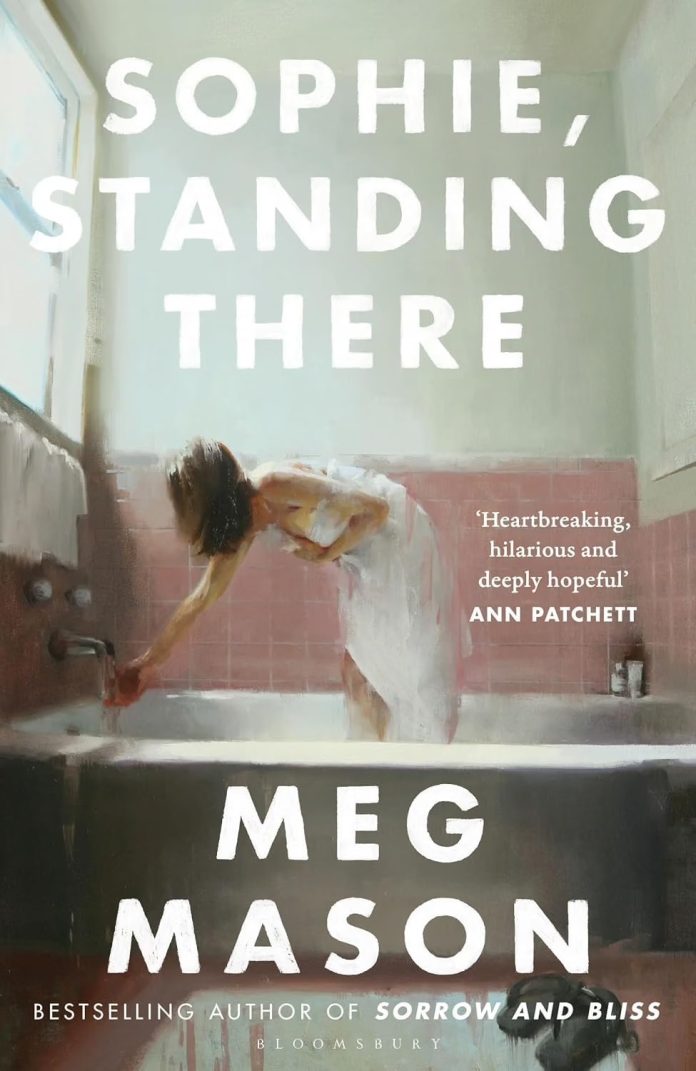
It is past one in the morning and Sophie Pattison is in the bath of a rented flat that belongs to the husband who asked her to leave. The fan drones, the light is the colour of an autopsy, and she is rehearsing how she would introduce herself to a famous novelist she has never met. Just her first name, tried three different ways, as though the wording is the thing standing between them. Sophie is thirty-seven, a sound technician on the literary festival circuit, and she has spent years kneeling at authors’ feet to clip battery packs to their waistbands without any of them glancing back. Sophie, Standing There by Meg Mason is about what grows in a person when nobody is looking at her at all, and it is by turns hilarious and very hard to read.
The Author in Her Head
The thread the whole novel hangs on is a relationship that exists in exactly one mind.
After the festival, a stray list of dream guests Sophie rattles off at the crew dinner ends with Lilac Dunne, a former child actor turned prizewinning novelist. On the bus home Sophie looks up a few lines of her work, recognises her own grief in them, and by dawn she is scrolling photographs with her phone tethered to the wall. Within weeks there are podcasts on loop, a borrowed advance proof on the bedside table, and an imaginary companion who walks beside her in the park and tells her when she can leave a janitor’s cupboard.
Mason is scrupulous about this. She never lets it tip into stalker comedy, and she never lets it be sweet either. Grief-stricken people build shelters out of whatever is to hand, and Sophie, Standing There by Meg Mason is precise about how a voice in your earbuds can keep an ex-husband out of your thoughts better than any friend.
Readers who know the term parasocial interaction will spot it on page one. Sophie spots it too, in a locked bathroom at her brother’s barbecue, and decides it is worse than that. She decides it is love.
The People Who Actually Show Up
Against the imaginary companion, Mason sets a cast of real ones who are much less convenient.
Laurie, Sophie’s older brother, who keeps his phone on all night for her and still manages to read the tone of a pause. Emma, the best friend from a teenage ice-cream job, now sober and a dietitian, whose kindness Sophie has started to find unbearable. Rob and Cass at the local bookshop, bickering over a till roll. A former colleague named Fraser, remembered mostly in stray asides, who never quite leaves the edges of the page.
The engine of Sophie, Standing There by Meg Mason is the gap between these two sets of relationships. The invented one asks nothing, forgives everything and never needs a text back. The real ones require Sophie to show up at a birthday dinner she forgot, and that is exactly why they matter.
What Mason Does With Comedy
It would be easy to describe Sophie, Standing There by Meg Mason as a sad book. It is also one of the funniest novels of the year.
The festival world is skewered with real affection: publicists loosening water bottle lids nobody asked them to open, an audience Q&A where no one stands up, a head of diversity eating carbonara while explaining why women on stage sit so upright. A sixty-year-old artistic director emails her like a newsletter. A bath towel from Ikea becomes a whole emotional history.
Mason’s sentences run on and double back the way anxious thinking does, stuffed with brackets and second thoughts, and the effect is intimate rather than showy. You laugh because Sophie would, and then you notice she has not eaten a proper meal in three days.
Where Sophie, Standing There Gives Ground
Four things stop it matching Sorrow and Bliss at its best.
- The middle idles. Once the fantasy is established, several chapters of podcasts, baths and scrolling restate it without deepening it.
- The run-on style is a choice that costs something. Some readers will find the doubling-back narration exhausting over three hundred pages.
- Some secondary characters are sketches. The festival crew in particular blur into one likeable, slightly interchangeable group.
- The ending declines to land. It is deliberate, even knowing about it, and readers who want resolution will feel short-changed.
None of that dents the central achievement. Sophie, Standing There by Meg Mason is the most exact portrait of adult loneliness I have read in a long time.
Is Sophie, Standing There a Standalone?
Yes. There is no connection to Mason’s earlier books and nothing to read first.
It is her third novel after You Be Mother and Sorrow and Bliss, the second of which became an international bestseller, won Fiction Book of the Year at the British Book Awards and was shortlisted for the Women’s Prize. Readers who loved Martha’s voice there will recognise the same blend of wit and damage in Sophie, Standing There by Meg Mason, turned outward this time onto a quieter woman.
Content Notes for Sophie, Standing There
Marital breakdown and emotional coldness. Infertility, IVF and pregnancy loss. A family member’s drug addiction and violent death, recounted. Grief for dead parents. A strict religious upbringing, discussed. Obsessive thinking and parasocial attachment. Heavy drinking in one sequence. Recovery from alcoholism in a secondary character. Brief sexual content. Sophie, Standing There by Meg Mason handles all of it without sensationalism, but some of it arrives unannounced.
Read it if / Skip it if
Read it if you loved Sorrow and Bliss; if you want a funny book about sadness that respects both; if you have ever worked backstage at anything.
Skip it if you need plot to drive a novel; if long, looping sentences wear you out; if you want an ending tied up neatly.
Read these next
Five for readers who finish Sophie, Standing There by Meg Mason and want to stay in this register:
- Tom Lake by Ann Patchett. Patchett has a cameo here, and her own novel shares its interest in fame at close range.
- Tell Me Everything by Elizabeth Strout. The author Sophie’s festival was supposed to host, on listening as a form of love.
- The Loneliness of Sonia and Sunny by Kiran Desai. A much larger canvas for the same ache.
- Love by the Book by Jessica George. A lighter novel about a reader building a life out of books.
- Consider Yourself Kissed by Jessica Stanley. For another sharp, funny look at a marriage from the inside.
Worth Your Shelf
Early on, walking home with the borrowed proof in her tote, Sophie looks up the printers’ names for the stray lines that get stranded when a paragraph breaks across a page. The one left alone at the bottom with nothing before it is called an orphan: it has a future but no past. The one carried over to the top with nothing after it is called a widow: it has a past but no future. She wishes, briefly, that she had never searched.
That is the question Mason spends the whole novel asking about Sophie, who has plenty of past and cannot see any future past the next bath. It is a slow book in places and a mannered one in others. It is also generous, funny and truer about loneliness than almost anything on the shelf, and it trusts you to notice which of those two lines Sophie turns out to be.







