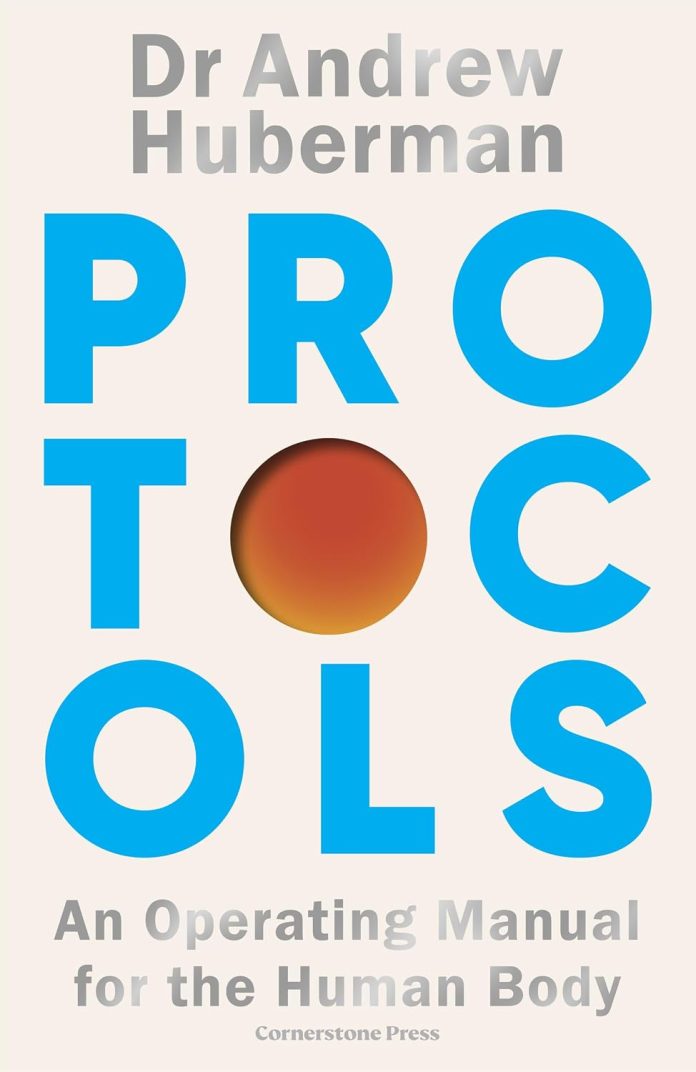
Within an hour of waking, go outside and get daylight into your eyes. Ten minutes if the sky is clear, roughly twice that if it is partly cloudy, half an hour if it is heavily overcast. Not through a window, not through sunglasses, not under a brimmed hat, and never by staring at the sun itself. If you wake before dawn, sit near a bright lamp until it rises. That is the first instruction in Protocols: An Operating Manual for the Human Body by Andrew D Huberman, and it shows you exactly what kind of book this is: a manual that gives you the minutes, the conditions and the exceptions, then spends several pages explaining the cells in your retina that make it work.
How An Operating Manual for the Human Body Works
Huberman is a Stanford neuroscientist whose podcast, Huberman Lab, became one of the most listened-to health shows in the world. This book distils that catalogue into seven chapters: sleep, exercise, stress control, nutrition, light, focus and learning, and personal growth. Together they hold forty-seven protocols, ranked within each chapter by impact.
Every protocol follows the same template. A box of bolded steps tells you what to do. A section explains the physiology behind it. A question-and-answer section handles the objections readers actually raise, such as what to do on a cloudy day or whether a late espresso really matters. You can read it cover to cover, but it is built to be dipped into, and the steps are skimmable in seconds.
The introduction is part memoir. Huberman grew up around physicists, spent his teenage years skateboarding through some rough scenes, and found his way into neuroscience through a college lecturer who made the brain feel urgent. The most charming story belongs to the exercise chapter: at sixteen he cold-called the bodybuilder Mike Mentzer, who rang back, coached him by phone for months and charged him most of his savings for the privilege.
The nutrition chapter is the clearest example of the method. Instead of a named diet, Protocols: An Operating Manual for the Human Body by Andrew D Huberman offers a ratio: how much complete protein a food delivers per calorie. Chicken and scallops sit at the top, beans and rice near the bottom, and grains and nuts are reclassified as carbohydrates and fats rather than protein sources. From there come plate thirds of protein, vegetables and starch, at least nine-tenths of food unprocessed, a modest fruit allowance and one treat a week. He refuses to call sugar poison and argues that eating windows work mainly by cutting calories, which puts him on the sensible side of several diet wars. Not every reader will accept his protein target of a gram per pound of body weight, which sits above what most research says muscle needs.
What Protocols: An Operating Manual for the Human Body Gets Right
The quiet thesis of Protocols: An Operating Manual for the Human Body by Andrew D Huberman is that the most powerful levers are free. He says plainly that no pill replaces sleep, exercise or stress control, and he usually offers the zero-cost version of a tool before the device.
What works
- The numbers are real numbers. A bedroom at 65 to 68°F. Caffeine stopped eight to ten hours before bed. A weekly training split of three lifting days and three cardio days with set ranges, rest times and heart-rate formulas. Very little is left vague.
- The sleep chapter is the book’s backbone. Fifteen protocols, built on Huberman’s own field of circadian vision science, explain why light timing, temperature and consistency matter. Anyone fighting sleep deprivation will find a usable plan here before they reach a single supplement.
- He admits gaps. He concedes that his famous advice to delay morning caffeine has no clinical trial behind it, that supplement studies are small and conflicting, and that rest techniques do not replace sleep. That candour is rarer in this genre than it should be.
- Conflicts are disclosed. The front matter states he is a paid advisor to AG1, Eight Sleep, Function Health, Reveri and WHOOP, and he flags financial ties again at the point of use.
Where the Operating Manual for the Human Body Gives Ground
- Weak evidence still gets strong language. The tone of Protocols: An Operating Manual for the Human Body by Andrew D Huberman is confident throughout. Some scientists have criticised his podcast for overselling thin findings, and the book is better than that reputation suggests, but not immune. Mouse studies, single small trials and correlational cohorts are sometimes narrated as settled. The sleep chapter’s claim that chronotypes split neatly into three equal groups, and the exercise chapter’s insistence on taking every working set to failure, are stated with more certainty than the research supports.
- The commercial ties are disclosed but not neutralised. Products he advises, part-owns or helped design turn up inside the recommendations. Disclosure is honest. It does not make the conflict disappear.
- It is long and repetitive. More than five hundred pages of main text, frequent repeats of the same rules, and an admission at the start of one chapter that its first three protocols largely re-run earlier ones. The editing shows strain elsewhere too: the exercise chapter promises five protocols and delivers four, and a promised sugar-craving tool never arrives.
- The notes are vast but uneven. Roughly eleven hundred endnotes, mostly peer-reviewed, sit alongside his own podcast episodes and lower-tier open-access journals. It reads as a bibliography assembled to support claims rather than a weighing of them.
Read It If / Skip It If
Who gets the most from Protocols: An Operating Manual for the Human Body by Andrew D Huberman, and who should pass:
Read it if:
- You want a single reference shelf for sleep, training and focus, with exact numbers.
- You already follow the podcast and want the essentials organised and searchable.
- You prefer to understand the mechanism before you change a habit.
Skip it if:
- You want a short, simple plan; this is a reference work, not a weekend read.
- You need advice for a diagnosed medical condition, which this is not. Talk to your doctor before trying the supplement or drug sections.
- You are wary of health advice from someone with product ties, however well disclosed.
Read These Next
Readers finishing Protocols: An Operating Manual for the Human Body by Andrew D Huberman will find these pair well with it.
- Atomic Habits by James Clear for the behaviour-change scaffolding that makes any protocol stick.
- The 5 Types of Wealth by Sahil Bloom for treating physical health as one asset among several.
- Why We Sleep by Matthew Walker, which Huberman credits, for the long version of the sleep argument (read alongside its critics).
- Outlive by Peter Attia for a longevity-focused take on exercise and nutrition from another podcast physician.
Worth Your Shelf
As a reference, yes. Protocols: An Operating Manual for the Human Body by Andrew D Huberman is the most organised, actionable version of his advice you will find, and its free core of light, sleep, training and calm is sound enough to change an ordinary week. Read it with a pencil and a little scepticism, start with the morning walk, and treat the supplement pages as the last chapter of the conversation rather than the first.
The sun is free. Most of what matters in this book is too.







