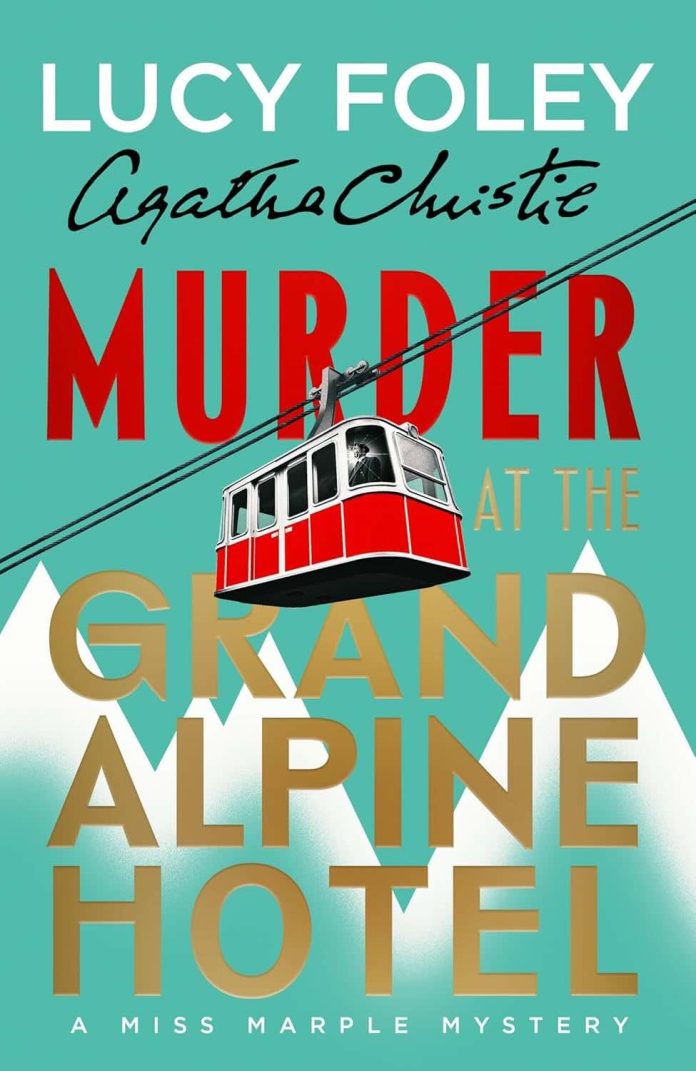
Four people narrate this book and each one arrives with a label stamped underneath their name. Diana Glass, The Help. Catherine Narracott, The Wife. Sylvia Sinclair, The Star. Bruno Crane, The Friend. Anyone opening Murder at the Grand Alpine Hotel by Lucy Foley and waiting for a fifth heading marked The Detective will be waiting a very long time.
Miss Marple never narrates a syllable of her own novel. She is seen, quoted, misjudged and underestimated, always from the outside, mostly by a paid companion who is not quite what she appears. It is the single boldest choice in the book, and it turns out to be the most faithful one.
A Body in the Red Gondola
The set-up is pure closed circle. It is 1950, and the Grand Alpine sits high above St Celeste, reachable only by a cog railway that runs to a strict timetable. Mrs Bantry has brought Miss Marple out from St Mary Mead for the mountain air.
Also in residence: Anthony Narracott, a Conservative leadership contender with a Victoria Cross, a limp that appears only when there is an audience, and a nut allergy the whole dining room learns about on night one. Within two days somebody has planted poison in his suite, sent a nut tart to his table, and run a strange black flag up the hotel pole.
Then Narracott takes the first gondola of the morning, alone, as he has every day. The doors open at the top of the mountain and he is dead on the floor.
The novel handles this with real economy. A short unattributed chapter in the voice of the gondola attendant does the work of an entire procedural, down to the empty coffee flask under the seat and a faint sweet smell he cannot place. Two more bodies follow. The train stops running. Nobody leaves.
Four Liars, and Murder at the Grand Alpine Hotel by Lucy Foley Trusts Them All
The rotating first-person structure is Foley’s signature and she has never used it better, because the Christie framework gives it something to push against.
Every narrator is concealing something and every one believes their own concealment is the reasonable one. Catherine has been trained since childhood into a performance of wifeliness so total that she narrates her own marriage in the vocabulary of finishing school. Sylvia, a Hollywood star on the wrong side of forty being offered the part of a twenty-six-year-old’s mother, carries a private grief that improves every page she is on. Bruno Crane, broke, drinking, missing part of one ear, is the most purely Christie creation here: a coward given just enough self-knowledge to be pitiable.
And Diana Glass, the companion who does the typing and the fetching, watches everybody through a camera lens and lets slip that she reads French rather better than her position warrants.
What Works
- Miss Marple is written correctly. She knits, she rambles about a girl in St Mary Mead who was rather a silly goose, and she uses the rambling as a delivery mechanism for the thing she has just worked out. Foley understands that the village parallel is not a quirk. It is the method. Readers who came to the character through the originals will find nothing off-key.
- The clueing is genuinely fair. Everything needed is on the page, most of it hidden inside domestic detail so small it reads as texture: a hairstyle, an animal’s behaviour, the order of prayers kept by visiting nuns.
- The hotel is fully realised. Ice-skating waiters, a bar concealed behind a hinged painting, troll masks with real animal teeth, a toboggan run rebuilt by hand each winter that maims a guest or two per season.
- The war is not decoration. Everyone here is five years out of a catastrophe, and it shows in what they cannot say to each other.
Where Murder at the Grand Alpine Hotel by Lucy Foley Gives Ground
- Miss Marple pays for her own absence. Keeping her off the narration keeps her off the page for long stretches, and the middle third occasionally feels like a Foley thriller with a guest star.
- A romance subplot eats real estate. The attraction between one narrator and a late-arriving investigator is well written and thematically defensible, and it still slows a book that had been moving beautifully.
- The solution leans on luck. The scheme requires several strangers to look at the wrong thing at the right moment. It holds, but only just, and readers who like their alibis engineered rather than fortunate will grumble.
- The capture happens offstage. After a superb final movement on the mountain, the closing arrest is reported rather than dramatised, which deflates the last few pages.
A Christie Book That Argues With Christie
The thesis of Murder at the Grand Alpine Hotel by Lucy Foley is about who gets looked at. A companion, a nun, a maid with an armful of laundry, an elderly lady with her knitting: all of them cross a lobby without registering on a single retina. The film star is the inversion, a woman so reduced to platinum hair and dark glasses that removing them removes her.
This is Christie’s oldest engine, the one that made an old woman in a village the most dangerous person in England, and Foley pushes it further than the originals ever did. She also does something the estate presumably had to approve, which is to put a decorated war hero at the centre and ask what a medal is actually evidence of. Nobody here is punished for the crime the reader expects them to be punished for, and Miss Marple’s verdict in the final chapter, delivered without a flicker of sympathy, is the hardest thing she has said in seventy years of print.
Who Murder at the Grand Alpine Hotel by Lucy Foley Is For
Reach for it if you want a fair-play puzzle with modern psychological depth, if snowbound hotels and last trains at ten o’clock are your idea of a good evening, or if you have read the Marple canon and want a continuation that has thought seriously about what the canon was doing.
Note that Murder at the Grand Alpine Hotel by Lucy Foley carries two names on the jacket. This is an authorised Agatha Christie Limited novel rather than a Foley standalone, and readers expecting the sourness of her contemporary thrillers will find something warmer and more formal. There is a wartime atrocity described briefly and plainly, and a running thread of coercive control inside a marriage.
Read These Next
- The Guest List by Lucy Foley. The closest thing in her own back catalogue: an island, a wedding, and the same rotating narrators.
- Marble Hall Murders by Anthony Horowitz. For readers who want another contemporary novelist working respectfully inside golden age machinery.
- The Game Is Murder by Hazell Ward. Puzzle-first, playful, and very aware of its ancestors.
- A Caribbean Mystery by Agatha Christie. Marple abroad and out of her own territory. The final chapter here contains a quiet joke about it.
- The Sittaford Mystery by Agatha Christie, for snow, isolation and a timetable.
For another sealed location full of wealthy strangers who are all lying, try The Black Orchid by Loreth Anne White.
The Last Word
The pleasure of Murder at the Grand Alpine Hotel by Lucy Foley is watching two very different writers occupy the same book without either being flattened. The structure, the glamour and the ache belong to Foley. The clue about the nuns and the clue about the dog belong entirely to Christie.
It is not a perfect novel. The middle sags, the romance is a luxury it could not quite afford, and the arrest is a footnote. But it is doing something that most estate continuations never risk, which is to look at the sainted dead of the last war and ask, politely, over the knitting, whether anybody ever checked.







