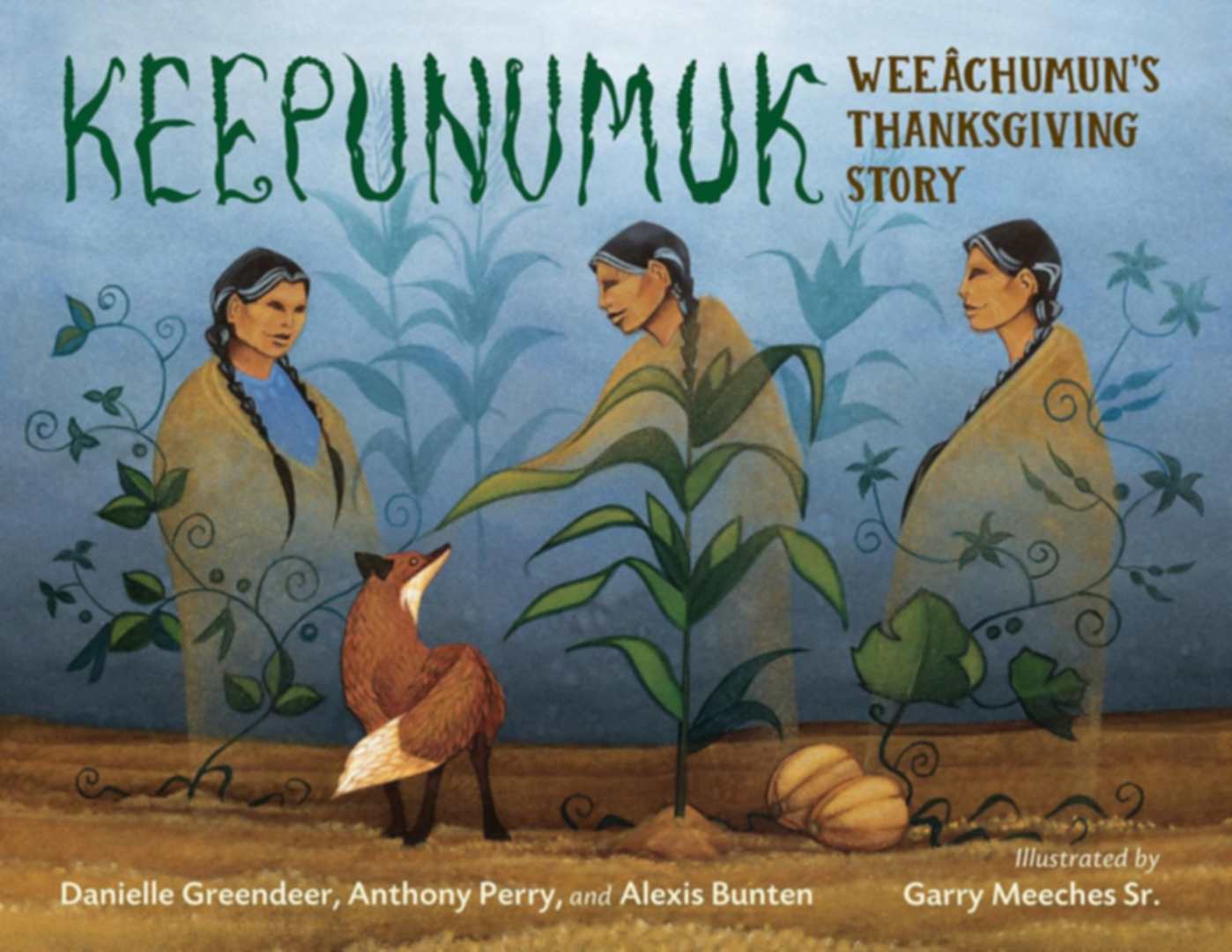


The trick of this picture book is a change of typeface. It opens in a present-day Wampanoag garden, set in clean modern type, where a grandmother called N8hkumuhs and her grandchildren Maple and Quill are deciding what to pick for lunch. When Maple asks whether the story she wants is about the first Thanksgiving, her grandmother gives the old name for it, Keepunumuk, the time of harvest, and promises: “Here’s what really happened.” Turn the page and the letters change to a hand-drawn storyteller’s face, the sky turns deep blue, and a ship with white sails is coming in. Keepunumuk by Danielle Greendeer, written with Anthony Perry and Alexis Bunten and illustrated by Garry Meeches Sr., is built on that crossing from a family’s table into a legend.
How the Story Is Built
Inside the legend the central figure is Weeâchumun, the corn, the eldest of the Three Sisters. Two winters after sickness emptied the villages of the people who tended her, she fears the coming winter will be her last. So she sends Fox to watch the newcomers and report back. Fox becomes the reader’s eyes for the whole middle of the book, standing at the edge of nearly every spread while the strangers come ashore, struggle through the cold and fail to grow enough food.
In spring the plants and animals hold a council. Beans, Squash and Deer want to help. Fox, who has seen the most, votes no, and Rabbit answers him with the book’s moral centre: frightening newcomers are still living things, and helping living things is how the world works. Weeâchumun then sends dreams to the First Peoples, Ousamequin meets the newcomers, and Tisquantum shows them how to plant corn with fish and seaweed. The harvest comes in, and the two groups feast for three days.
Then the frame closes. Back in the garden, the children talk about what they have heard, and the grandmother explains why the family prays before eating.
Danielle Greendeer and Company Change Who Acts
The quiet radical move in Keepunumuk by Danielle Greendeer is agency. In the version most American children meet at school, the Pilgrims are the subject of every sentence and the Native people arrive as helpful extras. Here the decision to help belongs to the land itself, and to the people who listen to it. The newcomers are not villains. They are hungry, grieving and deaf to the voices around them. But they are not the heroes either, and the book closes with a line that names both meanings of the day without flinching: for many Americans a day of thanksgiving, for many Wampanoag people a day of mourning.
What works
- The Three Sisters as spirit women. Meeches paints Corn, Beans and Squash as tall, braided women in golden blankets, slightly translucent, with the actual plants growing through their bodies. They are calm and watchful, and they look like guardians rather than cartoons.
- The acrylic palette. Cobalt skies, ochre grass and dark evergreens give the book the look of a woodland painting, and the winter spreads switch to snow and pale turquoise so the newcomers’ hardship is felt rather than explained.
- Language without fuss. Wôpanâak words such as wetu, nasamp and weeâchumun sit inside the sentences, and a pronunciation list at the front means an adult reading aloud will not stumble.
- Back matter worth the price. A map of traditional nations (used with permission from Aaron Carapella), a note that sixty-nine Wampanoag communities lived in the region in 1621 and only two are federally recognised today, Strawberry Thanksgiving and other harvest feasts, and a Spirit Plate practice that any family can try.
Where It Gives Ground
- The frame talks in lessons. The present-day pages carry most of the explaining, and the children’s lines sometimes sound written to deliver a point rather than spoken by a four-year-old. The legend pages are livelier.
- “What really happened” is a big promise. The grandmother’s line pitches Keepunumuk by Danielle Greendeer as corrective history, while the back matter, more honestly, calls this a new story built on traditional understanding. Families should read it as both.
- Tisquantum is simplified. He appears only as a skilled farmer. How he came to speak English, after being captured and taken to Europe, is left out, so parents of older children may want a fuller account alongside it.
Read These Next
- We Are Grateful by Traci Sorell. A Cherokee year of giving thanks, season by season, with Frané Lessac’s bright gouache.
- Fry Bread by Kevin Noble Maillard. Another family-table picture book about Native food, memory and many nations at one meal.
- Squanto’s Journey by Joseph Bruchac. The fuller life story of Tisquantum, told in his own voice, for slightly older readers.
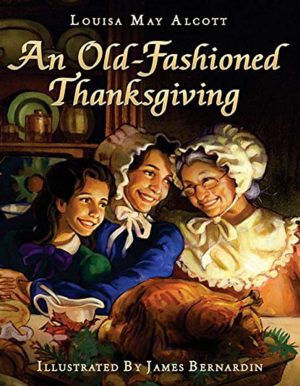
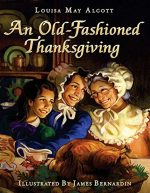
- An Old-Fashioned Thanksgiving by Louisa May Alcott. A nineteenth-century New England holiday from the settler side, useful for comparing how the day was imagined.
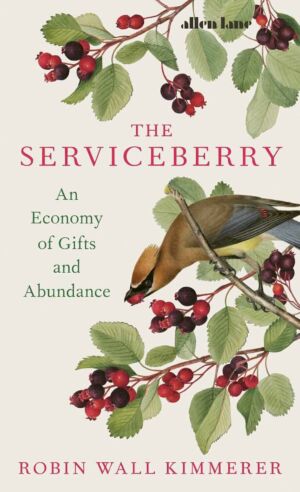
- The Serviceberry by Robin Wall Kimmerer. For the adults: a short essay on gift and reciprocity that shares this book’s idea that the land gives first.
About Danielle Greendeer and Her Co-Creators
Keepunumuk by Danielle Greendeer is a four-person, four-nation collaboration, and you can feel the care of a committee in its back matter. Greendeer brings the Wampanoag heart of it: she lives in Mashpee, on Cape Cod, and the real Maple and Quill who appear in a photo at the end are Mashpee Wampanoag children. Meeches supplies the paintings, and they are the book’s strongest argument.
- Greendeer is a citizen of the Mashpee Wampanoag Nation whose work covers tribal governance, cultural perpetuation and food sovereignty.
- Garry Meeches Sr. is Anishinaabe, born on the Long Plains reserve in southern Manitoba.
- This was his first picture book.
- Charlesbridge published it in August 2022, ahead of that year’s holiday season.
- The dedication thanks the Wôpanâak Language Reclamation Project, founded in 1993, whose youngest speakers are the first children in over a century to grow up with the language.
What Stays With You
Most Thanksgiving picture books end at the table. Keepunumuk by Danielle Greendeer goes one step further and asks who set it, and its answer, the corn and the people who listened to her, is gentle enough for a five-year-old and solid enough to unsettle a parent. The frame can sound like a lesson and Tisquantum deserves more than one page of farming, but the art alone earns this a place among Three Sisters stories on any family shelf. Read Keepunumuk by Danielle Greendeer before the turkey this year, then make a Spirit Plate and put it outside. The children will remember who it is for.