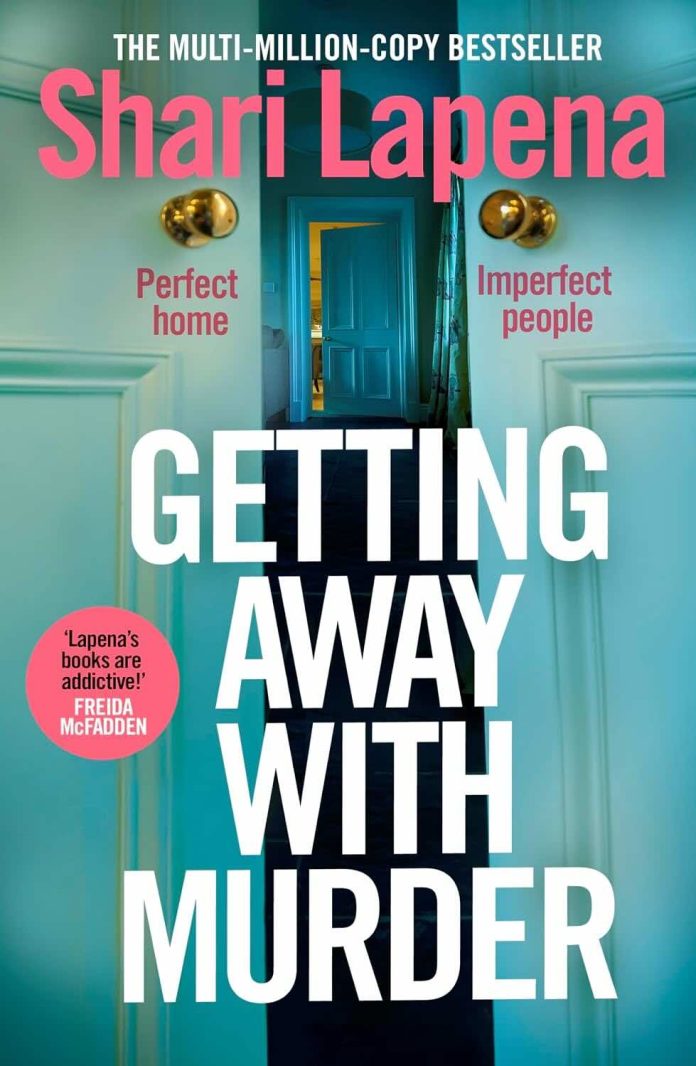
What if a thriller told you exactly who the killers are before the first chapter even begins? That is the gamble at the heart of Getting Away With Murder by Shari Lapena, her tenth stand-alone thriller, and it mostly pays off. This is not a whodunit. It is a “will they get caught,” a slow tightening of the net around two people you should despise but cannot stop watching. Lapena has always written about ordinary people doing terrible things behind respectable front doors. This time, she hands us the terrible thing in the prologue and spends the next three hundred pages asking a nastier question: what does getting away with it actually cost?
The Case File: A Brownstone Worth Killing For
Ted and Jill Westcott have the kind of life that gets photographed for magazines. A restored Italianate brownstone in Brooklyn Heights, a gallery job for her, an investment firm position for him, and no children to complicate the picture. They adore their house the way other couples adore their kids, and Lapena makes that adoration feel almost physical. The mahogany staircase, the heated porcelain tiles, the plaster ceiling rosette: the house is described with the loving attention most authors reserve for a romantic lead, and that is precisely the point.
Then the money runs out. Ted has quietly burned through his inheritance, borrowed from a loan shark, and lost a fortune on a stock tip. His older brother Greg, worth roughly forty-five million dollars, refuses to lend him a cent. Greg is also, conveniently, unmarried, childless, and fond of sailing without a life jacket. You can see where this is going. The prologue puts you on the deck of the Fortune Seeker in rough Atlantic waters, and what happens there is rendered with chilling, matter-of-fact calm.
What follows is the real story. A Coast Guard investigator with a chip on his shoulder starts circling. Anonymous texts arrive. Something small and glassy glints from a bookshelf. The couple who committed the perfect crime discover that someone, somewhere, has been watching.
Why the Inverted Structure Works
Lapena is working in the tradition of the inverted mystery here, the format Patricia Highsmith perfected and shows like Columbo made famous. Since we know who did it, suspense has to come from somewhere else, and she finds it in three places:
- The cat and mouse with Special Agent Ramirez, a working-class investigator from Queens whose resentment of the wealthy gives the procedural scenes a bitter, class-conscious edge that feels fresh for this author.
- The guessing game around the blackmailer. Once the Westcotts realize someone has evidence, nearly everyone in their orbit becomes a suspect: a best friend with a spare key, a cleaning lady with money troubles, a con man from Ted’s past, a bitter ex-sister-in-law. Lapena rotates through their viewpoints and keeps you genuinely unsure.
- The marriage itself. Watching Ted and Jill’s adoring partnership curdle under pressure is the book’s most satisfying long game. Jill even gets a pointed Lady Macbeth comparison, and it lands.
The short chapters and rotating perspectives are classic Lapena, and here the structure earns its keep. Nearly every viewpoint character wants something, hides something, or envies someone, which turns even the quiet domestic scenes into small studies in greed.
Characters You Love to Watch, Not Love
Nobody in Getting Away With Murder by Shari Lapena is especially likable, and the book is honest about that from the start. Ted is a soft product of privilege discovering an ugly steel inside himself. Jill married for money and knows it. Their friends measure affection in net worth. Even the sympathetic figures, like the Russian-born cleaning lady Nadya, get pulled toward compromise the moment opportunity knocks.
This wall-to-wall cynicism is a deliberate choice, and it works better than it should because Lapena keeps finding small, human notes inside the greed. Nadya’s complicated love for her wayward son. Lara’s grief colliding with her opportunism. Ramirez standing outside the brownstone at night, unable to explain his own obsession. These moments keep the book from tipping into pure misanthropy.
The Standouts
- Ramirez is the closest thing to a moral center, and his fury at watching wealth deflect consequences gives the novel its sharpest theme.
- Nadya quietly steals the book. Her chapters have a warmth and specificity the wealthy characters lack, and her arc delivers the story’s best final note.
- John Burnley, a charming ex-convict with a gold lighter and no conscience, injects welcome menace every time he strolls into a scene.
Where the Book Stumbles
“Getting Away With Murder” is a very good thriller rather than a great one, because the flaws here are real even if they never sink the story:
- The middle sags with repetition. Jill panics, Ted reassures, a text arrives, repeat. A tighter edit could have trimmed thirty pages of the couple relitigating the same fears.
- Jill’s unraveling is more told than felt. Her shift from cold co-conspirator to trembling wreck happens fast, and some readers will find the pivot convenient rather than earned.
- One legal turn near the end, while apparently grounded in actual New York law, resolves a mountain of tension with what amounts to a technicality. It is thematically perfect and dramatically a little deflating at the same time.
- Coincidence does some heavy lifting in the final third, particularly around who knows what and when.
None of this ruins the experience. It does mean the novel is more of a wicked entertainment than a masterpiece of the form.
The Writing: Plain, Fast, and Sneakily Sharp
Lapena’s prose has never been showy, and it is not showy here. Present tense, short declarative sentences, chapters that end on small cliffs. What sets this particular book apart is the irony humming underneath. Ted’s closing reflections on wealth, reputation, and how quickly the public forgives the rich read like quiet social commentary smuggled inside an airport thriller. The final pages deliver one of the meanest, funniest last images Lapena has ever written, and it recasts the whole novel as a dark joke about surveillance and class. I finished it in two sittings and grinned at the ending in a way I did not expect.
Shari Lapena’s Earlier Thrillers
If “Getting Away With Murder” is your first Lapena, know that she has been refining this formula since 2016. Getting Away With Murder by Shari Lapena sits comfortably alongside her strongest work. Her debut, The Couple Next Door, sold over four million copies and remains her calling card. An Unwanted Guest tried a snowbound locked-room setup, Not a Happy Family dissected inheritance greed, and recent bestsellers Everyone Here Is Lying and She Didn’t See It Coming sharpened her suburban paranoia. This new novel is her most morally daring, because it removes the mystery and dares you to keep reading anyway.
Read This Next: Similar Books
If the premise of Getting Away With Murder hooks you, these make natural follow-ups:
- Something in the Water by Catherine Steadman, another married couple who commit a crime for money and watch it metastasize
- The Talented Mr. Ripley by Patricia Highsmith, the gold standard for rooting against your better judgment
- A Simple Favor by Darcey Bell, best-friend betrayal with a wicked streak
- Behind Closed Doors by B.A. Paris, a perfect marriage hiding something rotten
- The Housemaid by Freida McFadden, for the upstairs-downstairs tension Nadya’s chapters echo
- The Couple Next Door by Shari Lapena herself, if you want to see where this all began
The Verdict
Getting Away With Murder by Shari Lapena is a confident, mean-spirited treat that trades the usual twist machinery for something more uncomfortable: a clear-eyed look at what money lets people survive. It is repetitive in stretches and its ending resolves on a technicality, but the propulsive pacing, the rotating gallery of schemers, and that final poisoned-dart image make it easy to recommend. Come for the perfect crime. Stay to find out that “getting away with it” and “winning” are two very different things.