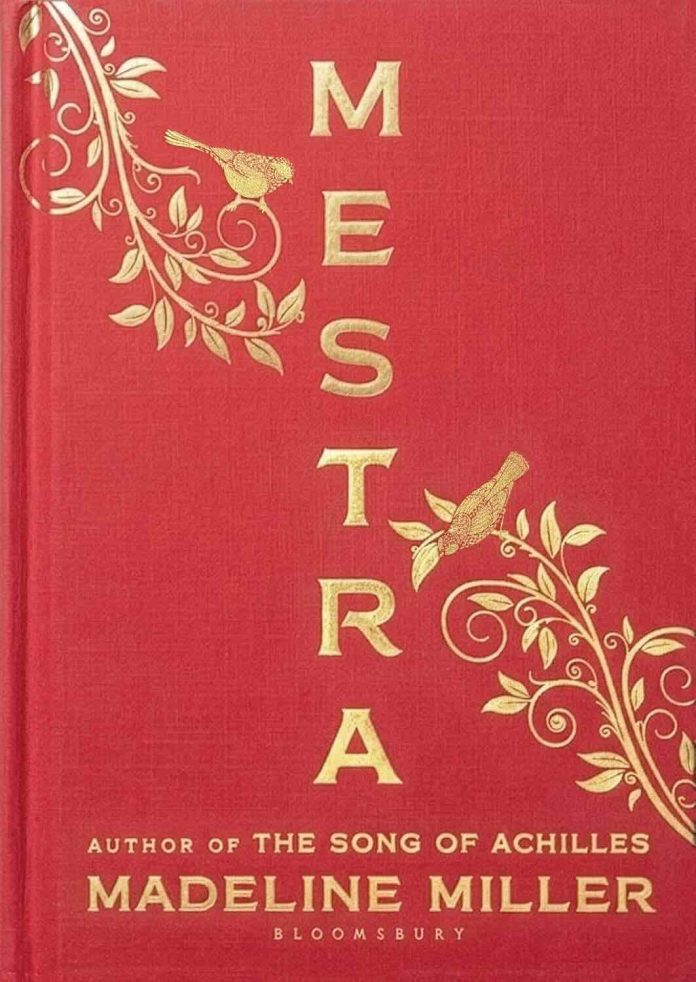
The deal is struck in the first paragraph. A king whose treasury, livestock and household are all gone sells his fifteen-year-old daughter to a passing merchant for seven roasted chickens. They had agreed on ten, but the buyer is clever: he brings them hot, in a basket, and lets the smell finish the negotiation. She can hear her father pulling the joints apart as she is led out in a veil made from an old dress. Mestra by Madeline Miller is ninety pages long, and it establishes its economy in about ninety words.
What Mestra by Madeline Miller Charges for the Gift
The through line here is not the curse. It is the bill.
Ovid gives us the outline. Erysichthon of Thessaly cuts down a grove sacred to Demeter and is punished with a hunger that cannot be satisfied; he eats his way through his wealth and finally through himself. His daughter has the power to change shape, so he sells her again and again, and she escapes each buyer by becoming something else. That is the whole myth, a couple of hundred lines, told from a distance and with a certain relish.
What Mestra by Madeline Miller does is stand inside it and start counting. Every transformation is priced. The first one arrives as illness: a cold that spreads up her body, a beard that hurts when she pulls at it, hands twice their old size. When she reaches home, the sight of her father is enough to strip it all off her again, and she is back to a thin voice and aching legs. That detail recurs, and it is the story’s cruellest invention. The change holds until he looks at her.
Then the testing begins. He asks her to become other women, and then better ones: a cook, a cousin, a queen glimpsed at a feast when she was a child, who once gave her a silver cup with vines on it. He wants her improved. Prettier, younger, plusher, all of it more saleable. And here is the limit she keeps running into: she can only become people she has actually known. She cannot invent. She cannot edit. Every body she wears belongs to someone.
The Sale, and the Arithmetic
The middle section of Mestra by Madeline Miller is a ledger. She is sold five times in a day, then six. As the cook, as the queen, as her nurse’s daughter, as her cousin, over and over, to men who check her teeth and ask whether she will breed. She escapes each of them by turning into the buyer himself and walking out through the front door, and she comes back to her father with stolen bread.
Miller handles the assaults with a technique that is also the story’s psychology. Hands go under the dress, and the narrator observes, carefully, that it is not her they are touching, and that when she changes she is wiped clean. She keeps a tally instead: roasted pig, beans in gravy, honeyed porridge, a millet cake. Six times is a new record. She says it out loud, hoping to be praised.
The horror in all this is arithmetical, and the story states it in one flat sentence about a chamber pot that contains nothing but a few drips and a single dry pebble. Everything he eats goes nowhere. Her conclusion, arrived at while tethered to an olive tree, is the line the piece turns on: they could rob a thousand lords, and he would still starve to death with his mouth full.
Mestra, Madeline Miller, and the Father Who Sells
Erysichthon is the best thing here, and he is built out of sales technique rather than appetite.
He was a great host once. He made his fortune by getting people to hand things over, one piece at a time, and he is still doing it. And he tells buyers this is their chance, that at that price she will be gone by noon. He is warm when she is useful and cutting when she is not: her successes are the god’s gift used well, her failures are her own dullness. When she suggests, twice, that he might simply apologise to the goddess and replant the grove, his refusal is total and instant. He has done nothing that needs forgiveness.
And the story is precise about why she keeps going back. She is fed on scraps of attention, and she recognises it far too late: she had never been his child, only the nearest available meat. Mestra by Madeline Miller does not soften that with a deathbed scene or an explanation. It simply lets her work it out, on her feet, in a hot room.
Where Mestra by Madeline Miller Gives Ground
Three things, and they are small.
- The god is dispatched very fast. The rape on the beach that sets everything moving gets a single short paragraph and one devastating line about not being able to fight a god. It is the right decision for the story’s proportions, but a reader coming for a reckoning with Poseidon will not get one.
- The coda explains a shade too much. A conversation with her cousin does useful work, and then does slightly more, handing the reader an interpretation of the gift’s origin that the story had already implied more elegantly.
- It leaves the theology open. Whether the power came from the god at all is raised and deliberately not settled. Some readers will find that the most sophisticated thing in the piece; others will find it a dodge.
Read It If, Skip It If
Mestra by Madeline Miller is short and very exact about who it is for.
Read it if:
- You want the Miller of Circe at her most compressed. The prose is plain, the images are few, and nearly every one lands.
- You like a myth retold without being modernised. Nobody here speaks in the twenty-first century, and the anger is not explained to you.
- You have ninety minutes and want them used properly.
Skip it if:
- You want a novel. This is a standalone short story, priced and packaged like a small book, and you should know that going in.
- Sexual violence, even briefly handled, is something you avoid.
- You need a myth to end in restitution. This one ends in something stranger and better earned.
Content Notes
The rape of a fifteen-year-old by a god, described briefly and without detail, with the injuries noted afterwards. Repeated sale of a child for sex, and repeated groping and handling by buyers, including a scene she escapes at the last moment. Starvation, in sustained detail, including a body described bone by bone. Self-harm by proxy: a parent cutting flesh from a living child and eating it. Cannibalism, reported. Animal slaughter for food, including beloved animals. Parental coercion and emotional abuse throughout.
Read These Next
Five of ours for readers who finish Mestra by Madeline Miller.
- Circe by Madeline Miller is the obvious next step, and a useful contrast in scale.
- I, Medusa by Ayana Gray takes another woman punished for a god’s assault and gives her a whole novel.
- This Immortal Heart by Jennifer Saint for the same territory worked at greater length.
- Mythos by Stephen Fry if you would like the source stories told straight first.
- Best Greek Mythology Retellings Like Circe and The Song of Achilles for where to go after that.
Worth Your Shelf
Ovid’s readers already know how Erysichthon finishes, and Mestra by Madeline Miller trusts you to know it too. She reports it secondhand, as gossip on a boat, with a sailor making big eyes over the detail about the fingers. The ending she actually writes is somewhere else entirely, and it is about the daughter.
Here is what stays. Every other wound in the story closes; the flesh comes back everywhere except one place above her elbow, which is shiny, pink and sunken, and her cousin touches it before she says anything at all. And when Mestra finally lists herself, she does it as a set rather than a self: the horse, the fisherman, the cook, the falcon, the lucky cow, and the girl with the scar. A woman who can be anyone has to decide what to count as herself, and the answer she reaches is all of it, including the mark. Ninety pages. Not one wasted.







