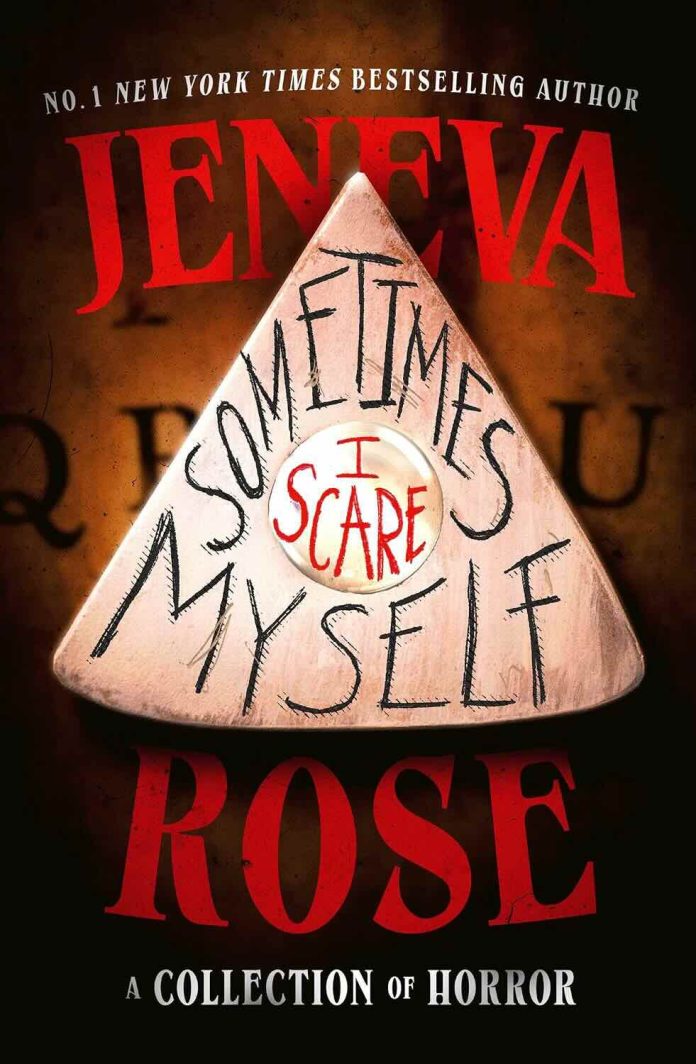
A woman reaches out to straighten a fork that does not need straightening. The place cards are aligned to the millimetre, the centrepiece sits low so nobody has to crane, and the roast is timed to the minute. She is not doing this because she enjoys hosting. She is doing it because plans make the world behave, and when things follow a schedule they do not swerve and they do not die. That is the first page of Sometimes I Scare Myself by Jeneva Rose, and it is a better guide to this collection than the blood on the cover.
What Sometimes I Scare Myself Actually Is
Set expectations first, because the packaging misleads. Sometimes I Scare Myself by Jeneva Rose arrives billed as a collection and the subtitle promises horror, both true, but these are not short stories. There are three novellas here, each around twenty-five thousand words with its own chapter numbering. If you wanted ten quick shocks before bed, adjust.
Rose opens with a note explaining where all three came from: intrusive thoughts, the kind that arrive as a what-if and then make themselves comfortable. What if you opened the door? What if you answered the call? And what if you didn’t? She says the stories live in the gap between impulse and consequence, and that is more than jacket copy. Every one of the three is engineered around a rule that somebody breaks without understanding that it was a rule.
In “Never Kill the Medium,” a thirtieth birthday dinner acquires an uninvited guest with a duffel bag of candles, a brass bell and a slab of wood scarred with old burns. Rings, watches and a lucky penny go into a circle. Names get spoken three times. Something answers, and the question becomes what happens to a door nobody remembers to shut.
In “The Nightmare House,” the centrepiece of Sometimes I Scare Myself by Jeneva Rose, a family leaves Chicago for a bargain property in a Wisconsin town of two hundred and fifty-six people, where the neighbours stare without waving and communicate almost exclusively in casserole.
In “All Curses Are Final,” five college friends stop at a gas station whose hand-painted sign announces that every item inside is cursed, the curse lifted at the point of sale, and one of them thinks it funny to slip a souvenir pen into somebody’s bag.
The Middle Story of Sometimes I Scare Myself
Of the three, “The Nightmare House” is comfortably the strongest, and the reason is what Rose does with the reader’s certainty.
Kristin is twelve weeks postpartum. A whisper brushes past her in an unlit hallway. A light switch pushes back against her thumb. Wet footprints cross her studio floor and dissolve into puddles as she watches. She is hit at an intersection and then listens to four witnesses and a sheriff agree it was her fault. Because we are in her head, we know all of it is real.
Her husband and her fifteen-year-old daughter do not. They sit her down, gently, with a plan to take some pressure off her, and the scene is agonising precisely because their kindness is so well meant and so completely wrong. Rose has written the most frightening thing in the book and it is not the ghost. It is a woman assembling perfectly good evidence in front of two people who have already decided what her evidence means.
Then the reveal lands and inverts everything, and an image that had been the scariest in Sometimes I Scare Myself by Jeneva Rose turns out to be the saddest in it. That is proper construction.
It also has teeth because it is true. Rose says in her acknowledgments that this one came from her own life, from a dream house ruined by neighbours and small-town politics, escalating to internet mobs, strangers knowing her address, and threats arriving while she was eight weeks postpartum. Her own gloss on it is the sharpest thing she writes anywhere here, and it amounts to this: the house was never the problem, the people on the other side of the property line were.
Where Sometimes I Scare Myself Overplays It
- The novella length shows. Three separate casserole deliveries. A fire that dies and gets rebuilt over and over. A character pressing his temple on what feels like every other page. Each story would be sharper thirty per cent shorter.
- Two of the three run the same play. Sometimes I Scare Myself by Jeneva Rose twice hands us a woman whose accurate perception is dismissed as hysteria, by men and by friends. Devastating the first time; a template the second.
- The first story tips from dread into splatter. One dismemberment sequence and a late massacre are choreography rather than tension, and the second of those throws away the claustrophobia that seventeen chapters of a locked condo had carefully built.
- The supporting cast is thin. Several characters exist to die in a particular order, and you can feel the queue forming.
- One rule is set up and never paid off. A host in the third story gives a specific, ominous instruction about keeping a fire alight. It never becomes anything, which is a loose thread in a book otherwise strict about its own logic.
- There is a prose tic. The construction “It wasn’t X. It was Y.” and its shorter cousin appear dozens of times across the three stories. Once you notice it you cannot stop.
What It Gets Right
Rose is a thriller writer moving into horror and she brings the thriller’s best habit with her: endings are supposed to close. All three of these land. The first has a last line that reorganises everything before it. The second has a twist and then an epilogue worse than the twist. The third climaxes on a woman paying for a souvenir by card, plus a three per cent surcharge, and makes it unbearable.
She is also very funny, which horror collections forget they are allowed to be. One character in the first story is a genuine comic creation, waving away an affair on the grounds that it happened two murders ago, and the jokes are what stop the gore in Sometimes I Scare Myself by Jeneva Rose going numb.
And the third story does something quietly clever. Its horror and its breakup are the same shape. The man in it spends the weekend explaining away evidence and recasting his ex-girlfriend as unstable, which is exactly the behaviour she left him for. The curse does not change him. It just hands him a knife.
Content Notes
Sometimes I Scare Myself by Jeneva Rose earns a long list. Extensive gore including dismemberment and bodies broken in impossible ways; a throat wound bleeding under running water; a hanging described; drowned children; an infant repeatedly placed in danger; postpartum mental illness used as an instrument of gaslighting; a family killed in a head-on collision; obscene sexual language spoken through a possessed medium; a fawn dying trapped in a gate and then cut in half on the page; sustained domestic gaslighting; an intimate partner attempting murder; heavy drinking throughout.
Read These Next
Four for anyone who finishes Sometimes I Scare Myself by Jeneva Rose and wants the next thing:
- You Shouldn’t Have Come Here by Jeneva Rose. Her closest previous thing to horror, and useful for seeing the middle novella’s remote-hostile-locals machinery in an earlier form.
- The Perfect Divorce by Jeneva Rose. For readers who came for her thrillers and want to know whether the horror turn is a detour or a direction.
- Solace House by Will Maclean. A far slower, colder haunted house, for anyone who wants the dread without the splatter.
- The House That Eats the Dead by Max Doty. Closer in temperature: nasty, quick and happy to show you the worst of it.
Readers building a horror shelf from scratch should start with our guide to horror books for people who have never read horror.
The Last Word
Taken story by story this is uneven, and averaging it does the book a disservice. What you are actually buying is one very good novella about being disbelieved, bookended by two efficient ones about consequences arriving with interest.
Sometimes I Scare Myself by Jeneva Rose closes with a note admitting that one of these three is getting a sequel and refusing to say which. It is a cheap trick and it works, because after the second story you will have a strong opinion about which one deserves it, and after the epilogue you will suspect the answer has already been sitting in your fridge since page one.