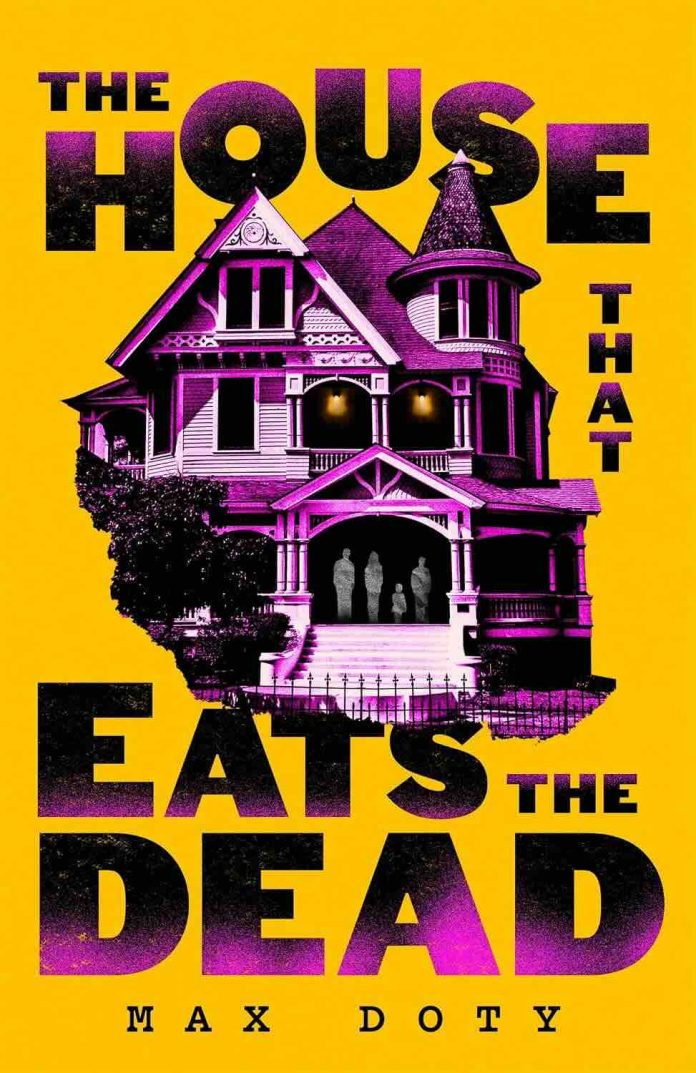
The realtor wants a letter. Sellers love a letter, and the Morgans need every advantage they can get on a house priced half a million below its comps. So Claire writes one, and the opening pages of The House That Eats the Dead by Max Doty let her get away with it: the children by the fireplace, the muffins with her daughter, the black lab deserving a yard at last. She wakes her husband to check it. He makes two small edits, tells her she nailed it, and falls back asleep.
Then she goes down the hall and sends a different letter. The one about the electrical fire that killed her parents when she was ten, about carrying her eight-year-old sister out a window while the house burned behind them, about her teenage son coming home from a mugging spitting three of his own teeth into his hand. The one that says this is the first house that has ever felt like it would refuse to burn with her inside it.
The seller accepts at list price. No counter. And Claire keeps that to herself, because a whole chapter of her family’s history now belongs to her alone, and she finds that she likes it.
That is the first ten pages of The House That Eats the Dead by Max Doty, and it tells you what kind of book you have picked up. The supernatural arrives later and quietly. The marriage is already the haunted thing.
The Rule Is Simple and Its Consequences Are Not
The house consumes dead organic matter. Crumbs, cardboard, leather, the grease off your fingers, the dead skin that would otherwise become dust. It makes a sound like sandpaper dragged slowly across wood. It leaves warm patches where it has fed, and those patches get hungrier.
The second half of the rule is the one that does the damage. Whatever the house eats is erased from the world’s memory. Photographs rearrange themselves. Nobody misses what is gone. The only exceptions are the two names on the deed.
The House That Eats the Dead by Max Doty escalates this with real patience. A stuffed bear the children have owned for a decade goes first, leaving two amber eyes in Claire’s pocket and two children who have never heard of it. Then groceries. Then a nosebleed, drunk out of the tissue. And then something with a heartbeat and a name, and a husband who points out, reasonably, in the voice of a man doing a cost-benefit analysis, that their six-year-old will never have to be told.
What Doty Gets Absolutely Right
- The horror is administrative. Comps, escrow, staging, disclosure obligations, the trust amendment nobody quite explained. The scariest sequence in the book is an open house.
- The rule stays consistent and specific. The house has favourites. It adores organ meat. It refuses apples. It is moody, it stress-eats, and it can be trained, which is a far more disturbing discovery than being told it cannot.
- Nothing is explained. No exorcist arrives. No researcher turns up with a theory of what the house is. It simply is, and the novel is confident enough to leave it there.
- The sentences are genuinely good. The house’s history is delivered through one six-page letter that could stand alone as a novella, and it is the best writing here.
The Marriage in The House That Eats the Dead by Max Doty Is the Real Machine
Tom Morgan is not a monster in the early chapters. He is generous, boyish, adoring, quick with a joke, and completely insulated from loss. He has never lost anyone. And he grades a funeral on whether the catering arrived on time. He tells his wife she is in charge of feelings, and he means it as a compliment.
His mother supplies the novel’s thesis in one line, delivered to Claire on the day they meet: a woman is a mirror, the frame may be plain or ornate, and what a husband cares about is his own reflection. Claire married at twenty-two out of a leaking apartment in the Mission, and has been playing a part ever since. The House That Eats the Dead by Max Doty is about what happens when a woman who has spent seventeen years agreeing finally gets access to something her husband cannot take from her.
The house is also, unmistakably, a battered thing. Someone burned marks into its bones a century ago to make it obedient. Claire’s decision to try kindness instead is the most original idea in the book and its most quietly upsetting one, because the reader can see what she is actually doing, and she cannot.
Where It Loosens Its Grip
- The last quarter becomes a thriller. The turn is well seeded and it works, but a novel that had been building dread out of paperwork resolves itself with a gun, a confession and a long explanatory monologue.
- A superb antagonist gets wasted. A rival executive with an unhealthy interest in the property is one of the sharpest inventions here, and she is disposed of in a sentence.
- The middle sags. A renovation subplot and a teenage grudge stretch further than the material supports, and the pattern of another body in the basement repeats past the point of shock.
- The closing pages let the narrator off lightly. The final ambition Claire settles on is thematically coherent and morally much tidier than everything preceding it.
Los Altos Was the Only Possible Setting
The house is a Queen Anne that predates the 1906 San Francisco earthquake by a decade and survived it, which is exactly the sort of detail a listing agent turns into a selling point. Doty knows this world precisely, and The House That Eats the Dead by Max Doty is scathing about it: the ten-foot walls, the neighbours who will never introduce themselves, the bakery where every woman is wearing the same leggings. A property that erases inconvenient facts is not an aberration in this valley. It is the logical end product.
Who The House That Eats the Dead by Max Doty Is For
Reach for it if you want horror that is quiet, domestic and morally serious, and if you like a rule-based supernatural premise followed all the way to its ugly conclusion.
Be warned that The House That Eats the Dead by Max Doty goes to some difficult places: the death of a pet, the death of a child, pregnancy loss, coercive control within a marriage, and a suicide that happens offstage. None of it is gratuitous. All of it is genuinely upsetting.
Read These Next
- It Was Her House First by Cherie Priest. The nearest neighbour on the shelf for a house with its own opinions about who belongs in it.
- House of Splinters by Laura Purcell. Gothic rather than suburban, but the same interest in a building that remembers.
- The October Film Haunt by Michael Wehunt. For readers who want literary horror that refuses to explain itself.
- The Only Good Indians by Stephen Graham Jones, for guilt made physical and impossible to outrun.
- The Haunting of Hill House by Shirley Jackson. Still the measure, and Doty has clearly taken notes.
Deena Helm’s debut Our Cut of Salt is the other side of this coin: the haunting is not the ghost, it is what nobody was told.
The Last Word on The House That Eats the Dead by Max Doty
This is a debut, which is faintly ridiculous. It is controlled, unnerving, occasionally very funny, and built on a premise sturdy enough to carry the weight it is asked to hold. The final act trades some of its strangeness for momentum, and that is the only reason it stops short of the top shelf.
What lingers is not the eating. It is the offer. The House That Eats the Dead by Max Doty hands an exhausted woman the thing every grieving person has wanted at three in the morning, and then makes her live in it.







