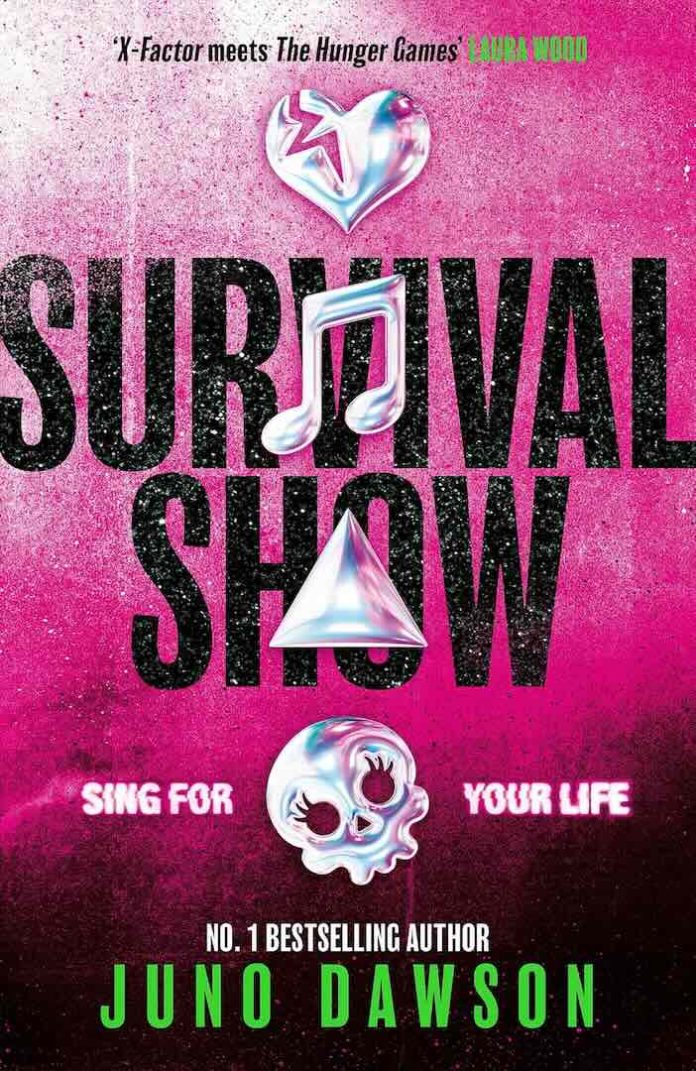
The contract runs to a hundred and fifty-two pages, but the clause that matters is short. Contestants will be judged by a public vote and the producers. Winners get a cash prize, a house and a recording deal. Eliminated contestants consent to forfeit their life. A cheerful casting assistant reads it out on a video call and asks, for legal reasons, whether the seventeen-year-old on the other end understands that this means death. She says she does. Survival Show by Juno Dawson is the story of what happens after she signs.
How the Survival Show Works
Taryn Beck lives in a refugee camp in the Scottish Borders, one of the English families driven north when the sea swallowed the south coast. Her mother died in a flu epidemic, her father labours on building sites, and her younger brother Jenson has a liver condition whose medicine keeps running out. In this Britain, the state will pay you to die. A programme called Project Population offers five hundred dollars for every year you have lived, and it is so popular that the rest of the world has copied it.
Starmaker is the most watched show on the planet. Every year, ten trainees move into a mansion in Media City, Michigan, to compete for places in a new group. In recent seasons, to rescue falling ratings, the show teamed up with Project Population. Each week, the lowest-ranked contestant walks into a glass Elimination Chamber, and her bandmates sing her a farewell song.
Taryn can sing. She cannot dance. She auditions anyway, because the prize would save her brother, and the novel follows her from a queue of hopefuls in a polluted northern city to a remedial dance camp in a ruined London mansion, and then into the house itself.
What Juno Dawson Is Really Satirising
The obvious comparison is The Hunger Games, and Dawson says as much in her acknowledgements, where she describes the pitch as that novel meeting the Spice Girls. But the target here is more specific. Survival Show by Juno Dawson is a book about the pop industry, and especially about the real Produce 101 style of idol competition, in which trainees are ranked by viewers week after week.
Almost nothing in the house happens by accident. There are calorie targets and weigh scales in front of the fridge. There are makeovers that assign each girl a “doll” persona. And there is a hidden camera in every room except the bathroom, a producer who singles out a fifteen-year-old for her weight, and a tabloid that knows everything by morning. The satire lands because Dawson knows the real thing so well: the fan comments, the stage names with numbers for letters, the promotional clothes, the sponsored flip phones the girls are told to name on camera.
It is also a book about how young women are turned against each other. The show pits the girls against one another and then makes them rank which of their rivals they want as bandmates. When Taryn steps off her mark to comfort a sobbing housemate, the producers mark her as a troublemaker and hand her a storyline as the weak link. Survival Show by Juno Dawson is at its sharpest when it shows how much of the competition is written in advance.
What Works
- Taryn’s voice. Wry, sweary, very British and very funny, she keeps the book from drowning in its own bleakness.
- The housemates. Leela, a German trainee who is quietly trans, and Suki, a bubbly Australian who is endlessly told to lose weight, are especially well drawn.
- The pace. Weekly challenges, cliffhanger results shows and tabloid interludes make it compulsively readable.
- The pop. Dawson clearly loves this music, and that love makes the book angrier rather than sillier.
Where Survival Show Gives Ground
- The satire is blunt. Some targets, like the sanitary product that sponsors every advert break, are hit so often the joke wears thin.
- The world is a checklist. Floods, war, epidemics, state euthanasia, anti-trans laws and a billionaire-run media all arrive at once, sometimes in a single paragraph.
- The mentor romance is uneasy. Taryn is seventeen and her love interest is an older star who is judging her; the book notices this less than it should.
- The ending tidies up fast. After a spectacular finale, the legal and personal aftermath is resolved in a few brisk pages, with a sequel clearly in view.
Read It If / Skip It If
Read Survival Show by Juno Dawson if:
- you loved The Hunger Games and want its questions asked about pop culture;
- you have ever watched a talent show and felt uneasy about the edit;
- you want a YA thriller with a sharp, funny, queer heroine.
Skip it if:
- you want subtle satire rather than a sledgehammer;
- repeated on-page deaths of teenage characters would be too much;
- you dislike romances between a teenager and an adult in authority.
Content Notes
The book opens with its own warning for mental illness, eating disorders, addiction and suicide. In addition: state-sanctioned killing of teenagers on camera; a shooting and other violent deaths; police violence at a protest; restrictive dieting, weight-loss injections and fat-shaming; transphobia, including a trans character’s story being leaked to the tabloids; homophobic laws; sexual harassment; a coerced termination of pregnancy; mob violence; frequent strong language. It suits readers of about fourteen and up.
Read These Next
Five for readers who finish Survival Show by Juno Dawson and want more:
- The Hunger Games by Suzanne Collins. The original televised fight to the death, still the benchmark.
- Sunrise on the Reaping by Suzanne Collins. Collins returns to Panem with sharper things to say about propaganda and the edit.
- The Escape Game by Marissa Meyer and Tamara Moss. A YA thriller set on a reality show where a contestant has already died.
- Scythe by Neal Shusterman. Another future in which the state has made killing routine, and teenagers must decide whether to serve it.
- 27 Profound Dystopian Fiction Books. Our wider guide for readers who want more broken futures.
Dawson’s earlier books include the bestsellers This Book Is Gay and Clean, and she signs off her acknowledgements by promising a sequel.
Worth Your Shelf
The image that stays with me is the sheet masks. On the morning of a live elimination, the remaining girls sit around the kitchen table in cooling face masks, poking porridge through the mouth holes, and someone starts to laugh. Soon all of them are on the floor, helpless with it, while the producer who controls their lives stands in the doorway, baffled.
Survival Show by Juno Dawson is not subtle and its ending comes too cleanly. But it is furious in all the right places, funny when it has no right to be, and genuinely thrilling. Most of all, it takes teenage girls, their music and their friendships seriously, which is exactly what the machine in the book refuses to do.







