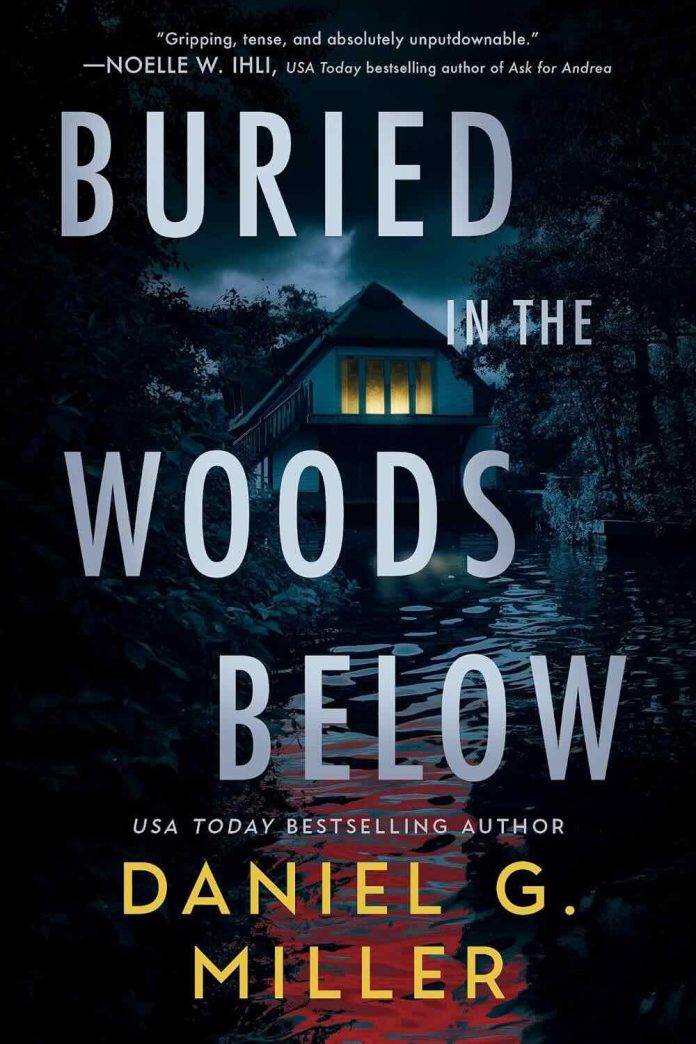
Seventy-four sailboats on the left wall. Forty-eight on the wall behind the bed. Charlotte Hoffman counts them the way she counts stairs, paces along a trail, floorboards in a hallway and, later, the concrete blocks of a room she would very much rather not be in. She is a management consultant, thirty years old, sent home from her firm for a month after what everyone at work is carefully calling an incident. Counting is how she keeps her feet under her. Buried in the Woods Below by Daniel G. Miller hands you that habit inside the first twenty pages and then spends the rest of the book showing you what it is holding up.
The Counting in Buried in the Woods Below
Most thrillers give the narrator a tic and then forget it. This one uses the tic as load-bearing structure.
Charlotte does not merely count. She unpacks the moment she arrives, squares the napkins, straightens a tilted frame in a house that is not hers. When the pressure rises, the numbers get louder and the sentences get shorter, and Miller times that so precisely you can feel a chapter tightening before anything has happened in it. First person present tense usually flattens a story into breathless reportage. Here it does the opposite, because it puts you inside the counting as it happens rather than hearing about it afterwards.
A second device works just as well. A crack appears in the guest room mirror on the second night, a nick barely worth noticing. Every time Charlotte passes it, the crack has travelled further. By the end of the week it reaches her waist. Nobody comments on it, and the book never explains what it is for. That restraint is the best writing decision in Buried in the Woods Below by Daniel G. Miller.
Building a Locked Room Out of a Lake
The setting does the rest. Big Island sits in Lake Minnetonka, reachable only by boat, half nature preserve and half a scatter of expensive houses. A century ago there was an amusement park here. What is left is a carousel with rusted horses and the skeleton of a Ferris wheel standing in a clearing, which is not a subtle image and does not need to be.
Charlotte comes for a week with the Parkers. Eric bakes for a living, mixes drinks he calls bootlegs, and collects nineteenth-century dolls with real hair alongside a fortune-telling machine that spits out hand-painted cards at the worst possible moments. His wife Laelynn runs a digital marketing firm and runs the household the same way. Their eight-year-old twins, Emma and Penelope, are the most unnerving thing in the book. The neighbour, Russ Neuman, wants everyone off his island, and his mother died in the Parkers’ house under circumstances the county recorded as undetermined.
Then the trap closes. A note goes up on the front door. A boat engine goes on the fritz. The mechanic is backed up. Cell service here was never reliable, and a storm arrives with a tornado warning behind it. Buried in the Woods Below by Daniel G. Miller assembles its closed circle patiently and without cheating, so that by the time nobody can leave, you have watched every exit shut for a reason you accepted at the time. The cast even gets one bright afternoon on the mainland at the James J. Hill Days festival in Wayzata, which makes the trip back feel considerably worse.
What works
The strongest parts of Buried in the Woods Below by Daniel G. Miller are structural rather than sensational.
- Chapter engineering. Forty-nine chapters plus a prologue and an epilogue, most of them four or five pages, nearly all ending on a turn rather than a shock. It is why the book reads faster than its length suggests.
- The prologue as a clock. A dated flash-forward opens the novel and then sits there ticking while the calendar in the chapter headings walks toward it.
- The twins. Emma and Penelope chant a counting rhyme, hold tea parties for damaged dolls, and lie with total composure. Nothing supernatural is required. Children who have worked out that an adult is frightened of them are quite enough.
- The domestic warmth. Miller writes ordinary pleasure well: burgers with the cheese cooked inside, blueberry pancakes, a game of Clue by candlelight. The comfort is genuine, which is what makes it useful to him later.
- The fair play. Everything the ending needs is on the page in plain sight. A second read is a different book.
Where Buried in the Woods Below Gives Ground
Four things keep Buried in the Woods Below by Daniel G. Miller off the top shelf of the subgenre.
- The Gothic props are laid on with a trowel. Antique dolls, a fortune-telling automaton, a decaying carousel, a drowned amusement park, a ghost child, a cracking mirror and a Saint Bernard called Heathcliff. Any three would have carried the atmosphere. All seven start arguing with each other.
- The middle repeats one beat. Wake to a crunch on the gravel, creep to the window, glimpse something, find a mundane explanation, go back to bed. The fourth time arrives with the reader already ahead of it.
- Some characters are there to be suspects. Russ Neuman and Carlos, a bartender from Chicago, get exactly enough page time to point at and not enough to become people.
- The prose reaches. Miller is a clean writer who occasionally cannot leave a storm alone. A single page hands you a sky like napalm, thunder like war cries and clouds like a waiting army.
Do You Need The Orphanage by the Lake First?
No. Buried in the Woods Below by Daniel G. Miller is a standalone with no shared cast, and the only thing carried over from The Orphanage by the Lake is a taste for cold water and buried history. Readers who came to Miller through the Tree of Knowledge books should know this is a quieter, more claustrophobic performance, the puzzle turned inward rather than outward.
Content Notes for Buried in the Woods Below
Buried in the Woods Below by Daniel G. Miller earns its warnings. There is workplace sexual harassment and an on-page sexual assault, sustained violence including the deaths of children, the poisoning of a dog described in detail, childhood abuse and the death of a parent, heavy drinking used as coping, a body recovered from water and depictions of psychiatric crisis and detention. One further note, offered plainly rather than as a complaint: this is a thriller that draws a line between mental illness and violence, and readers tired of that framing will find it here undiluted.
Read it if / Skip it if
Read it if you like a closed circle where the walls are weather and water; if short chapters and a ticking date are your idea of a good time; if you want a book that rewards a reread.
Skip it if you need your Gothic furniture rationed; if repeated night-time false alarms wear you out; if the content notes above describe a hard limit rather than a heavy week.
Read these next
Five for readers who finish Buried in the Woods Below by Daniel G. Miller and want the same weather:
- Pike Island by Tony Wirt. Another Minnesota lake, another island that will not let go, colder hand on the wheel.
- The Orphanage by the Lake by Daniel G. Miller. His breakout, and the better start for anyone who wants investigation rather than unravelling.
- Death on the Island by Eliza Reid. A remote island, a limited pool of suspects, considerably more wit.
- The Red Letter by Daniel G. Miller. For readers curious about his range outside the lake books.
- Psychological thrillers that play with your head, our guide to the shelf this sits on.
Worth Your Shelf
The last image is small and very well chosen: a blade of grass pushing up through a crack in concrete, and an ant working its way along it. Miller is a patient writer, and patience is why this holds together despite an attic of Gothic clutter he could have cleared out. Buried in the Woods Below by Daniel G. Miller is not the cleverest psychological thriller of the year and is not trying to be. It is a well-built trap with a real house inside it, warm enough that you forget you are in a trap at all, which is the only trick that matters. Read it over two nights with the lake wind coming in, then go back to the first fifty pages. You will find you were told.