 1
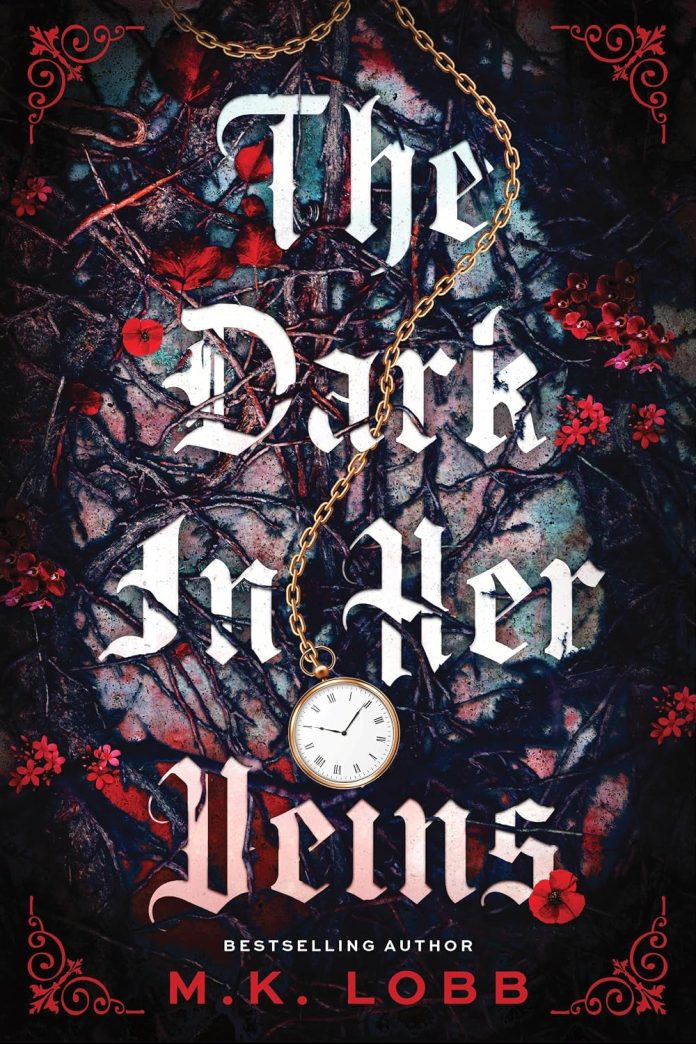
1She is twenty-two years old and both her hands are black to the fingertips. In Sundbourg, sin does not stay a private matter — it surfaces in the veins as a purple-black rot that climbs from the extremities, takes the mind somewhere along the way, and finishes the job. Talin Keller has been killing on the Prophet’s instructions for three years, and her skin has kept every receipt. She bathes in the dark so she does not have to look. The Dark in Her Veins by M.K. Lobb opens on a woman already sentenced by her own bloodstream, and then spends four hundred pages watching her refuse to serve the sentence.
The conceit sounds like a punishment mechanic. It turns out to be the best engine in the book.
What The Dark in Her Veins Does With Sin
Most fantasy that charges its heroes for moral compromise charges them in something invisible: a favour owed, a memory spent, a ledger only the reader is shown. Lobb bills hers in skin, in public, on a schedule.
That single decision generates an entire society. If violence is the deadliest of the six sins, and the marks are legible to anyone standing near you, then the pious cannot afford their own harm — so they hire people already condemned. A hired sinner is a recognised occupation. They stand at their employers’ elbows at state receptions, chins up, forearms discoloured, addressed by no one. The closest real-world analogue is the sin-eater, paid a few coins to take a stranger’s guilt onto their own account and then be shunned for carrying it.
The best sequence in The Dark in Her Veins by M.K. Lobb takes that arrangement to its logical basement. During the holiest week of the Regiment’s calendar, in a cellar beneath the cathedral, senior officials settle personal grievances by putting their sinners into a ring and letting them fight to the death, while several hundred immaculately dressed worshippers howl at them out of the dark. Nobody involved considers this a contradiction. Talin kills a woman there who is further gone than she is, and the novel is careful to let her notice that this is a mercy and a spectacle at the same time.
The clock in this book is a body. Every kill Talin commits is a payment she will see on herself the next morning, and the plot cannot cheat that, which is why the tension holds even through the stretches where nothing much is happening.
The Romance Is Hungry and Honest, and the Hero Is a Hole
The other half of The Dark in Her Veins by M.K. Lobb is Slade, the Warden of the Trench: a diabolist, immune to the rot, all but unkillable, who feeds on spoken confession and is the only creature alive who might be able to stop Talin dying. He is also the Prophet’s brother, and the monster the Prophet’s entire mythology rests on having killed.
What Lobb does well here is refuse to be embarrassed. Talin’s appetite is specific and she says so out loud — she wants it to hurt, she wants him to bleed for her, she resents wanting either. The dominance she hands over is negotiated on the page, with a safe word spoken aloud and a stated reason on his side that has nothing to do with cruelty and everything to do with what it means to be trusted by somebody who trusts no one. In a subgenre that often treats a knife as set dressing, this is written as character rather than décor, and it is the most confident prose in the book.
The failure is on the other side of it. The novel is first person, present tense, locked inside Talin’s skull, which is the right choice for the disease plot and a serious problem for the love story. Slade moves from planning to murder her to promising he will not let her die, and every step of that journey happens somewhere the reader is not. He is glorious on the page and vacant behind it. When the third act turns on what he really intended, the reveal lands as information rather than betrayal, because there was never enough of him established to be betrayed by.
Where The Dark in Her Veins by M.K. Lobb Gives Ground
- The middle becomes a house party. Roughly a hundred pages at a country house in the Outskirts — breakfasts, a tour, an argument about shoes, a hair-dyeing scene — where the plot idles. The company is good; the book knows it is stalling and stalls anyway.
- The whole third act turns on an overheard conversation. Talin listens at a door, hears the damning half, and leaves before the sentence finishes. It is the oldest device in the genre and it is asked to carry everything.
- The cult is a composite. The Solemn Apostles are genuinely frightening in flashback, but their doctrine is generic authoritarian boilerplate. The specifics that make real high-control groups so hard to leave are not on the page.
- The action is functional. For a novel about a professional killer, the fight choreography is mostly summarised, and the one true set piece is blocked rather than staged.
- It does not end; it stops. Both leads are captured, nothing is resolved, the central mystery is explained and then immediately deferred. This is book one of something, and the last chapter does not pretend otherwise.
What survives all of that is the twist, which is properly seeded — the Regiment’s leadership never seems to sicken, the scholars have a research programme nobody discusses, the Prophet has a curious distaste for doing his own violence — and which reframes the theology of the entire country in about two pages.
Content Notes
The Dark in Her Veins by M.K. Lobb opens with a warning list of its own, and earns it. Ritual child sacrifice on the page. A cult leader’s sustained abuse of a teenage girl, and her pregnancy by him. A mother attempting to burn her own child alive. Mass death by arson. A fight to the death staged as entertainment. Torture and repeated stabbing of a restrained man. Forced drugging. Terminal illness written as body horror. The sex is explicit and includes knife play, impact play, breath play, bondage and an on-page dominance dynamic; it is consensual and negotiated, and it is not incidental.
On shelving: despite the author’s YA backlist, this is an adult novel from an adult romance imprint.
Read These Next
- The Lion and the Deathless Dark by Carissa Broadbent, for a heroine bargaining with something immortal because the alternative is dying on schedule.
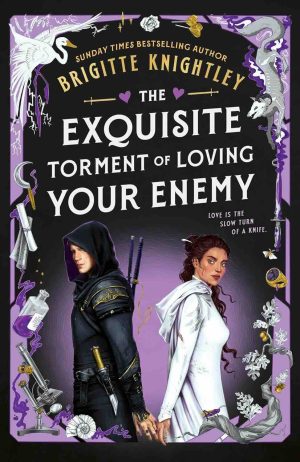
- The Exquisite Torment of Loving Your Enemy by Brigitte Knightley, if the professional-killer-and-her-target dynamic is what you came for.
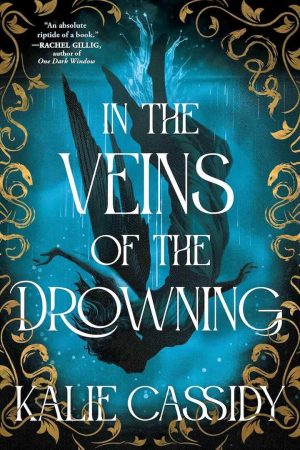
- In the Veins of the Drowning by Kalie Cassidy, for the same appetite for the ruinous and the same refusal to sand it down.
- To Steal from Thieves by M.K. Lobb, the author’s own, for readers who want her at a lighter angle before committing to this one.
- Seven Faceless Saints by M.K. Lobb, which shares the murderous theocracy at a lower temperature.
Readers who liked The Dark in Her Veins by M.K. Lobb for the disease rather than the romance should also know that the rot is the only element here with no obvious precedent in the subgenre.
What Stays With You
The image that lasts is not the altar or the cellar or the burning temple. It is a girl standing in a locked bathroom with the light off, gripping a countertop, deliberately not turning around, because in the near dark she is almost featureless and can almost pretend she is not dying.
That is the register The Dark in Her Veins by M.K. Lobb is best in — the small, private accounting a person does when the cost of their life is written where everyone can read it. The theology is a machine for making that visible, the romance is a machine for making it bearable, and the book is at its strongest when it lets both run and does not intervene.
It is uneven. The middle wanders, the hero is thinner than the heroine deserves, and the last page is a trapdoor rather than a landing. But the central idea is one of the best in recent romantasy, and The Dark in Her Veins by M.K. Lobb is unembarrassed enough to follow it down into the cellar and describe what is happening there. Go in knowing you will finish it and immediately want a sequel that does not exist yet.