 1
1 2
2 3
3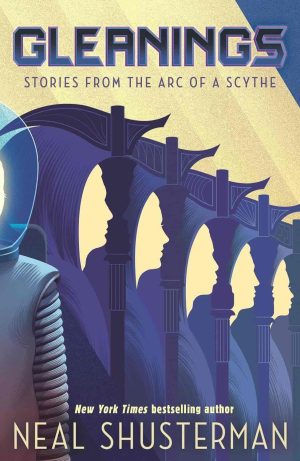 3.5
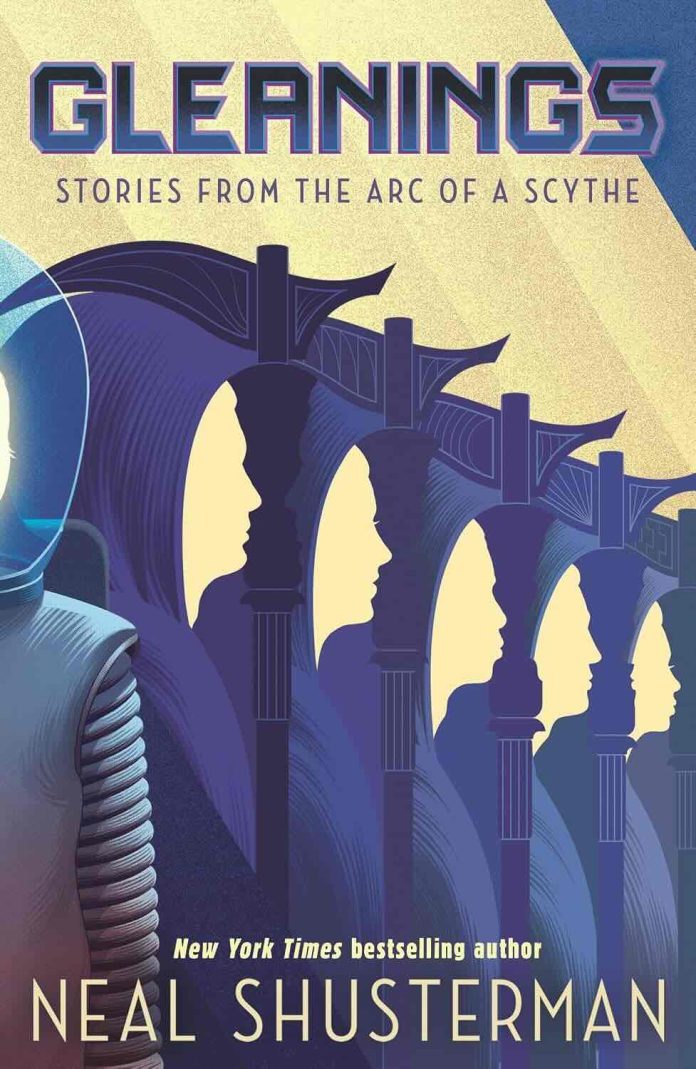
3.5At her first proper meeting of the world’s licensed killers, a gangly nineteen-year-old in a violet robe stands up and offers an opinion. The room laughs at her. Not politely: an echoing, chamber-filling laugh, and the woman chairing the session tells her to be less reactionary. Two months later she drives to a ruined Washington alone, blows a tyre in a pothole, walks the last mile past jeering drunks, and gleans the last president of the United States and his entire cabinet in a bunker under the White House. Gleanings by Neal Shusterman opens its real business with that story, and it is worth the cover price on its own.
Then she washes the blood off, finds her robe unwearable, turns it inside out, and discovers the lining is a soft lavender. The colour that a whole trilogy will come to fear.
How Gleanings by Neal Shusterman Works
This is a companion volume, not a fourth novel. Thirteen pieces, arranged across roughly two hundred years of the post-mortal age: a verse prologue written entirely by the author’s daughter, four stories co-written with other novelists, and eight solo. Some run twenty pages, one runs closer to seventy.
The pieces fall into three groups. There are origin stories, filling in how two of the trilogy’s central figures were made. There are side quests, following characters who appeared once and then vanished. And there are standalone jokes and tragedies set in the same world with no returning cast at all, which is where the collection is at its loosest and occasionally at its best.
The organising principle is that the trilogy told you what happened. This tells you how the people it happened to came to be the sort of people it happened to.
The Two Stories Neal Shusterman Needed to Write
Two entries justify the book, and they are a matched pair.
The first is the making of the Grande Dame of Death: awkward, dour, badly dressed, mocked with a nickname she hates, and then decisive in a way nobody in the room saw coming. It reframes her entire presence in the trilogy. She was never serene. She was a bullied teenager who found out what she could do, and then spent two centuries living with it.
The second is the making of the villain. A clever, resentful boy on Mars, sabotaged by his own parents, murders his best friend to steal a job, is quietly recruited, and destroys a colony of ten thousand people. It is the coldest writing in Gleanings by Neal Shusterman and possibly in the whole series, because it is told entirely from inside a head that keeps producing perfectly reasonable sentences.
The pairing is the point. The same world, the same machinery, the same appetite for significance, and one of them turns into a conscience while the other turns into a weapon.
What Works
- The range. A dog story, a farce about a woman who gleans by catapult, a horror piece set in a shared dream, a procedural satire, an elegy for an art teacher. Nothing here reads as one setting worked twice.
- The art-class story. A retiring teacher, four terrified students, a scythe running a competition with a year of immunity as the prize. It ends by manufacturing an object the trilogy had already mentioned in passing, and making you care about it retroactively.
- The unsavory piece. A grieving girl works out that the entire outlaw subculture is stage-managed, right down to the toy batteries powering a supposedly critical facility. It is the sharpest institutional joke in the series.
- A protagonist written for a whole story without a single gendered pronoun, with no comment made about it anywhere. That takes real control.
- The last page. A woman wakes up three hundred and thirty-four years out, on a moon of a violet gas giant, and is walked gently to a conclusion about who she now is. Perfect closing note.
Where Gleanings by Neal Shusterman Gives Ground
- It is a collection, so it is uneven. One entry is a sitcom episode with a punchline about tea. Another is a single joke about a smart dog stretched well past its natural length.
- It cannot be read first. Nearly every payoff depends on already knowing who these people become. Newcomers will find thirteen competent stories and none of the electricity.
- Explaining the villain slightly shrinks him. He was more frightening as a persuasive argument than as a boy who was told no by his father.
- The ugliest thing in the series is in here and gets past too briskly: a training regime that involves gleaning a service worker every week to teach an apprentice detachment.
- The co-written pieces are audibly in different voices, which is honest of the credit page and still a bump in the road.
Read It If
- The trilogy left you wanting to know how a nineteen-year-old became a legend.
- You liked the world’s bureaucratic satire more than its chase sequences.
- You are happy for a companion volume to be a set of variations rather than a plot.
Skip It If
- You have not read the three novels; start there instead.
- You need a collection to be even, and one weak entry in five spoils the run.
- You wanted more of the artificial intelligence’s interior life; there is one story of it here, and no more.
Content Notes
Gleanings by Neal Shusterman is not gentler than the novels. It contains a friend murdered slowly, described from inside the murderer’s thoughts; a colony of ten thousand incinerated by a teenager, including his own parents; service workers killed weekly as a conditioning exercise; a woman launched to her death by catapult; an elderly teacher euthanised on the page at her own request; a dog buried alive; ritual burning; suicide; and identities overwritten without consent.
Read These Next
Readers who finish Gleanings by Neal Shusterman generally want either more of this world or more short fiction with teeth.
- All Better Now by Neal Shusterman, the closest relative in his own catalogue: one engineered improvement, followed all the way down.
- UnBound, his earlier companion collection for the Unwind books, which does almost exactly this job and is a fair guide to whether you will want this one.
- An Oral History of Atlantis by Ed Park, if what you want is short fiction that keeps changing shape between pieces.
- The Sixth Faction by Veronica Roth, for more young people processed by an institution that thinks it knows best.
- The Last Bookstore on Earth by Lily Braun-Arnold, for the same generation living after the collapse rather than inside the machine.
What Stays With You
The collection ends where the trilogy pointed: on a moon orbiting something like K2-18b, three centuries out, with a woman discovering that her memories and her hands belonged to two different people. She takes the body’s surname and the mind’s first name, decides to open a restaurant, and walks out into lavender light. It is the warmest thing in four books.
Gleanings by Neal Shusterman is a four-star book with a five-star story inside it, and the honest recommendation is that you buy the collection for that story and treat the rest as a bonus. Some of the rest is very good. Some of it is a man being outwitted by a dog. Both, arguably, are what a companion volume is for.
A note entered into the record, in the manner these people prefer. Every conclave in this world opens with the Tolling of the Names: ten read aloud from each scythe’s ledger, standing in for all the others, because a profession that answers to nobody must at minimum keep a list. In that spirit, one entry: Simon & Schuster Books for Young Readers sent this copy, unasked and unpaid for. Nothing was promised in either direction, and the star withheld above was withheld on the merits. Read it aloud if you like. It will not take long.