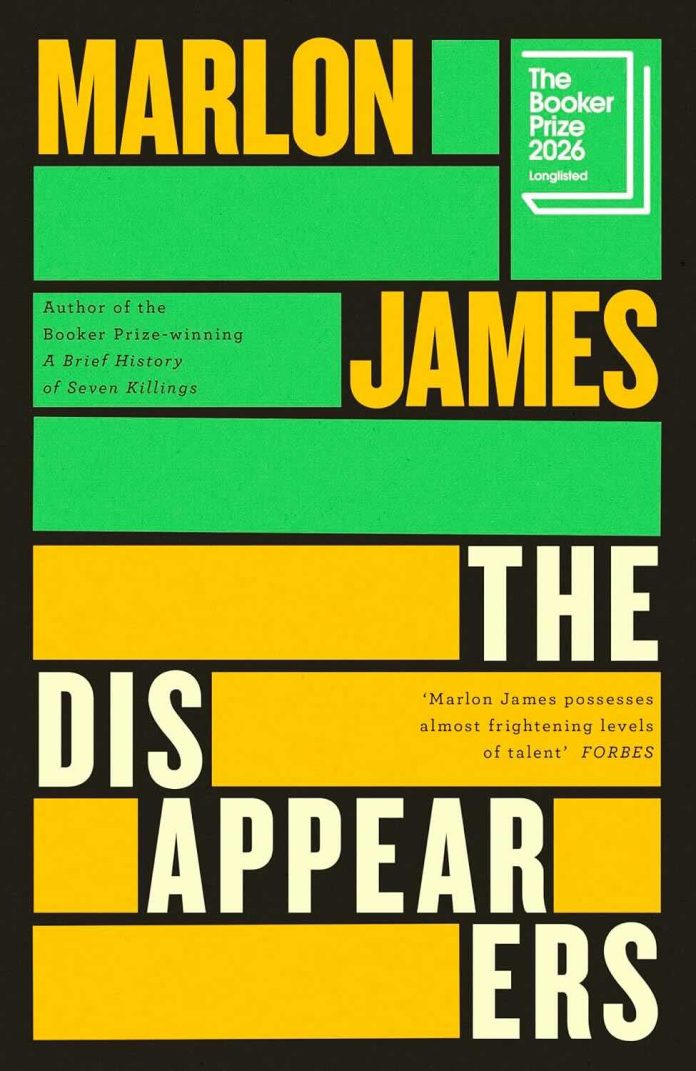
The Disappearers by Marlon James opens with a flier. Somebody has drawn a pink triangle in highlighter at the bottom, which is the only hint as to what the auditions are actually for, and eighteen-year-old Edmond Porteous turns up at a rotting house on Lady Musgrave Road because he has nothing else to do with his summer.
Inside is Havelock Titus, Oxford-educated, wearing green velvet in ninety-degree heat, staging John Herbert's 1967 Canadian prison drama Fortune and Men's Eyes in Jamaican patois. It will be the first openly gay play ever mounted in Jamaica. Seven men audition over a fortnight, and because only seven audition, all seven are cast.
Everything else in The Disappearers by Marlon James is what happens to those men afterwards. It is the longest book on the Booker Prize 2026 longlist and, on any reading, the most formally ambitious.
What Happens in The Disappearers by Marlon James
Kingston, May 1988. Eddy keeps a journal, and the first stretch of the novel is that journal: the rehearsals, the gossip, the AIDS panic on a campus where mattresses are being burned, the crowd at Tropical Plaza that beat two boys while the police watched and then took a turn themselves.
The cast assembles. Jordan Brown, thrown out by his parents, sleeping in a Volvo at the Jack's Hill lookout, with a mouth that could strip paint. Matt Chin, older, half-Chinese, the object of every entry in Eddy's diary. Orrin Turner, a data systems manager appalled to discover that a gay play contains gay content. Omar Joseph, a shipping millionaire quietly financing it. Rainford Ellis, who insists he is gay but not, you understand, one of those.
Then one night in the summer, men arrive at the house. What follows takes forty pages, is narrated entirely by the attackers, and is the most frightening thing I have read all year.
Afterwards, one man is dead and several are maimed. And two of the seven, Matt Chin and Orrin Turner, stop existing. No bodies, no funerals, no forwarding address. The rest of The Disappearers by Marlon James spreads across seventeen years and asks what it means that nobody can find them, and worse, what it means that after a while nobody is looking.
The Disappearers by Marlon James Changes Voice Five Times
The structure is the book's biggest gamble, and it mostly pays. Five parts, five separate modes, and nobody narrates twice.
Part one is Eddy's diary, funny and horny and adolescent. Part two is a chorus of the attackers, each headed with a first name and an initial: a police corporal writing flat surveillance prose and citing the sections of law he believes he is upholding, a Rastafarian quoting Leviticus, a visiting cousin from Brooklyn who thinks he is in a film, and one man whose page of unpunctuated fury reads like the inside of a skull.
Part three hands the novel to Jordan Brown in 1994, now running his dead father's funeral home, his chapters spliced with interview transcripts. Part four is epistolary, and one entire letter of The Disappearers is written in Polari, the coded slang of mid-century British gay men, which is both a virtuoso joke and a demonstration of the book's real subject. Part five is 2005, and it does something with the second person that I am not going to describe.
What Works
- The chorus of attackers. James refuses the word mob. These are individual men who each brought a weapon suited to a different appetite. Nothing in The Disappearers by Marlon James is more chilling than the one who realises, listening to a dancehall lyric, that he had only ever hated on the preacher's authority, while the singer writes about the sin as though he can see and smell and taste it.
- Jordan Brown. Filthy, funny, self-loathing, incapable of a straight sentence, and so dependent on rock lyrics that he admits he has no words of his own. His account of what his father did to him is the best thing in the first half.
- Havelock's letters. The register shift is total. He rejects the word tragedy for what happened, insisting on atrocity, and rejects perspective on the grounds that it implies a lesson.
- The comedy. This is repeatedly, genuinely funny, which nobody warns you about. Eddy's mother dancing alone to Booker T. at two in the afternoon. His fourteen-year-old sister, the sharpest person in the novel.
- The refusal to explain. Two men vanish. The novel is under no obligation to account for both, and does not.
Where It Stumbles
- Part three is enormous, and it is the reason this is not a five-star book. It runs to nearly half the length and it circles. The search, the interviews, the affair at its centre: each thread is strong, and each gets walked around three or four times. A firmer edit would have taken fifty pages out of it without losing a single idea.
- The journalist is a device. Peta-Gaye Burke exists to make Jordan talk. She gets no interiority, and the novel drops her without telling us what became of the article she spent three years on.
- Orrin Turner is a loose end. One vanished man gets an entire late movement. The other gets a sister, a mother, and an errand. There may be an argument in that asymmetry, and it still reads like a gap.
- The revenge sequence flattens. Once you understand the pattern, the successive incidents become a catalogue rather than an escalation.
- The essays. Havelock occasionally stops writing letters and starts lecturing, on empire and public health, on race and sexual projection. Good lectures, and audibly the author clearing his throat.
What The Disappearers Is Actually About
Vanishing, and how many kinds of it there are. The Disappearers by Marlon James counts at least four.
There is the vanishing done to you. There is the vanishing done by the press, which kills Omar Joseph a second time with a headline and a photograph of his body on a slab. And there is the vanishing AIDS performs, which Jordan calls a sequence of disappearing acts: friends go, then people try to make you go, then your own body starts leaving without you.
And there is the vanishing you do yourself, which the book treats as a discipline rather than an accident. Rainford puts it most bitterly. An ordinary man leaves a dent in a mattress and a mother who cannot look at his room. When a battyman leaves, the world closes over the space as though he was never born.
None of the legal architecture here is invented. Jamaica's Offences Against the Person Act, quoted almost verbatim in part two, criminalised sex between men from 1864, and Human Rights Watch has documented the consequences for decades.
A Word on Content Warnings
The Disappearers by Marlon James is the hardest book on the longlist and it is not close. It contains a prolonged assault described at length, a murder involving sexual mutilation, a blinding on the page, a live burial, a man burned alive at home, corrective rape, the killing of a trans woman by a street crowd, the sexual abuse of two schoolboys, a mercy killing, a death from AIDS in squalor, kidnap, suicide and repeated suicidal ideation, explicit and sometimes coerced sex throughout, racist slurs, and anti-gay lyrics quoted in full.
Who This Is For
Reach for The Disappearers by Marlon James if you want the most formally ambitious novel of the year and have the stomach for it, if you admired the polyphony of A Brief History of Seven Killings and want it turned on a smaller subject, or if you believe a novel should be able to be savage and hilarious in the same paragraph. Skip it if you need resolution, if you have a low threshold for explicit content, or if the list above describes something you have lived.
Read These Next
Five books to go to if The Disappearers by Marlon James has left a hole in you.
- A Brief History of Seven Killings by Marlon James. The Booker winner, and the other novel where Kingston is narrated by everyone at once.
- The Book of Night Women by Marlon James. Earlier, shorter, and the place to go if the voice is what you came for rather than the architecture.
- Giovanni's Room by James Baldwin. The ancestor. Shame, exile, and a man who cannot survive being seen.
- Young Mungo by Douglas Stuart. Glasgow rather than Kingston, and the same braid of tenderness and imminent violence around a gay boy. Stuart is on this longlist too, with John of John.
- Fortune and Men's Eyes by John Herbert. The 1967 play the whole novel is built around, and worth an hour of anybody's evening.
The Last Word on The Disappearers by Marlon James
There is a moment in part four where Havelock Titus, alive against every expectation, admits in a letter he will never post that he has begun to forget which of the missing men was which. He cannot hold their surnames, and tells himself it is because he is old.
That is the wound the novel keeps pressing. Not that these men were beaten, though they were, and not even that one was killed. It is that the people who did it walked home and forgot, that the people who loved them are forgetting too, and that a country can be built so that forgetting is the easiest thing in it.
The Disappearers by Marlon James runs to 598 pages, it is exhausting, and it is carrying about fifty pages it does not need. It is also the most ambitious book on this longlist, and it ends on a single line of dialogue that reorganises everything before it. I have not stopped thinking about that line since, which is not the same as saying the whole novel earns it.







