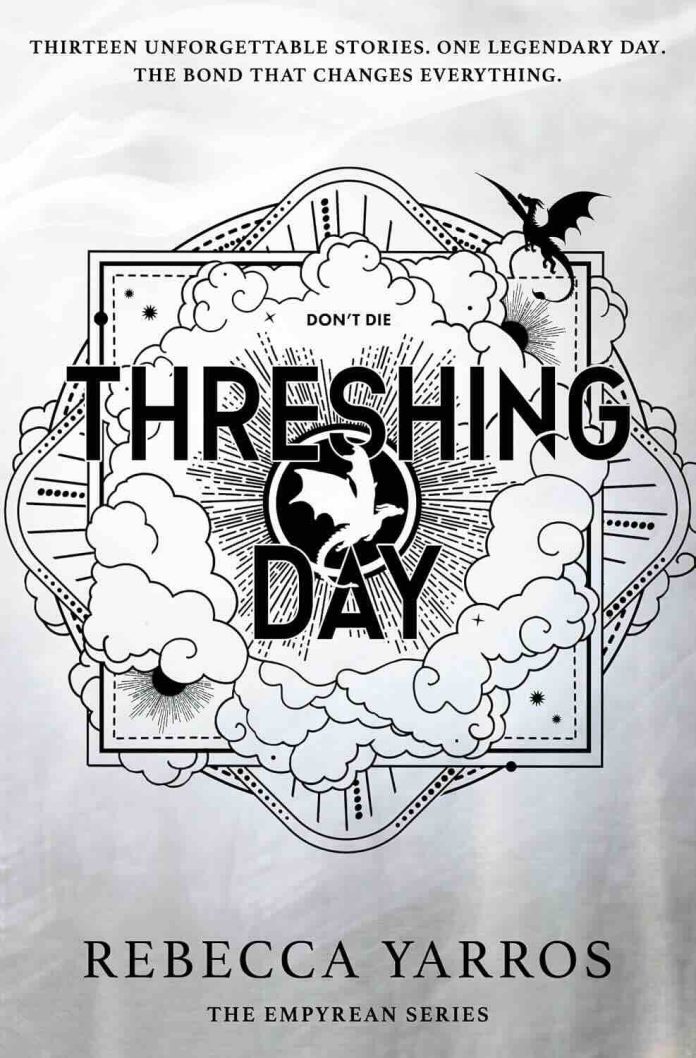
The first thing to settle about Threshing Day by Rebecca Yarros is what it is, because the number on the spine is doing a lot of work. This is Book 3.5: not a novel, not a prequel, not a story with a plot. It is thirteen first-person accounts of one event, the morning Basgiath’s first-years walk into a forest and hope a dragon picks them instead of eating them, spanning ten years, arranged oldest to newest and presented as an archive built after the fact.
The Frame Is Better Than It Needed to Be
Two professors of Dragonkind claim to have transcribed these accounts from Navarrian, preserving names to honour the dead. Before any of them sits a retired colonel’s advisory essay on preparing cadets for a day most will not survive: dragons find humans expendable, cadets who enter in groups are reduced to ash, never enter the Vale, never speak to a dragon that isn’t yours. He ends by regretting that he never recorded his own bonding and urging that survivors be asked to tell it. That is the excuse Threshing Day by Rebecca Yarros gives itself for existing, and it is an elegant one.
Better still, each account opens with an entry from the in-world Compendium: year, dragon’s name, breed, sex, descended line, estimated age, recorded riders. That last field does more work than any sentence near it. A dragon with none has been waiting, and you know before the account starts why that matters. One entry adds an instruction not to approach that dragon under any circumstances, and the reader’s stomach drops on cue.
Where Threshing Day by Rebecca Yarros Earns Its Place
Four accounts justify the book. The rest are good company.
The first is the one nobody will see coming. A father meets his son at the edge of the forest, tells him the marked children of the rebellion were never supposed to survive their first year, claims classified knowledge he cannot share, and asks the boy to watch them and report what they do. He wraps it in love, in a dead mother, in fear for a fragile girl they both adore. And every frustrating, self-righteous, catastrophic decision that character makes across the first two Empyrean books suddenly has a documented origin. Not a retcon. A receipt.
The second is a repeat’s account, and it holds the collection’s kindest idea: he was never found unworthy. His dragon simply wasn’t open to a bond that year, and when half a pair cannot open, the other waits. For a character whose humiliation has run quietly in the background for three books, that is an enormous act of authorial mercy, and it is immediately undercut: a squadmate falls to her death from a dragon’s back minutes after bonding, and the dragon makes him choose between climbing and grieving.
The third is a legacy rider discovering that the dragon choosing her is her own grandmother’s, hiding under a falsified record, and channelling power into her before she has flown. The fourth I will come back to.
Threshing Day by Rebecca Yarros and the Prince Nobody Mentions
Here is the best piece of construction in the book, and Yarros never points at it.
Early on, a marked cadet is cornered by a prince of Navarre holding a blade to his best friend’s throat. He kills the prince and two accomplices, and his dragon, the one the guide says not to approach, burns the bodies and the weapons to nothing, then splits his face open with her tail for hesitating. It is the most shocking sequence here, and it recasts a familiar scar as a favour rather than punishment.
Then the collection closes, ten years later, on a third prince entering the same forest under a false surname, hiding from his father, hunting one specific dragon. That dragon was drawn to this bloodline once before and was disappointed. The disappointment was the murdered brother. The murderer is four years into the same college. Neither knows, and the book ends on the surviving prince promising to come for his family.
Where Threshing Day by Rebecca Yarros Repeats Itself
- It is the same scene thirteen times. Enter the forest, feel the tug, meet the dragon, spar, get tested, mount, survive a dive. The variations carry it, but by the eighth account the beats arrive on schedule.
- Nobody whose name you know is in danger. Every narrator survives, because you have read the later books. The deaths belong to characters invented to die.
- Most of the dragons share one voice: arch, pedantic, insulting, secretly fond, forever correcting grammar and pronunciation. Two are exceptions, and they are the two best.
- The frame is set up and then quietly abandoned. What follows the transcription note is present-tense monologue and verbatim dialogue nobody could have recorded. Lovely conceit; unhonoured.
- It is entirely closed to new readers, and admits it twice with in-text spoiler warnings.
- The best chapter is in the wrong place, wedged between the funniest account and a short closer.
The funniest account is very funny. A brown swordtail soaks its prospective rider in a stream, drools on him, insists on the correct pronunciation of its name, climbs a redwood like a cat and dares him to follow. He hooks his belt over the tip of the swinging swordtail, is catapulted into the branches, and settles the score by smearing sap across the parts of the dragon’s back it cannot reach.
Content Notes
Threshing Day by Rebecca Yarros carries its own warning and needs it. The heaviest material is a sustained, deliberate suicide attempt: a bereaved cadet refuses her bond for hours, walks into the open with her arms spread, shouts at a dragon to incinerate her, and is tackled out of the fire by the last person she wants help from. Suicidal ideation elsewhere. Cadets burned alive repeatedly, one mid-sentence and four at once. A melted face described closely. A body cut in half, seen in passing. A named character falls to her death in flight. A dragon opens a cadet’s thigh with a talon as a test; another splits a face from brow to cheek. A blade at a throat with blood drawn repeatedly, then a killing and the destruction of the bodies to conceal it. Parents’ executions recalled, including one killed in his own courtyard. A father pressuring his son into informing on classmates. An assault on a sleeping cadet.
Read These Next
- The Ballad of Falling Dragons by Sarah A. Parker. The closest match for dragons written as alien rather than decorative.
- Broken Dove by Dani Francis. For readers who came for the lethal-academy machinery.
- The Strength of the Few by James Islington. Harder-edged and more political about who holds power.
- In the Likely Event by Rebecca Yarros. For what Yarros does with grief when there are no dragons in the way.
- Fantasy Book Tropes: Magical Patterns That Define the Genre. Useful for naming what the bonding scene does every single time.
The Last Word
Read Fourth Wing, then Iron Flame, then Onyx Storm, and only then this. The frame story conceit will not save a newcomer; the second account alone spoils a death the first novel spends four hundred pages setting up.
The fourth account that justifies Threshing Day by Rebecca Yarros is the one I held back. A girl who has lost her parents and her brother enters the forest planning not to come out, and the boy she blames for his death breaks the rules to save her, takes her fists without returning them, agrees with her accusation, then goes to report himself. What her dragon offers afterwards is not power. It is the option of refusing power until she wants it, and the promise that she will not be alone again. In a series built on bonds as a form of conscription, a dragon voluntarily handing back a choice is the most radical thing in these pages.
Which is what Threshing Day by Rebecca Yarros is finally about, underneath the sparring and the dives and the vomiting. Every one of these thirteen walks into that valley carrying a legacy they did not choose: a mother’s rank, a father’s treason, a dead sibling’s excellence, a crown. And every dragon that picks them has already read the whole file and picked them anyway. It is fan service. It is also the most efficient argument for this series that Yarros has published, and if those Compendium entries reading zero recorded riders were the point all along, she has been playing a longer game than anyone gave her credit for.







