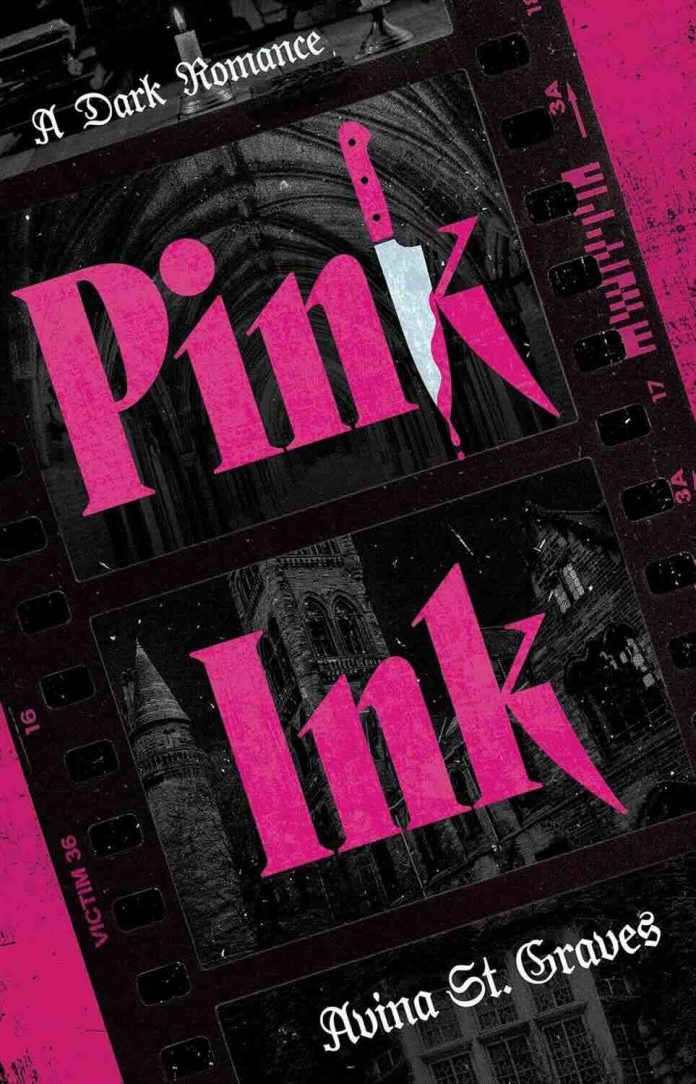
Thirteen hours into a student film shoot, a girl lies on a kitchen floor with pink corn syrup pooling under her neck, glitter in her hair, and a co-star who cannot be bothered to untie her wrists. The scene she is re-creating happened to a real man three weeks earlier. Nobody else on set knows that.
Pink Ink by Avina St. Graves hands its heroine a camera, a leaky police contact and a very bad idea. Reyna Sinaga is a final-year film student at Cresswell University, a Gothic Ivy dropped into New York, and she has spotted what an entire precinct has missed: a run of murders staged to echo famous paintings. She calls him Böcklin’s Shadow, and she restages his work in fake blood the colour her mother once said would make horror less frightening. Then her professor takes an unexplained fall, a substitute arrives, and Reyna finds herself arguing about brushwork with the man whose crime scenes she has been photographing.
The Argument That Starts Everything
Their first meeting is a fight in front of a painting, and it is the smartest scene in the book. Not knowing who is beside her, Reyna tells a stranger that his canvas is technically superb and emotionally hollow. Composition, harmony, colour, all faultless. What it lacks is intimacy. She backs it up by setting Manet’s mirror beside Berthe Morisot at her dressing table and asking which painter loved the woman he was looking at. Her verdict lands like a slap: “That woman is a subject, not his muse.”
That is the argument the whole novel runs on. Maddox Shaw is a prodigy in decline, a man whose murders are his real studio practice and whose canvases have gone dead because of it. He grinds his victims into his pigments, and a twenty-one-year-old with an unfinished degree has just diagnosed what is missing. St. Graves returns to one line as her thesis, and it does more work than any amount of banter: to be understood is to know intimacy.
A Debut That Is Not a Beginner’s Book
Pink Ink by Avina St. Graves is a traditional publishing debut by an author who already had a readership. She built her name independently with Death’s Obsession, Skin of a Sinner and The Saltwater Curse, and readers arriving from that backlist will find the same appetite for the grotesque and a firmer hand on structure.
A Killer Who Wants Notes
Maddox’s chapters are where the novel surprised me. He botches a kill early, loses his temper, wrecks the room and refuses to name the piece. Days later he watches his student’s short film and finds she has read the wreckage correctly and made something better out of his failure. The murderer discovers he has a critic, and it undoes him faster than any threat could.
The classroom feedback sessions prove St. Graves did her homework. He takes Reyna’s film apart shot by shot: the coffee mug filled to the brim in an exhausted character’s kitchen, the day-old sandwich on an otherwise clinical table, the choice to kill the woman from behind so the intimacy the film spent six minutes building dies at the crucial second. It is real craft talk, and it doubles as a man dissecting his own aesthetic without admitting it. When he later suggests a bread knife would be more interesting than an axe, both characters are discussing art and only one is joking.
What Works
- The art criticism is load-bearing. Michelangelo, Böcklin, La Tour, a Degas pose, even a feng shui joke about money flowing in the front door and straight out the back. Every crime scene is composed, and Reyna’s readings of them are the book’s love language.
- Reyna’s voice. Sleep-deprived, funny and specific. A pizza voucher she wants to use before she dies, a twenty-five dollar plate of bad nasi goreng, an EpiPen rattling in a satchel full of latex gloves.
- The courtship set piece. She mentions offhand that she is waiting for a light bulb moment. What he does with that remark is horrifying, meticulous and, inside the novel’s own logic, unmistakably a bouquet.
- The ending is an exhibition, not a speech. The final act pays off its running threads through objects on plinths, and the plaque on the centrepiece is worth the wait.
Where It Stumbles
- The secret society is scaffolding. The Order of the Hallowed Hive gets a hexagonal chamber, Latin liturgy, cloaks, six houses and an election, but its power stays abstract: a blocked bill, a merger, a bought congressman. It exists to squeeze the couple rather than to be a place.
- One separation too many. The third act hinges on Maddox being deliberately cruel to protect her, immediately after the book has already run a betrayal of trust. Two woundings, one narrative function, and the second is visibly engineered.
- The board gets cleared too easily. A late revelation dissolves several threats within a couple of scenes: a protector acquired, a crime scene cleaned, an engagement cancelled. It lets the air out of a plot that had been genuinely tense.
- Surveillance is filed under devotion. Phone tracking, break-ins while she sleeps, a photo archive she does not know exists. Pink Ink by Avina St. Graves offers this as proof of love and never tests the idea, which will thrill some readers and repel others.
- The supporting cast is thin. Abigail, the fiancée, is largely a delivery mechanism for information.
Romance, Heat, and Content
Heat Level at a Glance
Five out of five. The sex is frequent, explicit, and staged where being caught is part of the point, including an office window and a locked classroom.
A Word on Content Warnings
Take the list at the front of the book seriously. On-page torture, dismemberment and mutilation are described in loving detail. Beyond that: a professor and his student, breath play, impact play, exhibitionism, a nut allergy used as a plot device, parental physical abuse, self-harm scars, an arranged marriage, and references to off-page sexual violence and child abuse.
Who This Is For
Reach for Pink Ink by Avina St. Graves if you want your dark academia genuinely dark, if you like a romance where both leads are strange rather than one, and if morally grey has started to feel like false advertising. Skip it if graphic violence is a hard limit, if stalking as courtship is a line you will not cross, or if you need the villainy interrogated rather than adored.
Read These Next
- Butcher & Blackbird by Brynne Weaver. Two killers courting each other with gallows humour and worse impulses.
- Lights Out by Navessa Allen. If the surveillance thread hooked you rather than worried you.
- Ninth House by Leigh Bardugo. The secret society Cresswell wants to be, built with far more brick and mortar.
- Serial Killer Games by Kate Posey. The same premise, lighter and far less bloody.
- The Secret History by Donna Tartt. The original campus of beautiful people doing unforgivable things.
The Last Word
The book is at its best when it takes its own metaphor seriously and weakest when it remembers it owes us a conspiracy. Strip away the hooded assemblies and what remains is a strange, sincere story about two artists who cannot make anything worth keeping until somebody finally looks at their work and understands it. Pink Ink by Avina St. Graves is filthy, ridiculous and occasionally beautiful, and it always knows which of the three it is doing. Read it for the man who kills for a critique, and the girl who gives him one.