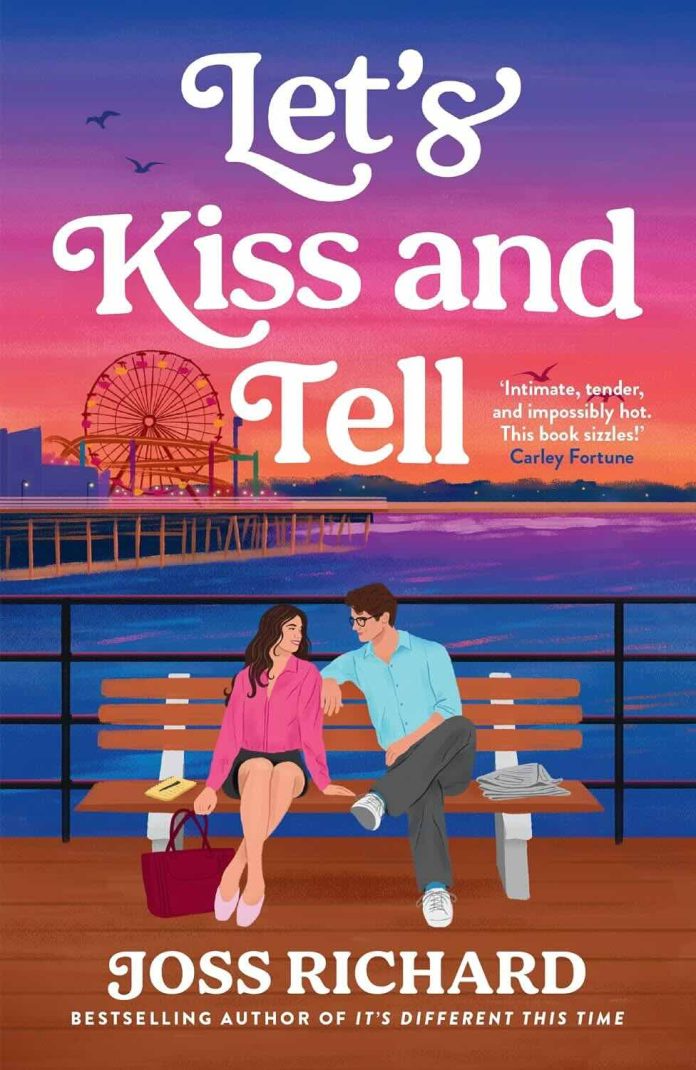
Eight vibrators are arranged on a kitchen table like dolls, next to a plate of cold Eggo waffles, and the woman ranking them is on deadline. That is the opening image of Let’s Kiss and Tell by Joss Richard, and it tells you the register straight away: filthy, deadpan, and quietly about work.
Lucy Reid writes the sex and relationships column at The Rue, a digital magazine under a large Los Angeles newspaper, and her editor has just explained that seventy-eight per cent of her readers are now in relationships and no longer find her relatable. Lucy, who is twenty-nine and has never been in a serious one, hears her job disappearing and says she has a boyfriend. She does not.
The Deal Is the Least Interesting Thing About It
The man she recruits is Marshall Oakley, a thirty-six-year-old senior news reporter who has just joined the parent paper and who needs a date for his ex-girlfriend’s wedding. They met at a bar, in front of a rack of records, before either knew where the other worked. The arrangement is five weeks: she gets a relationship to write about, he gets to walk into Palm Springs without a pity party attached.
What makes Let’s Kiss and Tell by Joss Richard better than that logline is that the romance runs almost entirely on professional respect. Marsh asks Lucy to be a named expert on a feature about sex work, and means it. She teaches him to write down how a room makes him feel; he teaches her to write down what is actually in the room. Their first genuinely erotic scene is not a kiss. It is a desensitisation exercise in a parked car, where she makes him say words out loud until he stops flinching, and he stops flinching somewhere around word four.
Richard also does something clever with structure. Between chapters, we get Lucy’s published columns, paywall cut-offs and all. So every private development arrives twice: once as it happens, and once as the sanitised, monetised version she files on Monday. By the halfway point the gap between the two is the story.
The Grief Under the Comedy
For a book as funny as Let’s Kiss and Tell by Joss Richard, there is a lot in the basement. Marsh keeps a small ceramic clementine on his mantelpiece, and the explanation for it, when it comes, recalibrates every scene he has been in. Lucy’s certainty about love traces back to a single afternoon at fifteen and an address in Riverside, and the novel eventually walks her back through it with her mother in a way that is not tidy at all.
Richard is good on the specific humiliation of an industry in decline, too. Layoffs hang over the whole book, land on someone the reader has grown to love, and are not softened afterwards.
What Works
- The dialogue. Lucy and Marsh talk like two people who genuinely enjoy the sound of each other, and the running jokes (a tooth fairy building a house, an assassin with a bad knee) pay off chapters later.
- The supporting cast has weight. Jonah, Quinn and six-year-old Sadie are drawn well enough that the reader misses them when they are off the page.
- It takes the sex-writer stigma seriously. The book is genuinely angry about how Lucy is treated by men who hear her job title and stop listening, and it never once makes her the punchline.
- The heat is well written and consensual on the page. Enthusiastic, specific, occasionally very funny, and always with someone checking in first.
Where It Stumbles
Four things keep Let’s Kiss and Tell by Joss Richard off the top shelf, and the first is the one that nags longest.
- One rule for the leads. The novel establishes that the company fires people for relationships across publications, and then does exactly that to two minor characters. Lucy and Marsh, who are far more entangled, face no consequence at all. The risk is used to generate tension and then quietly dropped.
- The sex-work feature never lands. It is well researched and the interview scenes are among the best writing here, but the trial it hangs on simply evaporates once it has finished bringing the leads together.
- The third-act rupture is a speech. Both of them deliver diagnoses of the other so complete and well organised that it reads as the author summarising her themes rather than two people losing an argument.
- The late revelation does too much, too fast. A conversation in the final third rewrites the heroine’s entire psychology in about six pages. It is moving. It is also carrying more weight than one scene can hold.
Heat, Content, and Who This Is For
Heat Level at a Glance
Four chillies out of five. Multiple explicit, on-page scenes, sustained dirty talk, and a toy that gets its own countdown.
A Word on Content Warnings
Infidelity, on the page and in the past. Pregnancy loss, discussed at length and central to one character’s history. A vasectomy and the grief behind it. Job loss and workplace precarity. An ex who does not accept being told no. Readers for whom the pregnancy-loss thread is close to home should know it recurs; Share is a good starting point for support.
Who Should Read Let’s Kiss and Tell by Joss Richard
Reach for it if you like workplace romance where the work is real, if you want banter with actual jokes in it, or if you have ever built a whole worldview out of something you half understood at fifteen. Skip it if closed-door is your preference, or if a romance that raises an ethical problem and then lets its leads walk past it will nag at you.
What to Read After Let’s Kiss and Tell by Joss Richard
- It’s Different This Time by Joss Richard. Her debut, a second-chance romance across a decade in New York. Quieter and more nostalgic, with the same instinct for what people avoid saying.
- Extracurricular by Rachel Lynn Solomon. The closest tonal match: sharp, sex-positive, and interested in the professional lives of its leads.
- The Fine Print by Lauren Asher. If the celebrity-adjacent, high-gloss Los Angeles setting is part of the appeal.
- Funny Story by Emily Henry. For the same trick of two people performing a relationship for an audience and forgetting to stop.
- Riding the High by Paisley Hope. For readers who came for the heat level and want it kept there.
The Last Word on Let’s Kiss and Tell by Joss Richard
There is a moment near the end where a man who has spent his whole career writing other people’s stories files one about himself, and it is the best thing in the book because Richard has spent three hundred pages earning it. That is the novel’s real subject: not fake dating, but the difference between being open and being vulnerable, which one character states outright and both of them spend the whole book failing to manage. It is a romantic comedy with a genuine argument inside it, a lot of very good sex, and one structural cheat it never quite owns up to. Lucy would tell you not to settle. She would also tell you this one is worth the weekend.







