If you want to know how to build an author platform, here is the short answer: gather readers you can reach directly, give them one home base where they can find you, and add one channel where new readers meet you. In practice that means an email list first, a simple author website second, one social platform you can keep up, and a steady habit of appearing in front of other people’s audiences. Authors in one large 2025 survey who had an email list reported a median income about 20 times higher than those without one, which is a pattern worth noticing, not a promise.
Who this is for and how we checked it. This guide is for debut and early-career authors, fiction and nonfiction, self-published or heading for an agent. On 3 November 2026 we checked every rule and figure below against the source’s own page: Amazon’s KDP Hyperlink Guidelines, Google Search Central, Pew Research Center, Jane Friedman’s platform class page, and the Written Word Media author and reader surveys (read in full, with their own caveats). Where a number comes from a survey, we name the survey, its size and its date.
What an author platform is (and what it isn’t)
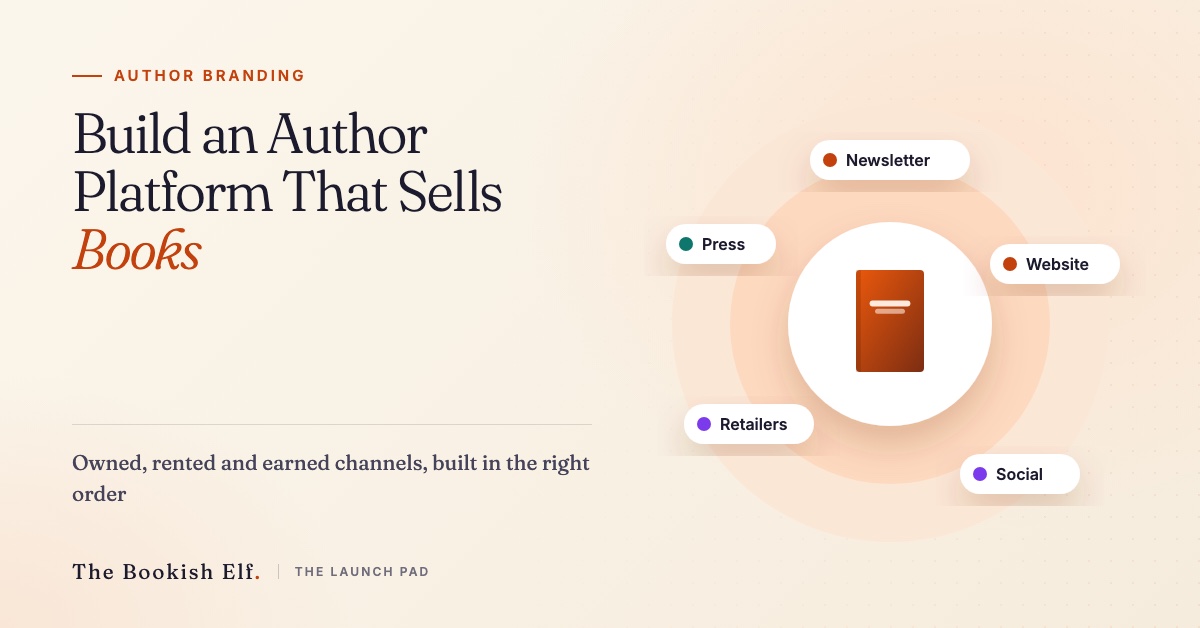
Jane Friedman, the former publisher of Writer’s Digest, defines platform as “visibility to your target readership” that turns into the ability to sell your work (Jane Friedman). Her core set is a website, an email newsletter and at least one social channel where you actually take part. We find it most useful to sort every piece of a platform into three rings, by how much control you have.
- You and your books
The centre of everything. Each book's back matter points readers to your next book and your free-story page.
- Owned: email list and website
Readers who asked to hear from you, and a home base you control. No algorithm in between.
- Rented: one social platform
Where new readers meet you. Pick one you can keep up every week.
- Rented: retailer and reader sites
Your Amazon author page and your Goodreads and BookBub profiles, kept current.
- Earned: other people's audiences
Podcasts, guest posts, newsletter swaps and group promotions in your genre.
- Earned: reviews and events
Reviewers, book bloggers, libraries, bookshops and festivals.
- Owned. Your email list, your website and the back matter of your books. No algorithm sits between you and the reader, and nobody can switch it off.
- Rented. Your social accounts and your profiles on Amazon, Goodreads and BookBub. They reach people you could never reach alone, but the rules change without asking you.
- Earned. Other people’s audiences: podcasts, guest posts, newsletter swaps, reviewers, bookshops, libraries and festivals. You earn a slot by being useful to their readers.
Learning how to build an author platform is mostly learning this order. Rented and earned reach brings new readers in; the owned ring is where you keep them. A platform is not a follower count, it is not something you can buy, and for fiction it is not a password to a book deal. It is the set of places where the right readers can find you, and the habits that keep them coming back.
Decide who you’re for and what you’re known for
Every later choice depends on one sentence: who reads your books and why. Write a reader promise before you build anything. A simple template: “For readers who loved [comp author or title] and want [the feeling], I write [genre] set in [your hook].” Then list three comparable authors whose readers you want. Their readers’ habits tell you where to spend your time.
If you write fiction
Your platform is reach within your genre. Readers rarely care about credentials; they care that the book delivers the feeling they came for. Series, back matter and an email list carry most of the weight. A worked example (hypothetical): a cosy-mystery debut set in a seaside bakery. Reader promise: “For readers who loved Richard Osman and want a warm puzzle with cake, I write cosy mysteries set in a Cornish bakery.” Her comps’ readers are heavy newsletter readers and Instagram browsers, so she starts with an email list and a free short story, and picks Instagram as her one social channel.
If you write nonfiction
Your platform is authority plus reach in your topic. Agents and publishers weigh it at the proposal stage, and the book often works as a calling card for talks, consulting or courses. Written Word Media’s 2025 survey found that nonfiction authors often earn through these adjacent offers rather than the book alone (Written Word Media, Dec 2025). A hypothetical nurse writing about burnout would build talks, published articles and a professional network alongside her list, because those are the proof a publisher looks for.
Claim your home base: a simple author website
Your website is the one public page you fully control. Keep it small: a home page with one clear sign-up, a books page, an about page, a contact page and a short press kit with photos and bios. Our guide to creating an engaging author website covers the build, the pages and the design choices in detail.
What has changed is the website’s job. Search sends fewer clicks than it did. Pew Research Center tracked the browsing of 900 US adults in March 2025 and found people clicked a traditional result on 8% of Google visits that showed an AI summary, against 15% when there was none (Pew Research Center, Jul 2025). Google disputes Pew’s method, but the finding is the best independent data we have. So an author site will rarely rank for “best thriller books”. Its real jobs are to answer branded searches (“[your name] books”), give agents, reviewers and journalists proof that you are serious, and turn visitors into subscribers.
You don’t need special files or markup for AI search. Google’s own guidance says there are no extra requirements or special optimisations to appear in AI Overviews or AI Mode: the page just needs to be indexed and eligible for a snippet (Google Search Central). Write clear pages about you and your books, and let normal search basics do the rest.
Start your email list before you think you need it
If you only build one thing, build the list. Written Word Media’s 2025 Indie Author Survey (1,346 responses, published 2 December 2025) found authors with an email list reported a median of roughly $300 a month, against roughly $15 for those without. Average list size rose with income: 18,327 subscribers for authors earning $10,000 or more a month, and 902 for those under $100. Its June 2026 mid-year survey (582 authors) found newsletter use rising from 39% of starting-out authors to 73% of those earning $2,500 to $10,000 a month (Written Word Media, Jun 2026).
Self-reported surveys of Written Word Media's own audiences. They show a pattern, not proof that a list causes income.
Readers say the same thing from the other side. In Written Word Media’s February 2026 reader survey of 3,589 readers, 49% said they subscribe to author newsletters, while 2% follow authors on TikTok (Written Word Media, Feb 2026). Two honest caveats: these are self-reported surveys of Written Word Media’s own audiences (the readers already subscribe to its deal emails), and they show a link between a list and income, not proof that one causes the other.
Setup is a weekend job, and we’ve written it up step by step in how to start an author newsletter, including today’s free-plan limits and the Gmail and Yahoo sender rules. For what to put in each issue, see how to create a compelling author newsletter.
One rule to know before you format your ebook. Amazon’s KDP Hyperlink Guidelines prohibit links in Kindle books to web forms that request customer information such as an email address, and to ebook stores other than Amazon. Amazon can remove links at its discretion (KDP Hyperlink Guidelines). So in your back matter, link to a page on your own website that describes your free story, and put the sign-up form on that page. Amazon still has the final say on any link.
Pick one social platform and do it well
One channel done every week beats four done badly. Choose with three questions: where do your comp authors’ readers already talk, what format will you still enjoy in month six, and can it send people to your list?
1. How much time can you give it each week?
2. Which do you enjoy making?
3. What do you write?
4. Where do your comp authors' readers talk?
Answer the questions to see your result.
Put your time into your list, your website and earned slots on podcasts and blogs. Add a social channel once your monthly email is a habit.
Low effort, text-first and conversational. Post a few times a week, reply to readers, and link your free-story page.
Covers, mood boards and short Reels. Post weekly, keep your sign-up link in your bio and in Stories.
Short video with a strong hook, several times a week. Point viewers to your link in bio and your list.
- Instagram suits covers, aesthetics and the Bookstagram community, and it is the biggest of the four by a wide margin.
- Threads suits chatty, text-first authors who like conversation more than polish.
- TikTok suits genre fiction with a strong hook and authors who like short video. Its US business became a joint venture in January 2026 (The Register), so its US future is settled for now. Our BookTok marketing guide covers the videos themselves.
- Bluesky has a lively literary and indie corner, but its registered accounts far exceed the people who use it each month (Bluesky’s own count against Similarweb estimates, both reported by the tech press in 2026), so treat it as a second channel.
Size matters less than fit: a small app full of your readers beats a huge one full of strangers. What to post? The same reader survey found readers most want to hear about future projects (67%), insights into characters and story (59%) and book recommendations (59%); only 19% wanted the writing process. For tone and pitfalls, read the dos and don’ts of social media marketing for authors. Not sure where to start? The quiz below suggests a first channel from four questions.
Set up your Amazon, Goodreads and BookBub profiles
These rented profiles are where buyers check you out, so claim them early and keep them current. On Amazon, claim your author page through Author Central, add a recent photo and a bio, and make sure every edition of every book is linked to you. Readers can follow you there and hear about new releases. On Goodreads, claim your author profile so your books, bio and photo sit together. On BookBub, claim your author profile too: readers follow authors there and get alerts about new books and deals.
Use the same name, photo and short bio everywhere, so a reader who meets you on one site knows you on the next. One Amazon change is worth knowing: Kindle Unlimited was renamed Kindle+ in October 2026 (press reports date it to 22 October), and KDP’s help pages now use the new name. Check your KDP Select settings rather than relying on older guides.
Earn space in front of other people’s audiences
The fastest growth usually comes from readers who already trust someone else. These are the earned ring of your platform:
- Podcasts and blogs in your genre or topic. Pitch one specific idea, not “an interview about my book”.
- Newsletter swaps and group promotions through BookFunnel or StoryOrigin. Written Word Media’s 2025 survey found authors rated swaps less effective than in earlier years, so choose partners whose readers match yours.
- Reviewers and book bloggers. Honest reviews on retailer pages and blogs give buyers proof.
- Libraries, local bookshops and festivals. Small events still build loyal readers, and a sign-up QR code on a bookmark turns them into subscribers.
- Paid features. Some sites sell promotion to their audiences. Judge them by audience fit, not reach alone.
A disclosure: The Bookish Elf sells book marketing services to authors, including features to our 200K+ social followers. We’ve reviewed books since 2018 and published more than 4,000 reviews, interviews and articles, but the free routes above work too. For how to time all this around release day, see our week-by-week plan to promote a self-published book, and for what it might cost, how much book marketing costs.
Measure what counts
Count the few numbers that show readers moving towards your books, and ignore the rest. Once a month is enough.
Days 1 to 14: foundations
Days 15 to 45: home base
Days 46 to 90: reach
| Measure | Where to find it | Why it matters |
|---|---|---|
| New subscribers per week | Your email platform | The clearest sign your platform is growing |
| Click rate on your emails | Your email platform | Open rates are unreliable since Apple’s Mail Privacy Protection |
| Replies to your emails | Your inbox | Shows readers care, and engagement helps inbox placement |
| Branded search impressions | Google Search Console | How often people search for your name or titles |
| Sales in launch week | KDP and other retailer dashboards | The real test of whether the platform sells books |
Follower totals look good in a bio but say little about sales. If you’re wondering how to build an author platform that lasts, this is the test: six months of steady sign-ups and clicks means it is working, whatever the follower count says. The 90-day checklist below turns all seven steps into tasks you can tick off.
What changes in 2027
Five shifts are already visible. Each is sourced; where we look ahead, we say it is speculation.
Now (2026)
Fewer clicks reach websites, so your name and titles need to be what people search for.
Pew Research Center, Jul 2025Renamed in Oct 2026 (reported 22 Oct); KDP's help pages now use the new name. Check your KDP Select settings.
KDP Help, read 3 Nov 2026Google says AI Mode queries are about three times longer than traditional searches.
Alphabet Q3 2026 remarks, Oct 2026Next (2027)
Gmail can sort Promotions by the senders each reader engages with most.
Google, Sep 2025Gmail began ramping up enforcement on non-compliant mail, including rejections, from November 2025.
Google sender FAQ, read 3 Nov 2026Watch
Only 7% of surveyed readers use AI tools to find books occasionally, and under 1% regularly. Watch, don't chase.
Written Word Media, Feb 2026Speculation: conversation will beat broadcast posting on Threads and Bluesky in 2027.
Our reading of 2026 platform changes- Search sends fewer clicks, so your name matters more. Pew’s 8% versus 15% click finding, and Google’s own figures (its Gemini app reached one billion users, and AI Mode queries are about three times longer than traditional searches, per Alphabet’s Q3 2026 remarks), point the same way. Build reasons for people to search for you by name.
- Email reach is earned by engagement. Gmail can sort the Promotions tab by the senders each reader engages with most (Google, Sep 2025), and Google has been stepping up enforcement on mail that fails its sender rules since November 2025 (Google sender FAQ). Engaged lists get seen; cold or bought lists don’t.
- Amazon’s subscription has a new name. Kindle Unlimited was renamed Kindle+ in October 2026. How that changes author payouts in 2027 is speculation; watch the monthly KDP Select figures.
- Text-first social keeps growing. Threads has added feed controls that let readers shape what they see, and Bluesky’s registered accounts keep rising while active use lags (Similarweb estimates, as reported in 2026). Speculation: in 2027, conversation will beat broadcast posting on these apps.
- AI book discovery is small. In the February 2026 reader survey, 71% of readers said they don’t use AI tools to find books, 7% occasionally and under 1% regularly. Watch it; don’t chase it.
FAQ: how to build an author platform
What is an author platform?
An author platform is your visibility to the readers you write for, and your ability to reach them when you have a book to sell. It’s built from owned assets (email list, website, back matter), rented ones (social and retailer profiles) and earned ones (other people’s audiences).
Do fiction writers need an author platform?
Yes, but a different one from nonfiction writers. Agents judge fiction mainly on the book, while readers of genre fiction respond to series, back matter and an email list. A small, engaged list matters more than a large following.
Can you build an author platform without social media?
Yes. A website, an email list, strong back matter and earned slots on podcasts, blogs and group promotions can carry a career. Social media speeds up discovery, but it’s the rented part of a platform, so it’s the part you can most easily skip.
How long does it take to build an author platform?
If you follow the steps in this guide on how to build an author platform, you can set up the foundations in about 90 days: a reader promise, a website, an email list and one social channel. Growth then comes from books, steady emails and repeated appearances in front of new readers, which takes years rather than weeks.
Do agents and publishers check your platform?
For nonfiction, yes: platform is part of most book proposals, because authority and reach help sell the book. For fiction, the manuscript comes first, though a list and an active presence can help once you’re published.
Put your book in front of readers
Our book marketing services pair your launch with reviews, features and social promotion on The Bookish Elf.
See our book marketing services