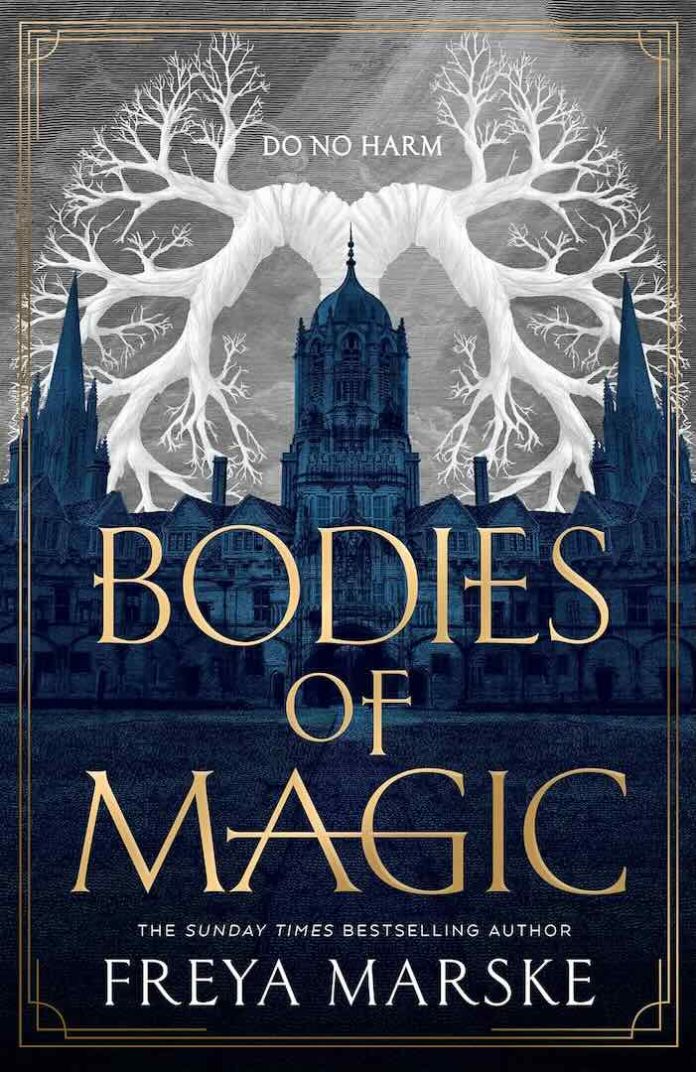
On the first morning of the Grand Exam, five final-year scholars walk into a chamber of the Rondelle expecting a patient and a folded paper question. They find a classmate dead on the floor instead. Then the proctor geas closes over them, the standing spell that stops any scholar discussing an exam case with anyone outside their group, and it turns out to have swallowed this too. There are five days of examination still to sit. For all five of them, none of these people will be physically able to say what they saw. Bodies of Magic by Freya Marske begins with that gag fitted, and every good decision in the book follows from it.
How the Grand Exam Works
Healing mages are produced in exactly one place on the continent, and the Grand Duchy of Sieuxerr has built an entire economy on the accident. Children are mage-tested, sorted by specialty, and any child who tests as a healer is funnelled into the Academie Sieuxerr whether or not that child ever wanted the work. Five years of study follow. Then a bond: five more years wherever the city has sold your contract, to whichever town or duchy paid the fee.
The Grand Exam is the last gate. Five days, five cases, one assigned group of five scholars who pass or fail as a unit. A patient is brought in, a question is unfolded, and an hour later a bell rings.
The magic itself is the best thing on offer here. Healing is sung. A healer holds a pitch and holds, simultaneously, a stubborn mental picture of the body as it ought to be, and the body is argued into agreement. Groups chalk an array on the floor and take roles inside it: one anchors the working, others feed magic in behind them, someone monitors the heart and lungs, someone takes the history. It is a craft with a technique, a literature and a set of bad habits, and Bodies of Magic by Freya Marske treats it exactly like one.
What Freya Marske Is Actually Writing About
Six years before the novel opens, a plague went through the Blue City. The healers stayed at the bedsides, as healers do, and a large share of them came out the other side with muscle spasm, exhaustion and pain that nobody has been able to treat. They call it the serrage. Hundreds of them have never worked again.
Everything in Bodies of Magic by Freya Marske runs off that. Cohorts were expanded to fill the gap, which means scholars with barely enough magic to qualify. The survivors carry the load and get spat at in the street for having failed to stop the thing. Faculty posts are being restructured out from under people in their fifties. Marske is a working doctor, and what she brings is not sentiment but specifics: the post-viral syndrome that nobody has a protocol for, the senior clinician who works a free clinic shift and is bitter about it, the student who has been taught that destroying herself is the professional standard.
What Bodies of Magic Gets Right
- The epigraphs. Every chapter opens with a document from inside the world: a history of the Blue City, a letter to the editor of a healing journal, the scholar’s handbook, an unpublished memoir, a page of a trashy detective serial, graffiti carved into a residence hall bathroom stall. Four hundred pages of worldbuilding and not one lecture.
- Five crises the murder does not need. Each of the five carries something the plot could have done without and is better for keeping: a coerced arrangement with a criminal, a father’s bribe discovered at the worst moment, an enormous power its owner is frightened of, a young woman who does not want to be a healer and has never been permitted to say so.
- Clement. The point-of-view scholar with perfect pitch is genderfree, and the novel simply builds that into the grammar of the world and gets on with the story. Their grief for the dead girl is the emotional spine of the book.
- The exam cases are real medicine. Each hour of diagnosis is worked through properly, and the best sequences in Bodies of Magic by Freya Marske are the ones where five tired students stand around arguing about a thyroid.
Where Bodies of Magic Gives Ground
- The detection is the weakest strand. The suspect pool is small, the investigating is mostly canvassing, and the solution arrives through pressure rather than through anything the reader could have assembled first. Mystery readers should come for the institution, not the puzzle.
- Days three and four repeat their shape. Sit the case, canvass a witness, regroup over food, open the day’s letter. The pattern is clear by the halfway mark and the middle sags inside it.
- One subplot belongs to a different novel. The crime-boss thread is enjoyable and entirely detachable, and it is resolved by an intervention that arrives from outside and costs almost nobody anything.
- The vocabulary lands unglossed. Serrage, phantome, geas, radial, anthem lark, Dux Scolaris, generalist belt, journade. Bodies of Magic by Freya Marske settles after fifty pages, but those fifty pages are work.
Content Notes and Heat Level
Bodies of Magic by Freya Marske opens with the author’s own warning and it is warranted. Suicidal ideation and self-harm are sustained and on the page, treated seriously and never resolved by plot convenience. Also present: grief, chronic illness and daily pain, a childhood in a controlling religious household, and burnout drawn with real anger. On heat, there is one explicit scene between two men late in the book and a good deal of anticipation before it; a second romance stays at a kiss.
Read It If / Skip It If
Read it if you want a magic system with a syllabus, if hospital novels and academic novels appeal to you equally, or if you have ever worked somewhere that ran on the goodwill of people it was quietly using up.
Skip it if you want a fair-play mystery with clues you can weigh, if a large ensemble introduced quickly puts you off, or if you need a fantasy world you can enter without learning vocabulary.
Read These Next
Five for readers who finish Bodies of Magic by Freya Marske and want more of the same weather:
- Cinder House by Freya Marske. Her gothic Cinderella retelling, shorter and colder, and the clearest short sample of what her prose does.
- Swordcrossed by Freya Marske. The warmest thing she has written, for anyone who came out of this one wanting the romance turned up.
- Blood Over Bright Haven by M.L. Wang. A magical research institution with an atrocity in its foundations, and a woman determined to publish inside it.
- The Will of the Many by James Islington. An elite academy in an empire where power is drained upward from the people below it.
- Ninth House by Leigh Bardugo. For the university that protects its own, and the outsider who refuses to let a death be filed away.
The Last Word
There is a detail that keeps coming back. The Academie’s library is fitted out with carrels, and scholars are encouraged to claim one and make it theirs for five years. One character, standing in a doorway, looks at those rows of little wooden boxes and sees them for what they are: a piece of furniture designed to hold every person in the room apart from every other person in the room. Tutorial groups rotate every term. Bedrooms have one chair. The building is doing it on purpose.
That is the argument Bodies of Magic by Freya Marske is making underneath the murder. A profession that isolates its trainees, ranks them publicly, and teaches them that exhaustion is a credential will eventually produce someone who has nothing left except a job title to protect. The mystery is the thinner half of this book. The institution is the other half, and it is drawn by somebody who has been inside one.







