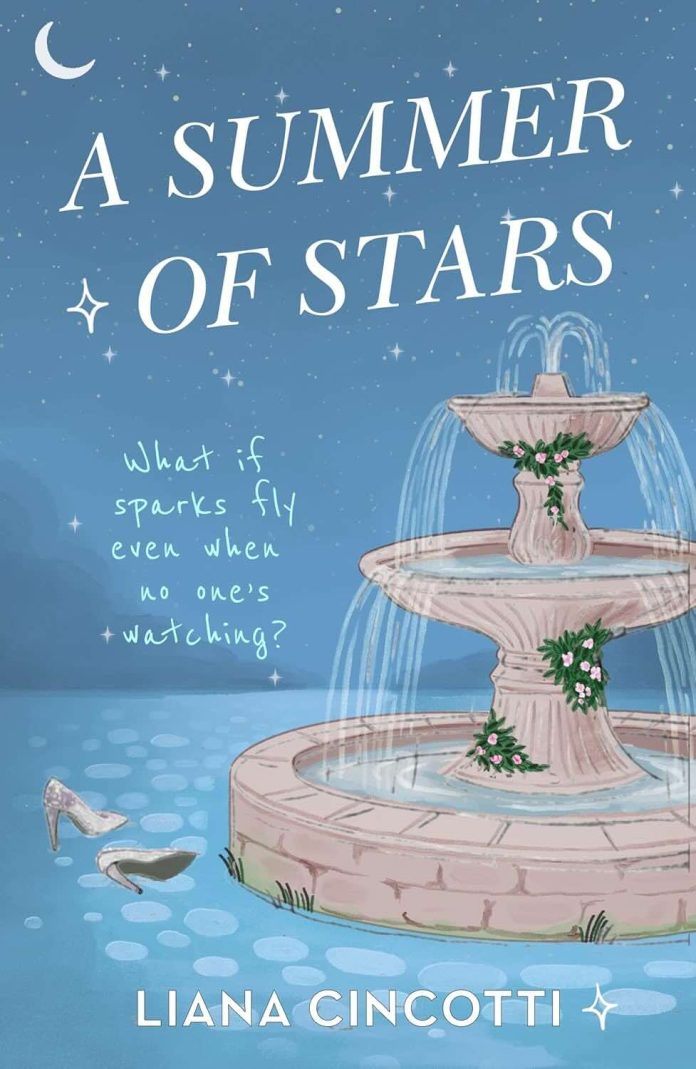
Nine tabloid headlines open A Summer of Stars by Liana Cincotti before a single character speaks, and every one of them is about how much the world hates the same woman. It is the smartest thing the book does, and it does it on page one.
Luna Aldridge has lost seven sponsors, her ranking has fallen from six to seventy-four, and her ex-husband has just gone on camera to explain that she was the toxic one. Her remaining sponsor sells love-themed jewellery and wants proof she is capable of it. Enter Kieran Alexander, a Hollywood actor with a romance film to sell and a playboy reputation to launder, who three years ago was overheard calling her a narcissist and an excuse for a tennis player.
A Contract, Two Grudges, and a Calendar
The setup of A Summer of Stars by Liana Cincotti is standard fake dating, and Cincotti runs it with unusual discipline. The PR teams draw up a four-month schedule of sightings, and the book simply follows it: Charleston, a jewellery launch, a countryside ball, Wimbledon, Roland-Garros, Cannes, Madrid, the US Open. Every chapter is headed by a real-sounding tabloid headline, so the reader keeps meeting each scene twice, once as gossip and once as it happened.
The device pays off far beyond novelty. This is a book about a woman whose entire professional life is decided by strangers reading a version of her, and the structure makes the reader do exactly that, over and over, before granting the correction. By the halfway mark you catch yourself resenting the headlines. That is the point.
Luna narrates in a dense, simile-heavy voice; Kieran in something plainer and more watchful. She reads his charm as technique. He reads her composure as vanity. Both are wrong in ways the reader can see and they cannot, which is the engine of the first half.
The Best Chapters Are Not the Romance
A Summer of Stars by Liana Cincotti is a debut with a traditional publisher behind it, and the seams show in an interesting way: the material Cincotti clearly cares most about is not the fake-dating plot at all.
It is Kieran’s family in Valencia. He is Kieran Alexander Alvarez, and he dropped the second half of his name and dyed his hair blond at eighteen because his father made that the price of leaving the restaurant for drama school. The scenes in that house, with an eighty-seven-year-old grandmother who emails him every article ever written about him and rates the women he is rumoured to be dating, are funny and specific and warmer than anything else in the book. When Luna finally says something to his father on a back deck at six in the morning, it is the most satisfying confrontation in the novel, and it does not involve either of the leads.
The other standout arrives late and involves Ava Williams, the younger player who slept with Luna’s husband. Cincotti sets it up as a showdown and then declines the fight entirely, in a scene about shoelaces that reframes a year of the book. Romance novels rarely give the other woman a full page. This one does, and it is better for it.
What Works
- The people-pleasing thesis. The dedication names it and the book earns it. Luna’s perfectionism is written as a survival strategy with a cost, not a quirk, and her recovery is measured in the size of the things she stops apologising for.
- The banter is genuinely funny. A running bit about hiring an elderly assassin, a croquet game she cannot stop trying to win, two dropped ice creams. Cincotti has the comic timing she claims to have inherited from nineties romantic comedies.
- Small objects carry the grief. A charm bracelet from Luna’s late mother does most of the emotional work, and the moment a charm breaks lands harder than the injury that preceded it.
- The consent line holds. Luna sets a no-intimacy boundary early and Kieran respects it without argument for a long stretch of the book, which is rarer in this trope than it should be.
Where It Stumbles
Four things hold A Summer of Stars by Liana Cincotti back, and only one is the sport.
- The tennis is wallpaper. An author’s note admits upfront that the sport is not accurately depicted and directs readers to the tour’s own site, which is honest but does not fix the problem. A player ranked seventy-four does not reach a Wimbledon final unseeded; the season here runs Wimbledon, then Roland-Garros, then Madrid, in that order. For a novel built on an athlete’s comeback, the athletics are set dressing.
- Jeremiah has no inside. The ex-husband is monstrous from his first line to his last, and never once surprises. Because he never becomes a person, Luna’s year of self-doubt reads as a mistake rather than a trap, which flattens the thing the book is actually about.
- A single lost letter. The three-year grudge turns on an apology that never arrived. It is a very old device, and the explanation for its disappearance arrives so late and so tidily that it works better as a plot patch than a revelation.
- The friend group blurs. Six colleagues are introduced with an age, a job and a hobby in parentheses, and several never move past it.
Heat, Content, and Who This Is For
Readers coming to A Summer of Stars by Liana Cincotti from the cover, which promises a sunlit European summer, should know what else is inside it.
Heat Level at a Glance
Roughly two chillies out of five. The kissing is written at length and with real physical detail; the sex closes the door and picks up the morning after.
A Word on Content Warnings
Infidelity shown on the page, sustained harassment by an ex-partner including unwanted physical contact, a coordinated online hate campaign, parental cancer, grief for a dead parent, a sports injury and heat exhaustion. The harassment thread is persistent rather than graphic, but it is the spine of the book.
Who Should Read A Summer of Stars by Liana Cincotti
Reach for it if you want a fake-dating romance with an actual argument inside it, if you like celebrity-adjacent stories about reputation, or if you have ever been the person in the room managing everyone else’s comfort. Skip it if you came for the sport, or if a villain who is simply awful all the way through will spoil the ride.
What to Read After A Summer of Stars by Liana Cincotti
- Fake Skating by Lynn Painter. The nearest neighbour: a contract relationship, an athlete under scrutiny, and jokes that land at the same frequency.
- Some Kind of Famous by Ava Wilder. If the Hollywood machinery is the appeal, this is the sharper book about being managed by a publicist.
- Carrie Soto Is Back by Taylor Jenkins Reid. The tennis novel this one is not, for readers who want the sport taken seriously.
- The Fake Out by Stephanie Archer. A warmer, filthier take on the same trope with a professional athlete at the centre.
- Picking Daisies on Sundays by Liana Cincotti. Her self-published first novel, where this voice started.
Cincotti’s own note sends readers to the WTA for how the tour actually works, and it is worth taking her up on it.
The Last Word on A Summer of Stars by Liana Cincotti
There is a better book somewhere inside it, one where the sport is real and the ex-husband is a person, and its absence is genuinely frustrating because everything around it is so capable. What is here is a warm, funny, unusually thoughtful romance about what happens to a woman who has spent her whole life being perfect on demand, and about the two men who told her she was unlovable, one of whom was lying to protect her. It ends with her winning the thing she wanted. It ends, more importantly, with her no longer needing the crowd to agree.







