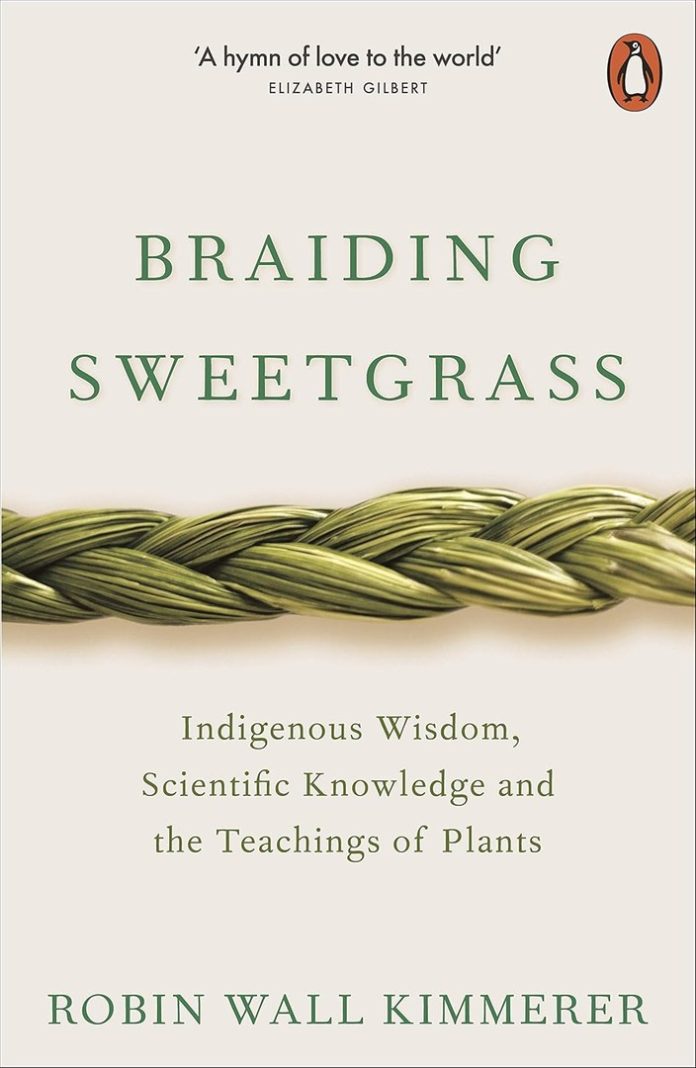


The book opens with an instruction rather than an argument. Hold out your hands, Kimmerer says, and take this bundle of sweetgrass; now hold one end while I braid, and I will hold it for you in turn. That small exchange is the whole design of Braiding Sweetgrass by Robin Wall Kimmerer. Three strands go into the plait: Indigenous ways of knowing, Western plant science, and the life of the woman trying to join them. A braid needs tension to come out smooth, and the best essays here pull hard in two directions at once before they lie flat.
How Robin Wall Kimmerer Builds the Braid
Braiding Sweetgrass by Robin Wall Kimmerer is a collection of essays, not a single narrative, and the structure does real work. Five sections follow the life of the plant: Planting, Tending, Picking, Braiding and Burning Sweetgrass. Each opens with a short note on how the grass is actually grown or harvested, so the botany frames the book before a word of argument arrives.
Inside each section, Kimmerer moves between three registers:
- Story. Creation accounts, beginning with Skywoman falling from the sky world onto Turtle’s back, retold as working instructions rather than folklore.
- Science. Mast fruiting in pecan groves, nitrogen-fixing bean roots, how maples sense spring with pigments in their buds.
- Memoir. Her childhood in upstate New York, a grandfather taken to boarding school, raising two daughters alone on an old farm.
The trick is that no strand is allowed to win. When a story makes a claim, the science tests it; when the science goes cold, a person walks into the frame.
What Robin Wall Kimmerer Asks of Her Reader
The thesis is simple to state and hard to live: the world is a gift, and a gift creates obligations. Kimmerer builds it from the ground up. As a freshman she told her adviser she wanted to study why asters and goldenrod look so beautiful together, and was told that was not science. Decades later she answers him properly, with the physics of complementary colour and the behaviour of bees, and then admits the question was always bigger than botany.
The chapter that matters most this month is “Allegiance to Gratitude”. At the Onondaga Nation School near her farm, the week begins not with the Pledge of Allegiance but with the Haudenosaunee Thanksgiving Address, the Words That Come Before All Else, recited by children who thank the earth, waters, plants, animals and stars in turn. Kimmerer weaves the full text through her own commentary and sets it against her daughter’s refusal to stand for the Pledge. Her students sometimes grumble that the Address runs long. Her reply is the best line in the book: “What a pity that we have so much to be thankful for.” Anyone looking for a Thanksgiving read about giving thanks rather than about pilgrims will find it in Braiding Sweetgrass by Robin Wall Kimmerer, which never retells the familiar holiday story as history.
What works
- The language essay. In “Learning the Grammar of Animacy” she discovers that in Potawatomi and Ojibwe a bay can be a verb, “to be a bay”, because the water is alive. It is the moment in Braiding Sweetgrass by Robin Wall Kimmerer most likely to change how you see a landscape, and her wry account of struggling with the grammar keeps it from turning reverent.
- Formal invention. “The Teachings of Grass” is laid out as a scientific paper, with a hypothesis, methods and results, proving that sweetgrass thrives when basket makers harvest it. The form is the argument.
- Rules you can use. “The Honorable Harvest” sets out a short, practical code: ask permission, take only what is given, never the first one, use it well, give thanks, give something back. It reads as a list you could pin to a fridge.
- Comedy in dark places. Walking the toxic waste beds beside Onondaga Lake, she pushes through the reeds and finds a hanged body and an axeman, which turn out to be props for a local haunted hayride. She laughs, then cries, and the essay earns both.
Where It Gives Ground
- The same lesson, again. Gift, gratitude, reciprocity, take only half: the argument is restated in nearly every essay. Two separate chapters reach the same research finding, that a plant declines when people stop harvesting it. Read straight through, Braiding Sweetgrass by Robin Wall Kimmerer starts to feel like one sermon given in many churches.
- Op-ed turns. “Maple Nation” begins as a funny piece about small-town civics and ends as a policy plea. A trip to a shopping mall is staged so that everyone in it looks lost, which is too easy.
- A long, dated centrepiece. The Superfund essay on Onondaga Lake carries legal and cleanup detail from around 2010 that already reads like old news.
- Tidy conversions. Several teaching essays end with sceptical students singing or giving thanks at dawn. Once is moving; the pattern makes the later ones feel arranged.
Read These Next
If Braiding Sweetgrass by Robin Wall Kimmerer left you looking harder at the trees outside, these go well beside it:
- The Serviceberry by Robin Wall Kimmerer, the short follow-up that turns the gift economy into a single, sharper essay.
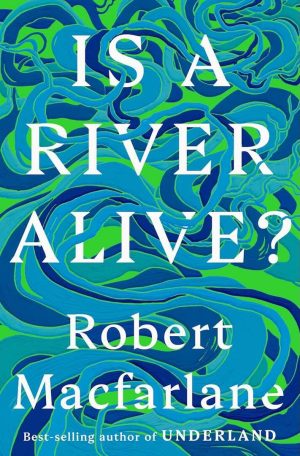
- Is a River Alive? by Robert Macfarlane, which pushes the same question of whether the living world has standing.
- Wandering Stars by Tommy Orange, a novel that begins with the boarding-school history Kimmerer’s family carried.
- The Hidden Life of Trees by Peter Wohlleben, for the science of how forests share and signal.
- Finding the Mother Tree by Suzanne Simard, the researcher’s own account of the fungal networks Kimmerer describes under the pecan groves.
About Robin Wall Kimmerer
Born in upstate New York in 1953, Kimmerer is an enrolled member of the Citizen Potawatomi Nation and a plant ecologist who specialises in mosses. She studied botany at SUNY College of Environmental Science and Forestry, earned her PhD at the University of Wisconsin in 1983, and later returned to teach at the college where she started. Her first book, Gathering Moss, won the John Burroughs Medal. Her 2024 essay The Serviceberry extends the ideas in this one.
- Braiding Sweetgrass by Robin Wall Kimmerer came out from Milkweed Editions, an independent nonprofit press, in 2013 and won the Sigurd F. Olson Nature Writing Award the next year.
- It reached the New York Times paperback list for the first time in February 2020, almost seven years after publication.
- More than two million copies sold within its first decade.
- In 2024 it was among the most borrowed books in American public libraries.
- Kimmerer received a MacArthur Fellowship in 2022.
The Last Word
Kimmerer is a better scientist than most nature writers and a better writer than most scientists, and the combination is what makes the strongest essays unforgettable. The book is also longer and more insistent than it needs to be, and some chapters read like the same lecture in a new room. Take Braiding Sweetgrass by Robin Wall Kimmerer slowly, one essay at a time, and the repetition stops mattering. What remains is a way of looking at a strawberry, a maple or a dinner table that is very hard to unlearn.
Say thank you first. Then ask what you owe.