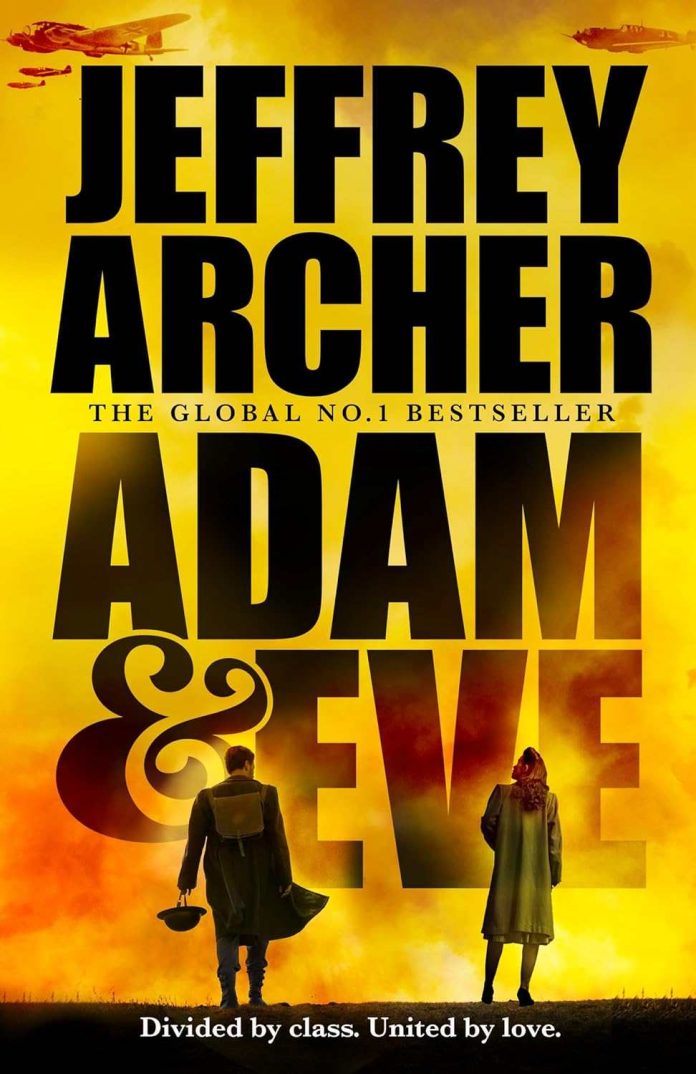
At eleven minutes past four on the morning of 11 November 1918, a village doctor is knocked out of bed and summoned to the great house. By breakfast, a countess is dead, an earl has a tiny premature daughter, and the word twin can never again be spoken under that roof. Later the same morning, in a thatched cottage on the estate, a shepherd’s wife gives birth to a boy who opens his eyes and cries just as the church bells ring out for the Armistice. A Rolls-Royce and two Labradors on one side of the river; a Bullnose Morris and a collie on the other. Adam and Eve by Jeffrey Archer sets out its class contrast in the first chapter, and the reader knows exactly whose hands they are in.
They are in good hands for the last time. Jeffrey Archer died at his home on 5 October 2026, aged 86, the day before this novel was published. His publisher, HarperCollins, said he died suddenly and peacefully between writing sessions, only a day after meeting readers at a sold-out London event to launch the book, according to the Irish Times report of his death. The book opens with a letter to readers announcing that, after fifty years of storytelling, this would be his final novel. It has become a farewell in a way nobody planned.
Where Adam and Eve Sits in the Archer Canon
Archer published his first novel, Not a Penny More, Not a Penny Less, in 1976 and sold three thousand hardbacks. Three years later came Kane and Abel, two men born on the same day at opposite ends of society, and the formula that made him one of the bestselling novelists alive. His readers will recognise the shape of this book immediately. It is Kane and Abel moved to a Norfolk estate next door to Sandringham, with the same mirrored births and the same long rivalry that becomes something deeper.
It also borrows from the Clifton Chronicles, his seven-volume saga of a poor boy who wins a scholarship into a world that does not want him. Adam Preston, the shepherd’s son, is a chess prodigy and a natural linguist who wins a place at the local grammar school and later at Trinity, Cambridge. Lady Evelina, who will insist on being called Eve, wants nothing more than to run her father’s farms, which in 1930s England she is not supposed to want.
What Adam and Eve Adds
The novel’s engine is a question Archer says he found in Hitler’s and Churchill’s speeches of 1940. On 15 September of that year, at the height of the Battle of Britain, Hitler wavered over Operation Sea Lion, his planned invasion of England. What if two ordinary young people had something to do with that decision? Adam and Eve by Jeffrey Archer spends four parts, each with its own dated span, getting there, and the payoff is worth the wait.
The four parts are cleanly divided. The first covers the childhood years to 1930 and is almost entirely free of war. The second, from 1933, takes in the abdication, the coronation and the Berlin Olympics, which Eve watches from the stands. The third is the Phoney War and the fall of France. The fourth, named for the invasion plan itself, compresses a single summer into its most tightly plotted pages. Within that structure, Adam and Eve by Jeffrey Archer moves from comedy of manners to espionage thriller without ever losing its warmth, though readers who come for the war should know that it takes a long time to arrive.
What works
- The supporting cast is the best Archer has assembled in decades. The Dowager Countess, gin-drinking, secretly a friend of Emmeline Pankhurst and forever scheming on her family’s behalf, steals every scene she is in. Frampton, the butler who irons The Times page by page, and his Sandringham counterpart, who meet every Monday for pints and royal gossip, form a comic double act that turns out to matter.
- The set pieces are pure Archer. A village cricket match with the scorecard printed in full. A best-of-three chess contest for Eve’s hand, refereed by her father. A disguise caper at an agricultural college entrance exam. A run across the Channel to Dunkirk in the family boat.
- The diaries and letters give it texture. The two children are made to keep journals from the age of six, and Eve’s spelling improves on the page as she grows. A chapter of alternating letters home from boarding school is a small delight.
- The final third is relentless. From the summer of 1940 the chapters shorten, the cross-cutting tightens almost to the minute, and the convergence of plot lines is as absorbing as anything he wrote.
Where It Gives Ground
- Coincidence carries a great deal of weight. People happen to be in the right doorway, on the right platform or in the right field at exactly the right moment. Archer readers expect it; newcomers may count.
- The villains are broad. In Adam and Eve by Jeffrey Archer, nuance is reserved for the heroes. The wastrel younger brother, the feckless cousin and the Nazi high command are drawn in strong primary colours, and one antagonist explains his own cleverness at length.
- The alternative history is gentler than the premise suggests. Do not expect an England under occupation. The divergence is a private one, and the wider war runs close to its real course.
- The history is mostly sound but slips. The new king is briefly called Edward VII rather than VIII, and a late battle is placed somewhere British troops could not yet have been in 1940.
Do You Need to Know Jeffrey Archer First?
No. Adam and Eve by Jeffrey Archer is a standalone, and it is a fine place to start. But readers who grew up on Kane and Abel will get an extra pleasure from watching him return, at the very end, to the mirrored lives that made his name, and from the long dedication of the closing pages to the idea of service.
Read These Next
The full run of his work is collected in our list of books by Jeffrey Archer. If Adam and Eve by Jeffrey Archer is your first, these are the natural next steps.
- Only Time Will Tell by Jeffrey Archer, the first Clifton Chronicle, for another scholarship boy finding his way in the shadow of war.
- Kane and Abel by Jeffrey Archer, for the original twin-lives formula at full stretch.
- An Eye for an Eye by Jeffrey Archer, for his late-career crime writing in the William Warwick series.
- The Nightingale by Kristin Hannah, for wartime courage told through ordinary lives.
- Fatherland by Robert Harris, if the what-if of a different 1940s is the thread you want pulled further.
The Verdict
Archer was never a stylist. His prose is plain, his dialogue does the work, and every chapter ends on a hook. What he could do better than almost anyone was make you turn the page, and Adam and Eve by Jeffrey Archer shows the gift intact at eighty-six. It is warm, often very funny, unashamedly patriotic, and braver in its closing chapters than his admirers may expect.
He signed off his letter to readers by hoping they had found what they were second best at. He found the thing he was best at fifty years ago, and he kept doing it to the last page.







