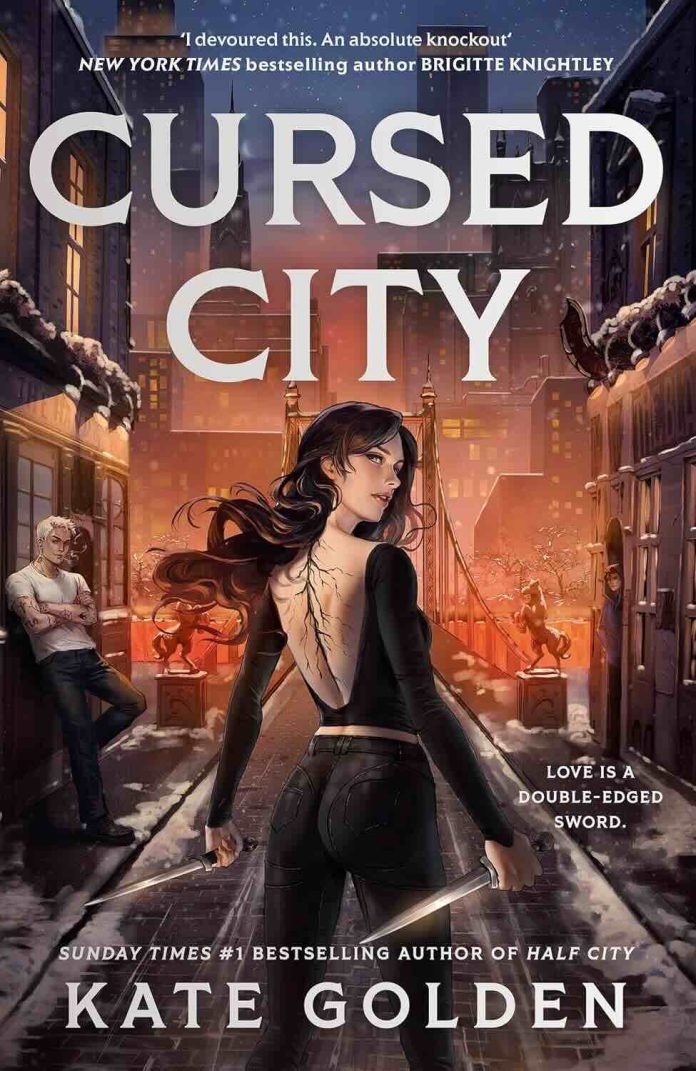
Vivienne Cadell opens this novel bleeding out on a nightclub floor, and within forty pages she has been healed with vampire blood, cornered by a newly turned bartender who wants to sell her to the mob, saved by a wooden clock thrown through his chest, and thrown herself out a ninth-storey window into a snowbank to escape her rescuer. Cursed City by Kate Golden does not open gently, and it does not pretend the first book’s ending was anything other than a wound.
Where Cursed City Sits in the Trilogy
Cursed City by Kate Golden is the second of three Harker Academy books, and it has the standard middle-book problem: no origin to explain and no ending to deliver. What it does with that space is the interesting part.
The first book closed with a dean’s conspiracy exposed, a father’s killer dead, and the deadliest spell in this world, the syrabraxa, carved into Viv’s spine. The rules are ugly and well built. Whoever kills the host absorbs the spell’s power and is driven permanently insane, which makes her the one person in the city nobody dares murder. A host who is never killed goes mad anyway, in three or four months. So she is simultaneously untouchable and on a clock, and the clock is the plot.
Everything follows from that. Her demon lover has been taken by the Brood, and the only creature strong enough to help her is his estranged brother, who owns a club called Fever Dream, sells guns and poppy out of it, drinks souls, and cannot kill her without losing his mind. A clean set-up for four hundred pages in each other’s company.
The World, and What It Charges for Power
The Astera of Cursed City by Kate Golden is split by a canyon into a wealthy north and a ruined south, crossed by a single bridge, with the underworld below. The names come without apology from Greek myth: Lethe, Erebos, Tartarus. The hunters’ college is hidden inside a museum and reached through a utility closet with an enchanted coin.
Two things save it from being furniture. First, the magic is priced. Fairy wings mask a spell for an hour and no longer; silver burns demons, wood kills vampires, oak kills nagas, and nagas burst when they die. Second, a genuine idea: the Elders, the lymantrian establishment, are five ancient elves on gold thrones in couture and Italian leather, and Viv’s senses tell her something about them she is not supposed to be able to detect. The novel’s politics are its sharpest feature: the people policing the monsters have an interest in the monsters continuing.
Three set pieces are worth the price. A brawl in a condemned Cineplex. A members-only club where Viv poses as a paid escort and discovers something about her own appetites. And a lagoon in a warded forest where three captive mermaids make an aeon’s skin glow, a chapter like nothing else in the genre, which ends with the demon’s back finally turned to the reader.
Cursed City, Kate Golden, and the Brother Problem
This is a love triangle that has already picked a winner, and the novel is honest about it by roughly page two hundred.
That should be a criticism and mostly it is not, because the brother is very good company. His register slips: modern crassness one minute, then under pressure he calls his nightclub his keep and warns people what becomes of those who disrespect him. He claims a thousand years of history with famous monsters, and the joke is that he may not be lying. He is also the only character who never lies to the narrator, which is the point.
The best material is quiet. A night barricaded in the school archives where he explains his tattoos, and the explanation reframes the whole character: the sleeplessness, the tolerance for silver, the flayed back. The slow revelation that the man described to us as amoral tips generously, hires people off the street, and has built a household rather than a criminal empire.
Where Cursed City by Kate Golden overreaches is in insisting on his wickedness. The phrase “there are no good guys” is said aloud several times. Meanwhile he buys charity cookies from a child, throws himself between a hunter and an ogre, and breaks into an apartment to recover a dead man’s locket. The novel argues for moral greyness while writing the most consistent code in the book.
Where Cursed City Gives Ground
Five things hold Cursed City by Kate Golden back.
- The middle third stalls. Weeks pass in summary. The friends report no new information, then report it again. The word nothing is load-bearing between chapters twenty-four and thirty-one.
- Three separate withholding devices. A mermaid speaks in riddles, a camera arrives loaded with a scavenger hunt, and a djinn is magically forbidden to name the object everyone needs. All three exist so the answer cannot arrive early.
- The bloodlust is a switch. Her episodes surge whenever a scene needs urgency and recede whenever it needs a conversation.
- The villain’s son has one note. Giggling, claw-clicking sadism, and the chapter inside his head confirms there is nothing else in there.
- The heist is under-planned for its billing. The book jokes about casino capers; the actual plan is that a werewolf breaks a wall and somebody watches a door.
Read It If, Skip It If
Cursed City by Kate Golden knows its reader.
Read it if:
- You came for the banter. It is genuinely funny, and it is doing character work rather than filling space.
- You want a heroine whose power is also her problem, and a novel willing to let her friends be frightened of her.
- You liked the first book and want the second to double down rather than reset.
Skip it if:
- You need a middle volume to resolve something. This one ends on the hardest cliffhanger in the series so far.
- Torture described in detail will spoil a book for you.
- You have not read Half City. This is not a starting point, and the earlier novel has not been reviewed here, so there is nothing to link you to.
Content Notes
Sustained torture, including flaying, the removal of fingernails and teeth, and a mutilation through the eyes. Soul-taking treated as permanent condemnation. A members-only sex-and-drugs club, including a safe-worded non-consent scene the narrator watches. Drugging. Graphic combat injury and dismemberment. A songbird killed and eaten. A parent’s murder recalled repeatedly. A child separated from a parent, and long imprisonment. Suicide considered as a tactic. A plan for the extermination of a species. Frequent profanity, explicit sex, and a masturbation scene in close third person.
Read These Next
Five of ours for readers who finish Cursed City by Kate Golden.
- A Reign of Rose by Kate Golden closes her other trilogy and shows what she does with an ending.
- A Promise of Peridot by Kate Golden is her previous middle book, and a useful comparison.
- If Not for My Baby by Kate Golden is the contemporary romance excerpted at the back of this one.
- A Tale of Dreams and Demons by Elizabeth Hernandez for another demon romance with a harder edge.
- Dark Academia: What Is It and Why Is Everyone Obsessed with It on the subgenre this series is built inside.
The Last Word
The most revealing thing in the book is a name other people use for the demon and he never uses for himself. A werewolf calls him Cernunnos, the antlered god the Celts gave the wild things and, in some readings, the underworld as well. The mermaids use it too, along with White Stag, Buck of the North, Lord of Wild Things. When Viv finally asks why, the answer she gets is a question: who else could have led them out of hell?
That is the novel in one exchange. The people around this character have decided he is a god, he has decided he is a monster, and the narrator spends the book working out that both positions are marketing. Whether Cursed City by Kate Golden has earned the place it leaves everybody in is a fair argument, and the last chapter is short enough to read twice. What is not arguable is that the second book knew which demon you came back for, and gave him the closet, the lagoon and the archives. The first was a mystery. This is a courtship conducted entirely in insults, and it works.