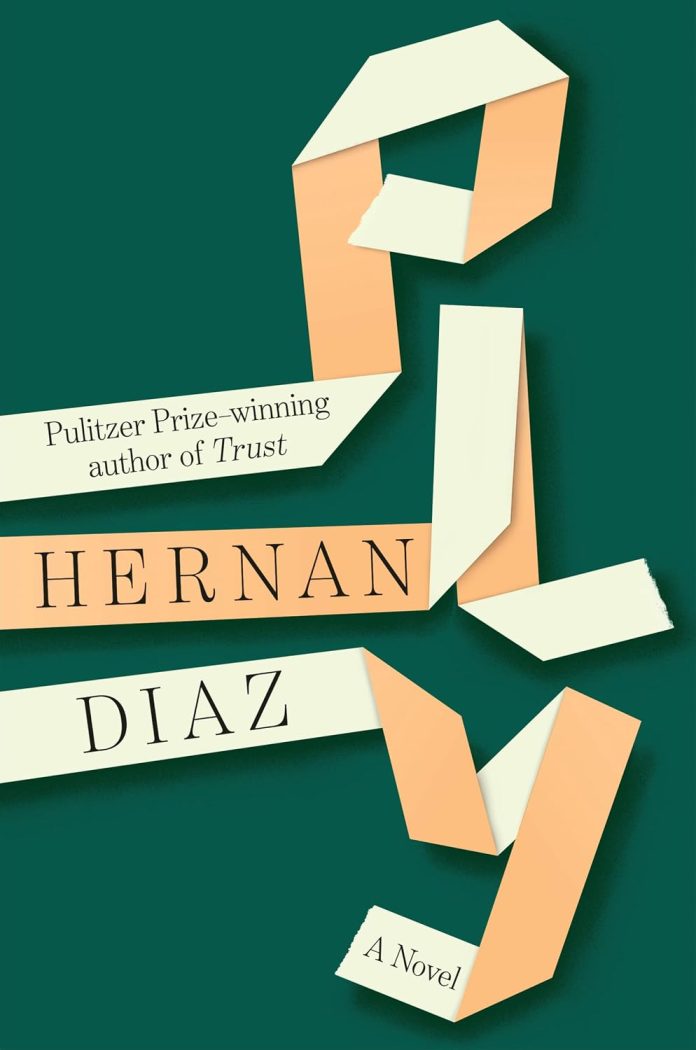
Most power thieves work fast. They tap a line, drain what they can into as many batteries as they can manage, and run before the monitors register the dip, which takes about fifteen minutes. The narrator of Ply by Hernan Diaz has built something better: a single battery that holds forty ordinary charges and draws so slowly that the theft reads as a normal fluctuation. One site, one pinch, four days, no trace. It is an elegant machine, and it is about to ruin her life, because in a city this depleted an elegant machine is the only thing left worth stealing.
She is about twenty-five, unnamed, and known to us only as the pincher. The state dissolved generations ago, leaving two profitable services standing: a company that owns the electricity and a company that owns the water. Private contractors patrol on behalf of whoever pays, and a militia of unpaid volunteers enforces laws that no longer exist, out of love. Most people cannot read. Almost nobody lives past forty.
The Rules of Pinching, and Why Hernan Diaz Needs Them
The first fifty pages build a world by refusing to describe it. We are never told what happened. There is no plague chapter, no war chapter, no dated collapse. What we get instead is an economy, explained from the inside by someone who has to survive it: what a charged battery trades for, why nobody puts up solar panels, which of the three rotting bridges still carries a truck, why the river is taboo and therefore the safest place to live.
That restraint is what makes the premise land. Because power here means two things at once and the novel never separates them, every scene about stealing electricity is also a scene about who is allowed to hold authority. The company’s contractors ignore assault and robbery, which do not concern their clients, then hunt power thieves with a zeal that exceeds their contracts. They hate the pincher specifically. Her mentor once told her why: theft is the strongest possible endorsement of ownership.
Then a watcher appears. Someone leaves two irreplaceable components on the riverbank in a taped lunch box with a note promising goodwill. Two downtown bosses want her battery. And the watcher turns out to be an old physicist named Pola, who has spent a fortune building a particle accelerator in a museum basement and needs the whole grid to run it.
What Ply, Hernan Diaz’s Third Book, Is Actually Building
Diaz won the Pulitzer for Trust, a novel assembled from four documents that each corrected the last. Ply by Hernan Diaz is doing something related and riskier. Part One is first person and past tense. Part Two switches to third person and present tense, so the woman we have been inside becomes “the pincher,” watched from outside. In the closing stretch the first person returns, but it has come loose: within a single exchange, the “I” slides between the pincher, Pola, and a child called Ines, and you have to work out from the content whose mouth a sentence came from.
It sounds like a stunt. In Ply by Hernan Diaz it is the argument. Pola spends the middle of the book explaining that a self is not a substance but an event, the result of particles interacting under fixed laws, and that if you follow this honestly the border between a person and the world stops making sense. The grammar then does what the physics claims. The novel’s title is a word for one layer of a twisted thread, and by the end you understand why.
Two other things deserve their own paragraph. The first is Anton, the broker who moves the pincher’s batteries, a man who claims to have walked from Sofia to Lisbon and sailed the Atlantic, and whose insults are a form of choreography. He takes apart the phrase “I am here for you” word by word to prove that each one is meaningless, then offers it to her anyway. He also delivers the finest speech in the book, on paranoia as an excess of meaning rather than a deficit of it: if reality has been written for you, there must be a writer, which makes paranoia the twin of religion.
The second is the rewilding. Deer trot down avenues on ceramic hooves. A lynx takes a fawn in four bounds. Two moose come out of the woods locked by the antlers, looking like one animal that has unfolded into two. Black bears keep a whole district unpopulated by coming for the acorns. None of it is decorative, and none of it is mourned.
Where Ply by Hernan Diaz Gives Ground
Five things stop Ply by Hernan Diaz from being the book it keeps promising to be.
- The physics lectures are too long and repeat themselves. Pola explains the scale of the smallest possible length three times, with three analogies. Her memory is failing, which makes one repetition deliberate, but the reader still pays for all three.
- Part One is slow. The childhood sections are gorgeous and the sequence of mentors is beautifully done, but the plot does not really start until close to the halfway mark.
- The antagonists are cardboard. One crime boss delivers a long monologue about where gold comes from; the other barely exists; the investor arrives near the end to say the theme aloud. Beside Anton and Pola they are unfinished.
- The pronoun merging can simply lose you. Sometimes the ambiguity carries the meaning. Sometimes it is only ambiguity, and the last forty pages ask for a patience not every reader will have on hand.
- The book’s warmest relationship ends in summary, reported by the wrong person, offstage.
Read It If, Skip It If
Ply by Hernan Diaz will not suit every reader, and is not trying to.
Read it if:
- You want post-collapse fiction that treats the collapse as settled and gets on with it.
- You liked what Trust did with form and want to see the same nerve applied to a self.
- Sentence-level prose is what you read for.
Skip it if:
- You need a plot that moves from chapter one.
- Undramatised science lectures are a dealbreaker.
- You want to know at all times who is narrating.
Content Notes
Ply by Hernan Diaz carries a heavy load. Radiation sickness in sustained detail. A finger deliberately broken on the page; torture referenced, including mutilation. A child is beaten as part of a deception. Death by suffocation, by sepsis, by cancer, and by assisted overdose. Drug addiction throughout. The trafficking of children is implied. Brief explicit sex between women. Animals killed on the page.
Read These Next
Five of ours that sit closest to Ply by Hernan Diaz.
- Station Eleven by Emily St. John Mandel for the other great novel about what people keep making after the end.
- The Unworthy by Agustina Bazterrica if you want the same ruined world narrated by someone who has learned not to explain it.
- Absolution by Jeff VanderMeer for science that refuses to resolve into an answer.
- Immaculate Conception by Ling Ling Huang on the border between one consciousness and another, and what crossing it costs.
- 27 Profound Dystopian Fiction Books if this is the territory you want to stay in.
Also worth knowing: Diaz embeds Hawthorne’s story about a man who tells his wife he is leaving for a few days and then lives one street away for twenty years. Pola has named her collider after him without having read it, which is the sort of joke this novel is happy to leave lying on the floor for you to find.
The Verdict
There is a number at the centre of Ply by Hernan Diaz: the smallest length at which anything can be said to happen, roughly the Planck length, below which physics has nothing to say. Pola’s whole life has gone into reaching it. The novel’s quiet suggestion is that she has the scale wrong in the other direction, and that the thing she cannot see is the child in the room.
It is baggy in the first half and over-explained in the second, and it contains at least forty pages that a firmer editor would have cut. It also contains Anton, a city being handed back to its animals, and a formal gamble that genuinely means something. Ply by Hernan Diaz is not as tidy as Trust and is reaching for more. Take the slow half on faith. It pays.







