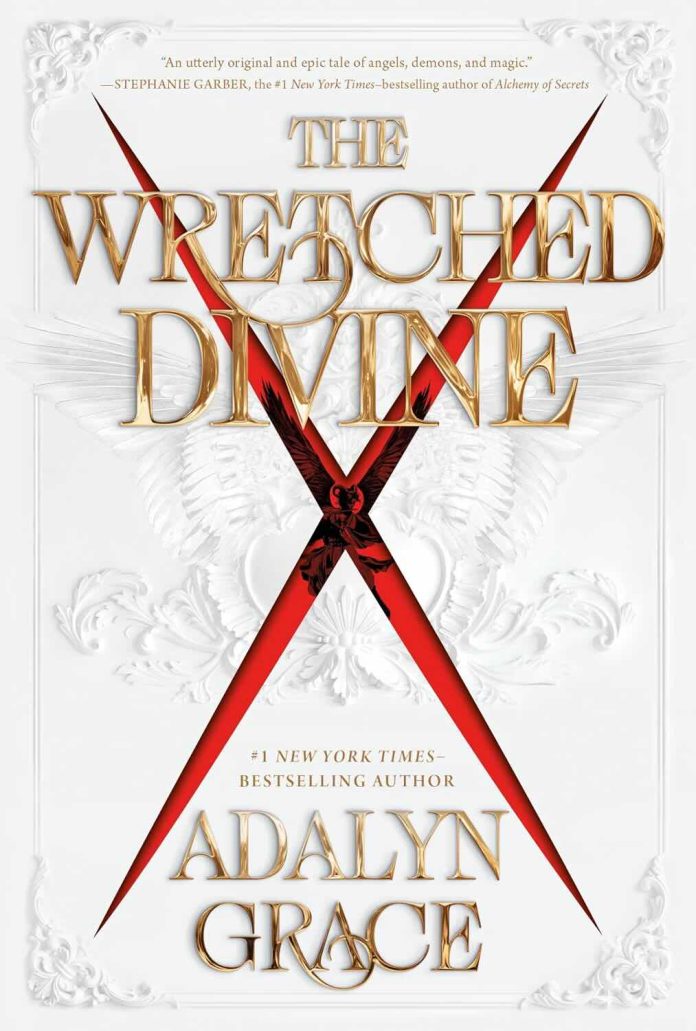
Five times across five hundred pages, The Wretched Divine by Adalyn Grace stops its plot and runs a short section set centuries earlier, in which two young angels choose the same vocation and one of them ruins the other. Those five interludes total perhaps forty pages. They are the best thing in the novel by a wide margin, and everything the main story does well, it does because they exist. That is an unusual verdict to reach about a book this long and this crowded, but it is the honest one: the romantasy on the surface is competent and frequently exciting, while the tragedy underneath it is genuinely good.
The Wretched Divine by Adalyn Grace Hides Its Best Novel in the Margins
The interludes are labelled as beginnings and placed after chapters eleven, twenty-five, forty-one, fifty-one and fifty-eight, which means they arrive just often enough that you stop expecting them. Two novices pick the soldier’s path together. One falls in love with a mortal woman. The other reports him, and tells himself it is duty.
What follows is the most efficient cruelty in the book. A commander does not punish the offender directly. He kills the woman while she sleeps, then hands the informer a blade and makes him carve the wings off his own friend. Grace writes it in a handful of pages without a single raised voice, and by the fifth interlude the reader understands that the entire present-day plot is one man’s five-hundred-year invoice.
Sixty Chapters, Two Narrators, One Kingdom in Trouble
The main body alternates first-person between Aurelie Chantelune, a twenty-five-year-old knight of Rhovar, and Yuriel, the soldier angel bonded to her. Aurelie carries a professional secret: years ago she failed to kill a demon and filed a report saying otherwise, and her career sits on top of that lie.
The world is built on a clean opposition. Angels serve in five orders, wield a silver light that is lethal to demons, and rank themselves by how many wings they carry. Demons descend from the seven deadly sins and inherit a magic from whichever one they came down from. A wrathborn wine merchant with a talent for sound turns up in chapter one selling something, and the pleasure of the first two hundred pages is watching a reader work out what.
What The Wretched Divine by Adalyn Grace Does With a Bond
The bond is the best mechanical idea here. Angel and human, or demon and human, can be tied together so completely that they share pain, share pleasure and die together. Grace uses it for everything: as a tactical constraint in fights, as a reason two enemies cannot kill each other, as a lie detector, as the mechanism by which a secret becomes impossible to keep.
It is also where the novel gets into trouble, and the trouble is worth naming plainly because a lot of readers will hit it before anyone warns them. The bond transmits an encounter Aurelie did not consent to experience. A drink offered at a suggestion precedes a scene in which the narration has her wondering whether the want is hers. Creatures whose established magic is mind-influence are present and encouraging during another. The book is aware of the pattern, and later flags it in its own voice by noting that this time no such excuse was available. Being aware of a pattern is not the same as having earned it, and readers for whom consent is a threshold question rather than a theme should treat this as a warning rather than a nuance.
The Con at the Centre
Underneath the quest structure there is a real plot, and it is good. Somebody is looking for a cure. Somebody else has spent decades manufacturing the disease, and the delivery mechanism is so ordinary and so social that the reveal lands as a small horror rather than a twist. A wedding toast does more damage in The Wretched Divine by Adalyn Grace than any battle in it.
The last hundred pages are genuinely relentless. A commander arrives with an army. A bargain is offered and refused on pride. And the climax gives Aurelie a choice that most romantasy protagonists never have to make: she saves her people by taking their bodies away from them, one by one, by name, and the novel makes her feel every second of it. Whatever else is wrong here, that is a real ending to a real argument.
Where The Wretched Divine by Adalyn Grace Overreaches
- The cast outgrows the book. Five angel orders, two vesper species, seven sins, two kingdoms, a royal family, a knight company and an archive. Several characters exist to deliver one fact and are then carried for four hundred pages.
- The middle third is a shopping list. Locate an ingredient, travel, obtain, argue, travel. The prose is fine and the structure is a to-do list.
- A late reveal about a returning character is guessable by page two hundred, because the novel keeps a person offstage in a way that only makes sense if they are coming back.
- The princess deserves her own book and does not get it. Her secret bond and her complicity are the most morally interesting material available, and both are handled in summary.
- Nothing closes. The final page is a hard cliff, deliberately, and the epilogue exists to install a sequel rather than to finish anything.
Content Notes
Unusually heavy for the shelf it will sit on, and The Wretched Divine by Adalyn Grace arrives without a publisher warning page, so this is the whole list. Repeated intimacy staged under compromised agency: an intoxicant taken at a suggestion, creatures with mind-influence magic present and encouraging, and a bond that transmits a third party’s encounter to the narrator without her having consented to experience it. The central relationship also proceeds throughout on deception the reader understands and the narrator does not. Torture, including an angel fixed in place through the wrists and wings. On-page mutilation: wings carved from a living angel, and a daughter cutting out her own father’s tongue to conceal what he is becoming. A regicide. Mass involuntary transformation of named characters, including a climax in which the narrator magically compels dozens of people into it. Poisoning. Battlefield injury and amputation. A pleasure house as a setting. Grief, survivor guilt, and a religious institution that manufactures shame as policy. Explicit consensual sex scenes.
Read These Next
- The Mirror of Infinite Endings by Stephanie Garber. Grace thanks her in the acknowledgments, and the structural ambition is the shared trait.
- Kiss of the Black Flame by Helen Scheuerer. The nearest shelf neighbour for divine orders and a bonded enemy.
- Angel Down by Daniel Kraus. For readers who want angels written as a threat rather than a hierarchy.
- Phantasma by Kaylie Smith. The other friend in the acknowledgments, and better on bargains.
- Fantasy Book Tropes: 30+ Magical Patterns That Define the Genre. Useful for seeing which conventions Grace keeps and which she is quietly dismantling.
What Stays With You
The theology is the sharpest thing in The Wretched Divine by Adalyn Grace after the interludes. Grace has built a religion whose scriptures are quoted at the head of every chapter and whose commander is a coward, and she is careful to separate the two. The decent angel in the novel is decent because he keeps choosing a person over an order. The monstrous one is monstrous because he mistook his own fear for doctrine and then had five centuries to formalise it. By the end his blood is running dark, and the novel does not need to explain the joke.
What stays is smaller than the war. An informer who has spent centuries being the good soldier, discovering that the single worst thing he ever did was obey. A woman who lied on a form about sparing something, and has been quietly proud of the lie ever since. A broken flute nobody can play. The Wretched Divine by Adalyn Grace is overstuffed, uneven and roughly a hundred pages longer than its plot requires, and it contains forty pages about two boys and a pair of wings that are better than anything else on this shelf this year.







