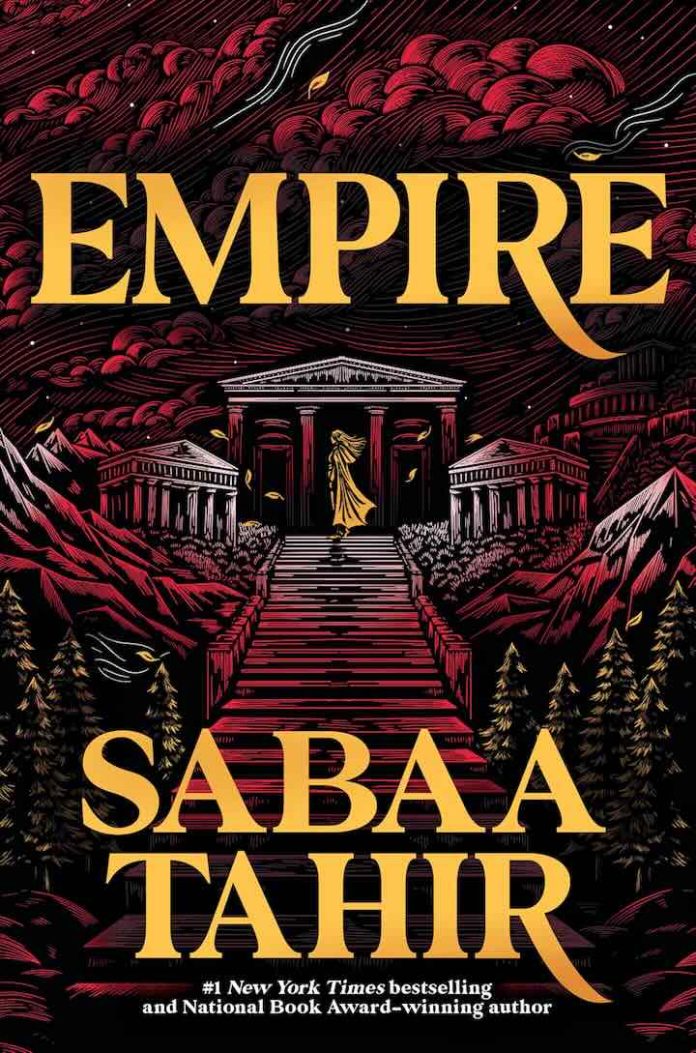
Empire by Sabaa Tahir hands its hero a power he regards as a violation. Quil Farrar can lift memories out of a mind, draw them from stone and soil, and press them into someone else. He has spent a book and a half refusing to touch it. By the last page he has used it to crack open a foreign court, to unknot the creature stalking the woman he loves, and to sit with his aunt while she dies. That is the thread worth following here, because every significant turn in this novel is a memory being taken, given, hidden or dug back up.
What Sabaa Tahir Does With Memory
Most epic fantasy treats a magic system as furniture. It has rules, a cost and a place in the plot, and the theme happens elsewhere. In Empire by Sabaa Tahir they are the same object.
A jinn queen tells Quil early on that memory does not live in the head. It lives in the body, the blood, the bones and the earth. That is a nice line until you notice the book has been constructed around it. Quil’s breakthrough comes when he stops shoving images at people and offers them a feeling instead. The antagonist turns out to be a knot of memory rather than a spirit. The resolution requires somebody to be reassembled out of other people’s recollections of him. And the most devastating scene is not a duel. It is a man who cannot reach someone, choosing to fill her mind with their whole shared life so that her last minutes are not fear.
Involuntary memory, the way a scent drags a whole era back, is doing quiet structural labour throughout. Tahir never stops to explain any of it. She builds the machine and lets it run.
The Empress Who Cannot Read Her Own Dream
Empress Helene Aquilla takes a wound near the liver in the opening movement and refuses to stop campaigning. What follows is the best writing in the book.
She sends her nephew a letter she should have coded and does not, because she is tired and there is nobody left to be frightened in front of. She keeps returning to a ravine choked with dead brush, muttering about rains followed by drought, trying to clear tinder that cannot be cleared. And she tells Quil she dreams that she burns. Every reader will assemble that before she does, and watching her fail to read her own warning powers the entire second half.
When it arrives, it is unsparing. She has saved legions and cities and a capital, and she ends where she does because she stopped to shield one child. Quil’s response, memory rather than rescue, is the finest idea Tahir has had in this world.
Empire by Sabaa Tahir Buries Its Real Subject in History
Halfway through, the series’ whole backstory gets rewritten, and it is the most ambitious thing Empire by Sabaa Tahir attempts.
Without spoiling the mechanism: two peoples who share an origin fell out over how far magic should be pushed, and the losing side took a revenge requiring an enormous quantity of death. The death they used was not theirs. A thousand years of famine, exile, poisoned metal and one ruinous war trace back to a single crime, and its victims were children who had been told they would be safe.
That is the book’s thesis, said plainly. Children pay the price for adult pride, for war, for country, and nobody is ever made to pay them back. It works because Tahir spends four hundred pages proving it rather than asserting it. A girl exiled at twelve for following an order she was too young to question. A boy who sold himself to highborns for a bag of lentils because the orphanage had no food. A queen draining street children to keep her power lit. A brother who could not make himself walk into a cave. All the same argument.
The Pilot and the Rebel
The liveliest thread, and the one I would have given fifty more pages, is Cero and Karinna.
He is a Kegari pilot with a secret about his own magic. She is a Martial rebel sent to expose it and reflexively vicious about everything. They loathe each other on principle for a good while, and the turn is gradual, specific and unembarrassed: a bathing pool, a stolen map, a kiss she engineers as a trap, a cat who reads them both better than they read themselves. Then he erupts. Have you ever been hungry, he asks her, and the speech that follows about decades of starvation and what he did to eat is the best thing anyone says out loud here. It is rage, not exposition, and she has no answer to it. Their strand also gives Empire by Sabaa Tahir its only reliable comedy, most of it from the cat.
Where Empire by Sabaa Tahir Carries Too Much
- Five points of view is one too many. Aiz’s chapters thin into plot bulletins through the middle third, and the tracker’s spend a long stretch circling the same despair from different rocks.
- Two long journeys run in parallel. One character crosses two continents, another flies an ocean. Both are well written and both run long. The second part is mostly travel.
- Six sorceress-queens, one personality. They arrive in a block with a distinguishing fact each and then operate as a chorus. Two of them do things.
- Resurrection inflation. Once somebody is being revived after two years dead, death has stopped costing anything, which undercuts the loss the book handles so well elsewhere.
- The sacrifice rule is convenient. It arrives from a jinn’s mouth exactly when the plot requires a sacrifice, and a volunteer surfaces within a page.
- A load-bearing rule gets quietly repealed. A bond is broken at ruinous cost, the novel insists three times that it can never be remade, and then it is remade with a hairpin. The scene is lovely. The rule was doing work.
- The prologue cannot carry a newcomer. It is a genuine, useful recap of Heir, but the weight of Helene, Elias, Laia and the Blood Shrike assumes a quartet you have already read.
Content Notes
Empire by Sabaa Tahir is marked for fourteen and up and needs a longer list than that suggests. Sustained aerial bombing of civilians. Children killed on the page by having their life force drawn out, one mid-sentence while begging. A throat cut at a parley. A woman burned alive over several pages, screaming, heard by someone who cannot reach her. A death by crushing. A heart removed from a living body by magic. A suicide, presented as sacrifice and talked into existence by another character. Torture, captivity and starvation as state policy. A child’s body handled and grieved over at length. Possession, including being made to speak in your own voice while someone else chooses the words. Survivor guilt in two siblings. A brief recollection of child survival sex work. Animal death. The mass killing of children in the backstory. A consensual sex scene near the close, more explicit than this series has previously been.
Read These Next
- Heir by Sabaa Tahir. Start here, not here. The prologue recaps it, but the recap is a courtesy, not a substitute.
- The River She Became by Emily Varga. For the same blend of inherited myth and a heroine with a debt she did not sign.
- A Forsaken Prophecy by Stacey McEwan. If what you want is the prophecy machinery taken seriously and then dismantled.
- Fallen City by Adrienne Young. Another siege, another young ruler, considerably tighter.
- Young Adult Book Tropes. For readers who want to see which patterns Tahir is using and which she is refusing.
What Stays With You
Tahir has a habit of writing rulers who choose duty and then showing you the bill. Here that becomes a question one character puts to another and keeps asking: loyalty or freedom. The answer it settles on is not grand. The choice arrives every single day, and some days you are allowed to pick yourself.
What stays with me is smaller than the war and smaller than the reveal. It is a woman fussing over dry tumbleweed because some part of her already knows, and a boy who cannot save her deciding that if he cannot stop it he can at least crowd out the fear. Empire by Sabaa Tahir has more moving parts than it can hold quite steady, and it fumbles a rule or two before the finish. It also contains the best fifteen pages Tahir has written, and I would forgive a great deal for those.







