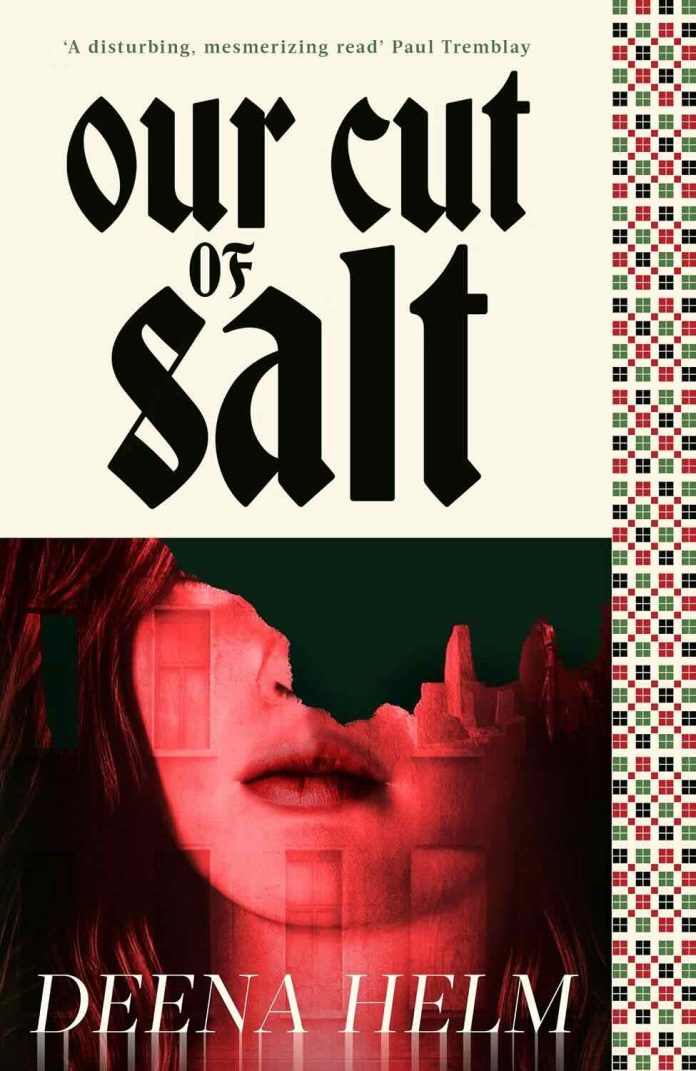
Our Cut of Salt by Deena Helm is built out of four voices and one refrain. Three of the voices belong to women in the same family across sixty years: Nuhad, sixteen in Haifa in 1948; her daughter Haifa, named for the city, in a suburb of Chicago in 2002; and her granddaughter Marina, arriving in that city for the first time the same summer. The fourth belongs to a stone house above a fishing-supply shop, which narrates in the first person and cannot stop. Between the chapters, a question keeps returning: why is the house in Haifa haunted? Each of them answers it differently, and none of them has the whole answer.
Three Women, Three Hauntings
Marina is in her early twenties, mixed Palestinian and Italian American, a computer science graduate with no job and no idea who she is. She has been asking about the family’s history her whole life and receiving almost nothing, because her grandmother sealed the past shut and her mother inherited a locked box rather than a story. When Nuhad dies, Marina is sent to Palestine to collect her things, and talks her mother into four nights in Haifa first.
What she wants there is a house. The old family address in Our Cut of Salt by Deena Helm has been reconstructed from fragments: two doors down from Im Suheil, round the corner from the bank, opposite the small church. It is the most her mother has ever been able to give her.
The house is still standing. It is also for sale, as it has been over and over for fifty years, because nobody who moves in stays.
Our Cut of Salt Gives the House a Voice
The interstitial chapters of Our Cut of Salt by Deena Helm are where its author takes her real risk. The house speaks in fractured syntax, slashes instead of punctuation, a refrain of dripping, whole passages in lowercase, and capitals when it loses control. It remembers every resident since a soldier broke the glass of the shop door in 1948 and took up residence upstairs, hanging his clothes in the family’s closets. It has been counting.
The inversion this sets up is the novel’s engine. The house is not evil and it is not possessed. It is the mourner. It kills because it has been kept empty of the family it was built around and cannot stop remembering them, and because remembrance is the only thing it has left. Settlers call it cursed; Rania, who lives two neighbourhoods away and knew the girl who grew up in it, has a definition that runs bone-deep and is not the same one at all.
The Breath Is the Whole Book
Our Cut of Salt by Deena Helm opens by proposing that occupation is a theft of air, then spends the novel proving it physically. Rania holds her breath for about twenty seconds every time she walks past her friend’s old house, twice a day, and refuses to take the longer route. Marina, who has nearly drowned several times and believes the sea wants her, arrives in Haifa and begins to feel what she describes as rocks collecting in her lungs. There is a chapter called Dyspnea, the clinical word for air hunger, and the house breaks it into three parts: a hunger, an ask, and a dissatisfaction.
It is the most disciplined thing here. A metaphor that is also a symptom, a chapter title, a plot mechanism and a diagnosis, and it never once has to announce itself.
What Our Cut of Salt Does Better Than Anything Else
The single best scene in Our Cut of Salt by Deena Helm is not supernatural. Rania cleans for an Israeli couple, and at a dinner party her employers call her out of the kitchen to settle a bet: is the haunted house actually haunted? She says murder haunts a house. She tells them, in front of their guests, who lived there and what happened in 1948. And she is dismissed the same night, and told it is for her own good because she is near retirement anyway. It is flawless, and it does more work than any of the novel’s direct address.
Khaled, Rania’s grandson, gets the other high point, and it is not an argument either. Asked how he manages, he refuses the compliment: Palestinians are not superheroes, being called endlessly resilient is what lets people off helping, and the resilience was forced on them. Then he tells Marina what he actually wants, which is to lace up his shoes and walk: Haifa to Akka, to Beirut, to Jerusalem, to Gaza, to the pyramids. Just to move.
Salt, meanwhile, does five jobs and holds all of them: a home remedy rubbed into a bleeding cut, a child’s private revenge, the sea, a grave marker a cyclone cannot shift, and something a dying woman asks for by the glass.
Where Our Cut of Salt Strains
- Our Cut of Salt by Deena Helm explains where it could dramatise. The opening paragraph is a thesis, the refrain sections are essays, and there are direct asides on refuse quotas, airport threat-level stickers, beach access and hospital negligence. Some of this lands hard. Some of it turns characters into spokespeople, and Rania and Khaled occasionally arrive with finished positions rather than dialogue.
- The Chicago strand is the weakest. Haifa’s chapters cycle one beat: inadequacy, her mother’s ghost, the same three words. The loop is deliberate and accumulates less than intended.
- The antagonists are thin. The employers, the realtor, the American tourist in the next hospital bed: each demonstrates one variety of obliviousness and none resist the reader.
- The climax is overcrowded. Seven or eight major beats arrive inside one storm, several within a page of each other, and the images fight for room they have earned.
- The turn to hope is asserted rather than earned. After two hundred pages of suffocation the ending reaches its resolve in about two, which is stirring and also skates past everything the book has established.
Content Notes
Our Cut of Salt by Deena Helm needs a long list. The Nakba is depicted directly, including the April 1948 expulsion of Haifa: shelling, a crowd crush with a trampled body, a gunshot wound sutured without anaesthetic, and the shooting of a child. Human remains are handled and later exhumed on the page. Several drownings, one of them a child in a bathtub, and strangulation marks described on a body. A boy is shot by police in the street and then charged. Racist harassment including being spat at, airport and checkpoint profiling, and medical negligence resulting in a death. Sustained panic and breathlessness. Domestic violence overheard by children. Deliberate poisoning of a water supply. A stabbing and a crushing death. Dementia, terminal cancer and hospice care. Emotionally withheld parenting across two generations. References to Deir Yassin and to the Holocaust. The Author’s Note gives casualty estimates for Gaza.
Read These Next
- I’ll Tell You When I’m Home by Hala Alyan. The non-fiction companion to this exact subject: what displacement does across generations of one family.
- Fugitive Dreams by Ramsey Hanhan. For the same ground handled without the supernatural.
- The House That Eats the Dead by Max Doty. If what you want is the house as predator, at full horror volume.
- Starling House by Alix E. Harrow. Another building with a voice and a debt somebody inherited.
- Too Soon by Betty Shamieh. Three generations of Palestinian women, and much funnier.
The Last Word
You should know what you are picking up. This is a Palestinian novel about the Nakba and the occupation, written from that standpoint and making no attempt to appear neutral, and it closes with an Author’s Note that gives figures for Gaza and ends with the words Free Palestine. Helm says in it that horror was the only honest vehicle she could find for her anger and grief. Whatever a reader brings to that, the choice of form is the interesting part, and she is right that it works: the genre lets her make memory itself the monster.
What stays with me from Our Cut of Salt by Deena Helm is not the deaths. It is a house so lonely that the only thing it knows how to do with a family is keep them, and a woman who walks past it twice a day without breathing because taking air from those stones feels like theft. For a debut, the control of that is remarkable. The lecturing is the price, and on this one I would pay it again.







