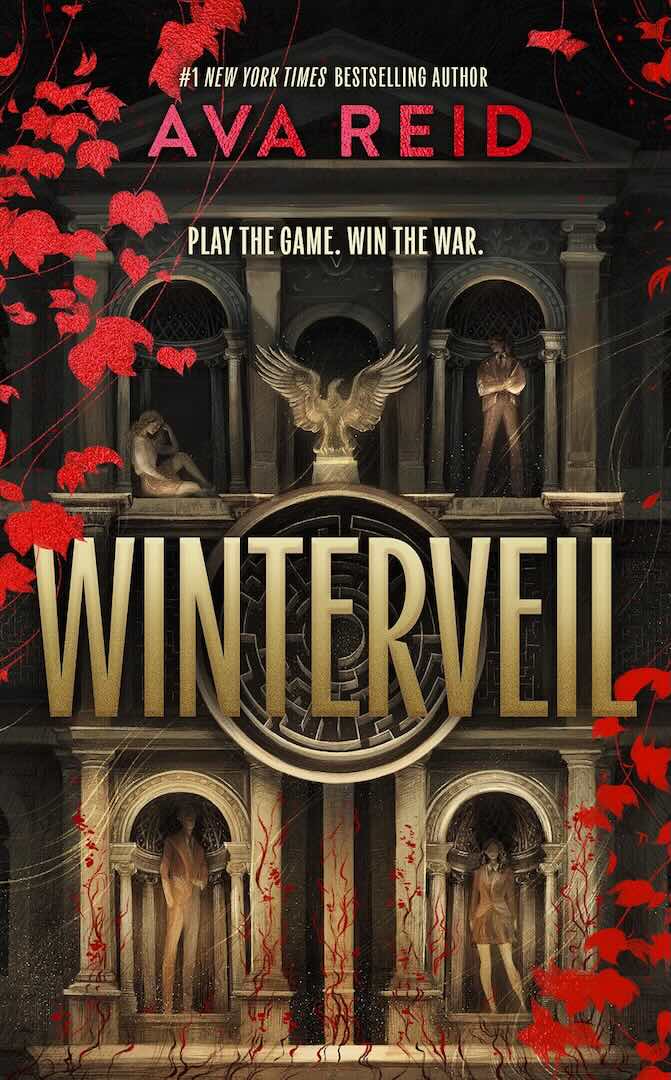
Mikhail Gorbachev was shot on the steps of Downing Street in 1984, and the thaw never came. Fifty years later the Soviet Union still stands, proxy wars flicker across every continent, and a secretive school in the Virginia mountains picks up gifted teenagers from courtrooms and holding cells instead of admissions offices. Winterveil by Ava Reid drops four of them into that school and then into something worse, and it is the most interesting premise she has worked with yet.
Where Winterveil Sits in Ava Reid’s Work
Readers who know Reid from her drowned libraries and folkloric bargains should recalibrate before starting.
This is still recognisably her. The prose is dense and fond of a slightly archaic word, the literary references come thick (Shakespeare, Mary Shelley and Milton all do structural work), and the emotional register is intense. But the fairy tale has been swapped for realpolitik, and the magic for neuroscience and game theory. The nearest comparison in her catalogue is the speculative turn of Fable for the End of the World, though Winterveil by Ava Reid is far colder and far more interested in how institutions eat children.
It is also clearly the opening of a longer story. More on that below.
A Cold War That Never Ended
The worldbuilding is delivered in fragments between chapters: a scrapped 1963 press release announcing the academy, newspaper clippings about each protagonist’s arrest, a NATO resolution, redacted agent files. It is an efficient device and a good one.
The school, Valeran, was founded after the Cambridge Five were unmasked, on the theory that brilliant, bored, privileged young people are exactly who a hostile power recruits, so America had better recruit them first. Its students are ranked every night on a public board. The top strategist wins a weekend furlough. Everyone wears a gold cuff with their name on it, and nobody is quite sure what the nodes stuck to their temples during war simulations are really for.
The alternate history is sketched rather than exhaustively built, but the details land: a president nicknamed the Kid, a tech CEO who wants to sell the Pentagon his guns, a third Red Scare on the evening news.
Four Criminals and a Headmaster
Winterveil by Ava Reid rotates between four points of view.
Julian Joyce-Young III was elected mayor of Boston at eighteen, on a dare, and arrested months later for taking bribes. Klaudia Shimonova, Leningrad-born and raised on the Upper West Side, made ten million dollars on the stock market at fifteen by forging her father’s signature. Giselle Buckley is a pageant queen from a West Virginia coal town who can recall anything she has seen once, and who was jailed for stealing credit card numbers she glimpsed at checkout counters. Nadiya Karam is the headmaster’s ward, the school’s best shot, and the only one who has lived at Valeran since childhood.
Two romances develop. The one between Giselle and Nadiya is tender, sapphic and the emotional anchor of the book. The one between Julian and Klaudia is a chess match conducted mostly through glares, and it is more fun.
What Ava Reid Gets Right
- Klaudia. A girl who has made herself cold on purpose because the alternative was her father’s hands, and who treats every social interaction as a game-theory problem. She is the best character Reid has written.
- The simulations and Thymos. A student-built strategy game, tested on the whole school, becomes the book’s best set piece: a tournament final where the rankings, the romance and the plot all collide on one stage.
- The use of genre. Spy thriller, dark academia and speculative neuroscience fit together more cleanly than they should.
- The structural surprise at the halfway mark. The book changes location and changes rules, and the second half of Winterveil by Ava Reid is much stronger for it.
Where Winterveil by Ava Reid Stumbles
- The first act is slow. A lot of time is spent establishing the rankings board and the cafeteria politics before the plot arrives.
- The villains are broad. A tech billionaire who shouts “awesome” and a handler who speaks only in riddles are fun to hate and impossible to fear.
- The male gaze gets heavy. Julian’s chapters dwell on Klaudia’s body far more often than the book seems to notice.
- It stops rather than ends. The final chapters scatter the four leads at the worst possible moment and cut out. A reader expecting any resolution will be frustrated.
Is This a Standalone?
Not in any satisfying sense. Winterveil by Ava Reid closes mid-crisis with the central mission unfinished, two of its leads apart and the true purpose of the academy only half explained. It reads as the first part of a series. Readers who hate cliffhangers may want to wait for book two.
Content Notes and Heat Level
This is upper YA, and the content warnings are real: an attempted sexual assault, on-page sexual content between older teens, the recounted suicide of a sibling, parental abuse, torture during a training exercise, gun violence, drug use, and staged self-harm used as a means of control. There is also casual antisemitism and anti-Russian prejudice, which the book treats critically. The heat level is moderate, with one explicit scene and several fade-to-black moments.
Read These Next
Five for readers who finish Winterveil by Ava Reid and want more:
- A Study in Drowning by Ava Reid. Her YA breakout, for the academic rivalry and the romance that grows out of it.
- Fable for the End of the World by Ava Reid. Her other dystopia, if the corporate villainy was what you liked.
- The Will of the Many by James Islington. A rigged academy, a ranking that governs everything and a hero hiding who he is.
- Ninth House by Leigh Bardugo. Secret societies, old money and a heroine the institution underestimates.
- The Atlas Six by Olivie Blake. For a small group of brilliant, unlikeable students competing for one prize.
The Verdict
Halfway through the novel, in a snowbound lodge that is not quite what it seems, Julian and Klaudia sit down to a game of chess to pass the time. He opens with his favourite line. She answers with the most solid defence available, and he spends the rest of the game on the back foot. The game is interrupted before it ends. When she looks at the board later, she can see he has already hung his queen.
That abandoned position is Winterveil by Ava Reid in miniature. The moves are clever, the players are well matched and the tension is real, and then the board is left standing with no result declared. Reid has built her most original world and her best character, and she has made a genuinely strange twist work. What she has not written yet is an ending. Worth reading now for the ideas. Worth rating properly once the second half exists.







