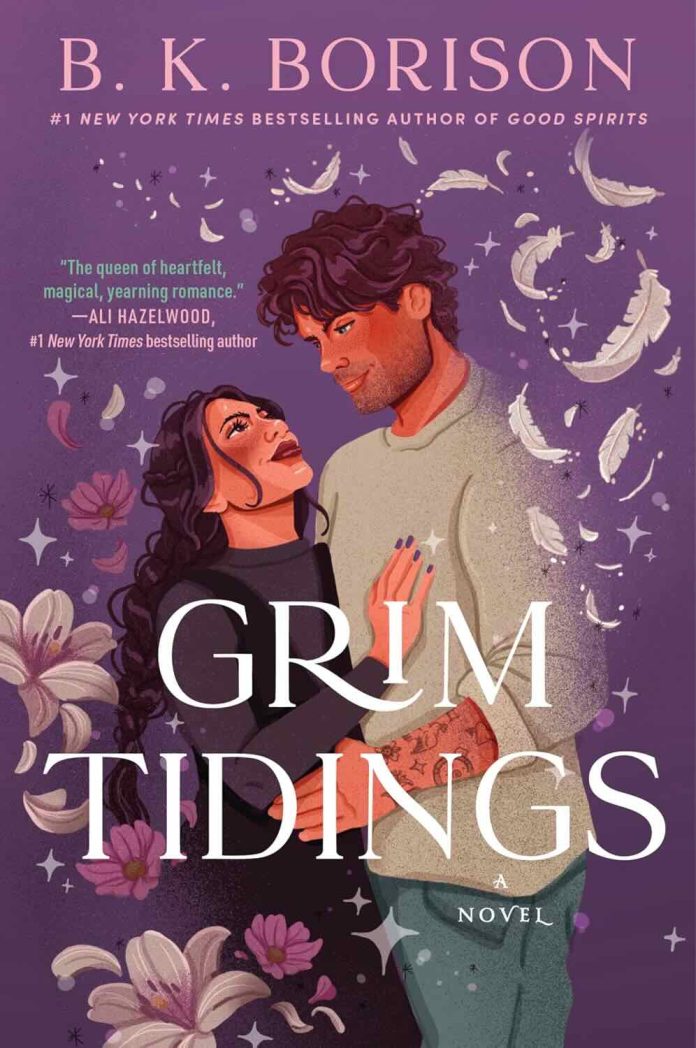
A woman in black robes stands in front of an ancient yew tree in a glass atrium at the centre of a labyrinth, and asks it for something different. She has been collecting souls for roughly a hundred years. She still drinks water she does not need and eats a doughnut for breakfast, because letting go of her mortal habits feels like letting go of the last of herself. The tree says nothing. She picks the lowest berry, puts it on her tongue, and receives her next assignment anyway. Grim Tidings by B.K. Borison opens with a Grim Reaper quietly begging for a reprieve, and the joke of the book is that she gets one, just not remotely in the shape she wanted.
Where Grim Tidings Sits in the Ghosted Series
This is the second Ghosted novel and the reading order is simply Good Spirits, then this one.
The first book put a rebellious Ghost of Christmas Past in the path of a woman who did not deserve haunting. This one crosses the corridor to a different office entirely. Darcy Moore died in 1918 after a childhood spent in hospital beds and was assigned to the Reapers, who are staffed, according to departmental logic, from the souls with the greatest capacity for darkness. Gabriel died in Athens in 445 BC and became a Guardian. He has lost exactly two souls in all that time, and he wears both of them as unhealed scars across his chest. A third loss costs him his wings.
She walks into the bar he has been tending for a decade. He makes her a sidecar before either of them realises what the other is. Grim Tidings by B.K. Borison gets roughly seventy pages out of that collision before it changes into something considerably softer.
What B.K. Borison Does With the Afterlife
The setting is the joke that keeps paying out. The Department of Hauntings and Spirits is not a kingdom of the dead, it is an employer, and a mediocre one. Nobody has replaced the water filter in a month. There is a suggestion box. There is a lounge on the fifth floor last used during the Crusades, and an intake clerk who works by appointment only and will not process a soul because he is late for a meeting. The head of the Reapers has not been to the office in centuries, partly because the fluorescents wash him out.
None of that undercuts the feeling, which is the harder trick. Grim Tidings by B.K. Borison is genuinely serious about what Darcy does, and the comedy is the pressure valve rather than the point. The book takes the oldest job in fiction, the figure who walks you from one side to the other, and asks what it costs the person doing the walking.
What B.K. Borison Gets Right
- The list. Darcy wrote out everything she intended to do if she ever got out of that hospital room, and she has carried the folded page since 1918. Bumper cars. Swim at sunset. Change a tire. Bake a pie, with an asterisk specifying a good one. Watching Gabriel work out what that piece of paper actually is, rather than what he assumed it was, is the spine of the romance.
- The flower shop. There is a seventy-eight-year-old florist called Frank who eats cherries at the bar three nights a week and keeps three bins of peonies that never go into a single arrangement. What Borison does with him is the best writing in the book, and it is quietly set up from his first scene. Not a word of it will be spoiled here.
- Aelia. An eight-year-old Reaper in a sequinned tutu and light-up mermaid shoes, carrying a scythe taller than she is and swearing like a docker. She should not work. She is the funniest thing in Grim Tidings by B.K. Borison.
- The magic has a texture. Gabriel’s tattoos appear one per life he has shaped. Darcy’s power is not a tap she can turn; it arrives when death is near and otherwise withers whatever she touches. That constraint does real work in the plot rather than sitting there looking atmospheric.
Four Places B.K. Borison Loses Her Nerve
- The last two chapters remove every consequence. The punishment Gabriel has feared for a thousand years turns out to have been something else all along, and it costs him nothing when it finally arrives. It is warm. It also unbuilds the tension the book spent four hundred pages assembling.
- The antagonist deflates on contact. The head of the Reapers is invoked as an ancient terror for two hundred pages and then turns up in sunglasses with a lollipop, complaining about his paperwork backlog. He is a delight. He is not a threat.
- The central explanation is delivered over a folder of forms. A third party arrives late and explains the whole architecture of the book to a man who signs in three places and initials on page seven. The gag lands. The mechanics do not.
- Enemies to lovers is over by page seventy. Gabriel’s hostility softens fast, and what follows is four hundred pages of pining rather than friction. Readers who came for the fight will find it settled early.
Do You Need to Read Good Spirits First?
Not strictly, but you should.
The two books share a world, a town and a governing bureaucracy rather than a cast, and Grim Tidings by B.K. Borison explains its own rules from scratch. You can start here without confusion. What you lose is the pleasure of the crossover, which arrives late and is handled with a light enough touch that a new reader will simply nod past a scene an old reader will grin at. Good Spirits is also shorter, warmer and set at Christmas, which makes it an easy weekend before this one.
Content Notes and Heat Level
Grim Tidings by B.K. Borison earns its warnings and handles them carefully. On the page or closely recounted: a long childhood illness and death in hospital, the death of a young child, a fatal road accident, sustained grief, and an injured animal. The heat level is explicit, with two full scenes, and the consent conversations inside them are unusually good. Nothing here is gratuitous, but a reader who is raw about losing someone should know what the last third involves.
Read These Next
Five for readers who finish Grim Tidings by B.K. Borison and want to stay in this weather:
- Good Spirits by B.K. Borison. The first Ghosted book, and the one that built the department.
- If I Stopped Haunting You by Colby Wilkens. For an actual haunting, two writers who loathe each other, and a similar line in jokes.
- First-Time Caller by B.K. Borison. Her contemporary voice with no magic at all, if the ghosts are not the draw.
- And Now, Back to You by B.K. Borison. The Heartstrings follow-up, for more of the same emotional generosity.
- Happy Ending by Chloe Liese. For readers here mainly for the tenderness and the careful handling of bodies that do not cooperate.
What Stays With You
Long before anything is explained, there is a detail in the flower shop. The top three bins on the wall are almost always full of peonies, pink and white, heaps of them. Frank is careless with the lavender and tosses the roses about, but he handles the peonies one at a time, laying them out flat and specific. They never go into a single arrangement he sells.
That is the book in one image, and it arrives two hundred pages before the reader is allowed to understand it. Grim Tidings by B.K. Borison is a novel about people who have built whole lives around a thing they cannot say out loud, and about a woman who has spent a century believing that being present at an ending makes her the cause of it. The plot loses its nerve at the finish. The argument underneath it does not. Borison closes with a note explaining that she wrote the book for her husband, who works in palliative care, and once you know that, every choice in Grim Tidings by B.K. Borison reorganises itself around it. Death is in the job title. Mercy is what the book is actually about.







